
Aged Cheeses and Processed Meats: How They Interact with MAOI Medications
 Jan, 28 2026
MAOI Tyramine Calculator
Food Selection
Your Current Intake
No foods added yet
Important Safety Information
Consuming more than 10 mg of tyramine can trigger dangerous blood pressure spikes. The danger zone begins at 10-25 mg. Symptoms include severe headache, racing heart, sweating, and blurred vision. If you experience these symptoms, seek emergency care immediately.
Always consult your doctor before making dietary changes while on MAOI medications.
If you're taking an MAOI antidepressant like Nardil or Parnate, your lunch could be more dangerous than you think. It’s not about calories or fat - it’s about something called tyramine. This natural compound hides in aged cheeses, cured meats, and even soy sauce. For most people, it’s harmless. For those on MAOIs, it can spike blood pressure to deadly levels - sometimes within minutes.
Why Tyramine Is a Silent Threat
Tyramine isn’t a poison. It’s a substance your body normally breaks down with an enzyme called monoamine oxidase. But MAOI drugs block that enzyme. When that happens, tyramine builds up and forces your nerves to dump a flood of norepinephrine - a powerful stimulant that sends your blood pressure soaring. Systolic pressure can jump 50 to 100 mmHg in under 30 minutes. That’s not just a headache. That’s a medical emergency.One bite of aged cheddar can trigger it. So can a slice of pepperoni on pizza or a spoonful of soy sauce in stir-fry. The reaction isn’t rare. Emergency rooms see 3 to 5 cases every year directly tied to cheese and MAOIs. And it’s not just cheese - processed meats are just as risky.
Which Cheeses Are Dangerous?
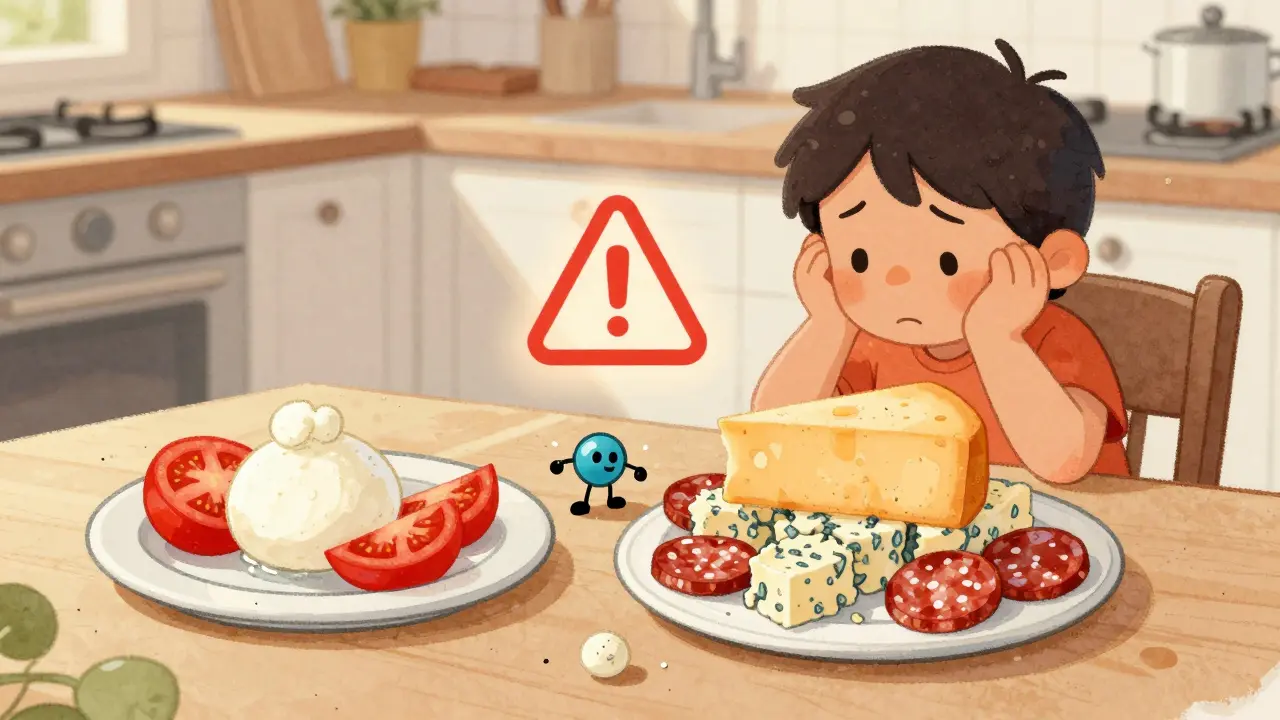
Not all cheese is the same. Fresh cheeses like mozzarella, ricotta, and cottage cheese are safe. They’re made quickly, stored cold, and contain almost no tyramine - under 50 mcg per gram. But aged cheeses? That’s where the danger lives.- Aged cheddar: 72-953 mcg/g - a 30g serving can pack 2-28 mg of tyramine
- Parmesan: 610-1,400 mcg/g - just one tablespoon can hit 10 mg
- Blue cheeses (Stilton, Gorgonzola): 1,000-3,500 mcg/g - the highest risk
- Swiss: 400-1,200 mcg/g
- Feta (brined): 350-800 mcg/g
- Camembert and Brie: 200-600 mcg/g - moderate risk
That’s why you can’t just assume “it’s cheese, so it’s fine.” A block of cheddar aged six months is a different animal than the mild block you bought last week. The longer it sits, the more tyramine builds up. Even the same brand can vary - batch to batch, shelf to shelf.
Processed Meats: The Hidden Trap
If you think cured meats are just salty snacks, think again. The curing and drying process lets bacteria ferment proteins - and that’s where tyramine forms.- Dry summer sausage: 300-900 mcg/g
- Pepperoni: 200-600 mcg/g
- Salami: 150-500 mcg/g
- Bacon: 75-250 mcg/g
- Corned beef: 60-180 mcg/g
- Bologna: 50-200 mcg/g
Here’s the kicker: fresh meats - like grilled chicken, roast beef, or turkey you cook yourself - have less than 10 mcg/g. That’s why many people on MAOIs switch to freshly cooked proteins instead of deli slices. A sandwich made with fresh turkey and fresh mozzarella? Safe. One with salami and cheddar? A ticking time bomb.
The Threshold: How Much Is Too Much?
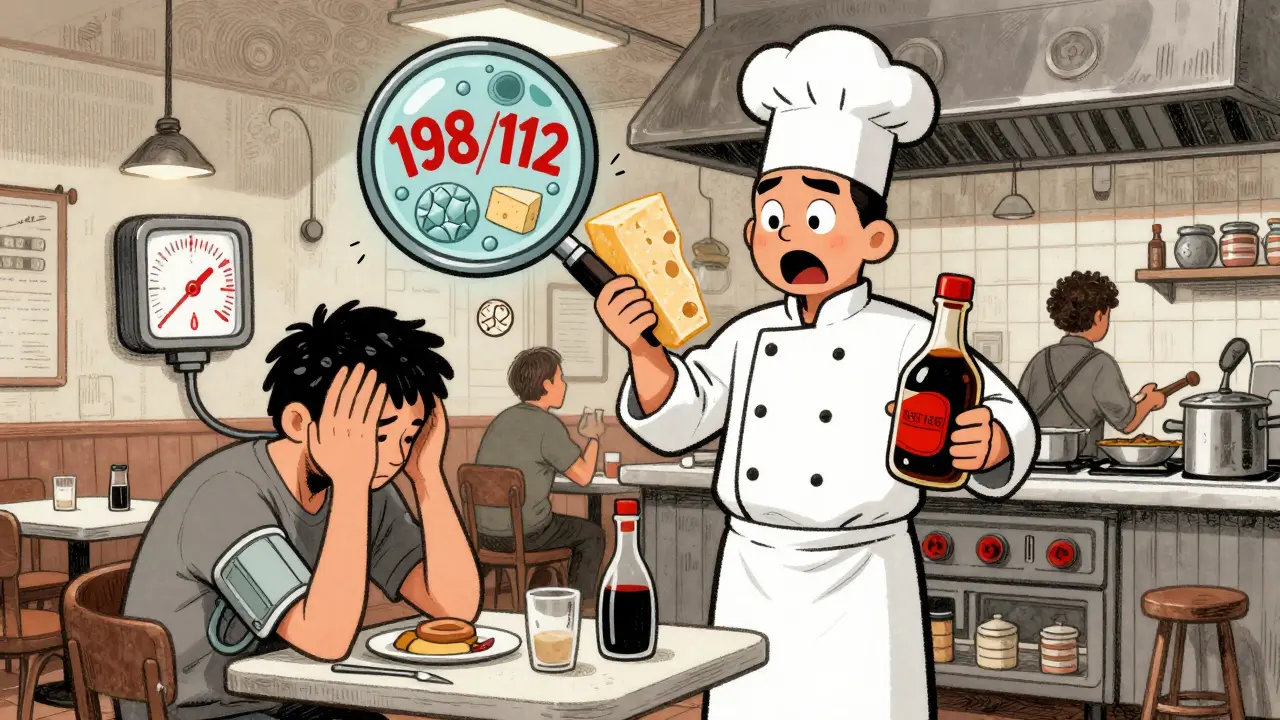
There’s no universal “safe” amount. Some people react to 6 mg of tyramine. Others can handle 20 mg. But the danger zone starts around 10-25 mg. That’s not a lot.One ounce (28g) of aged cheddar could hit 20 mg. One slice of pepperoni pizza? Maybe 15 mg. A tablespoon of soy sauce? Up to 15 mg. Combine them? You’re past the line.
And it’s not just the amount - it’s timing. Symptoms hit fast: pounding headache behind the eyes, racing heart, sweating, nausea, blurred vision. Some people describe it as “a vice squeezing their skull.” Blood pressure readings of 180/120 aren’t uncommon. That’s a stroke or heart attack waiting to happen.
What About Other Foods?
You might hear rumors about bananas, chocolate, or peanuts being dangerous. They’re not. Bananas have under 10 mcg/g. Chocolate? 50-150 mcg/g - safe in normal portions. Peanuts? 75-200 mcg/g - fine unless you’re eating a whole bag. The real culprits are fermented and aged products.Don’t forget the sauces:
- Soy sauce: 1,000-2,500 mcg/g
- Miso: 800-2,000 mcg/g
- Fish sauce: 1,200-3,000 mcg/g
These are common in Asian cooking. A stir-fry with soy sauce and fermented black beans? That’s a high-risk meal. Same with kimchi or aged fermented tofu. If it’s been sitting in a barrel for weeks or months, assume it’s dangerous.
What Happens After You Stop the Drug?
You can’t just stop your MAOI and go back to eating cheese the next day. Your body needs 2 to 3 weeks to rebuild the monoamine oxidase enzyme. Until then, the risk stays the same. Many people don’t know this. They stop their pills, celebrate, and eat a plate of blue cheese - and end up in the ER.That’s why doctors tell you to keep avoiding high-tyramine foods for at least 14 days after your last dose. Even if you feel fine.
How to Stay Safe
Managing this isn’t about being perfect. It’s about being smart.- Read labels: Look for “aged,” “cured,” “fermented,” or “dry-cured.” Avoid anything that says “naturally aged.”
- Choose fresh: Fresh mozzarella, ricotta, cream cheese, and cottage cheese are your friends.
- Ask questions: At restaurants, say: “I’m on a medication that can’t have aged cheese or cured meats. Can you confirm this is fresh?”
- Use apps: The Mayo Clinic’s “MAOI Diet Tracker” scans barcodes and flags high-tyramine foods. Beta testers got it right 89% of the time.
- Keep a food diary: Note what you ate and your blood pressure. You might find your personal threshold - maybe 15g of cheddar is okay, but 30g isn’t.
- Carry an emergency card: In case you collapse, paramedics need to know why. Write: “On MAOI - avoid tyramine. Risk of hypertensive crisis.”
Real Stories, Real Consequences
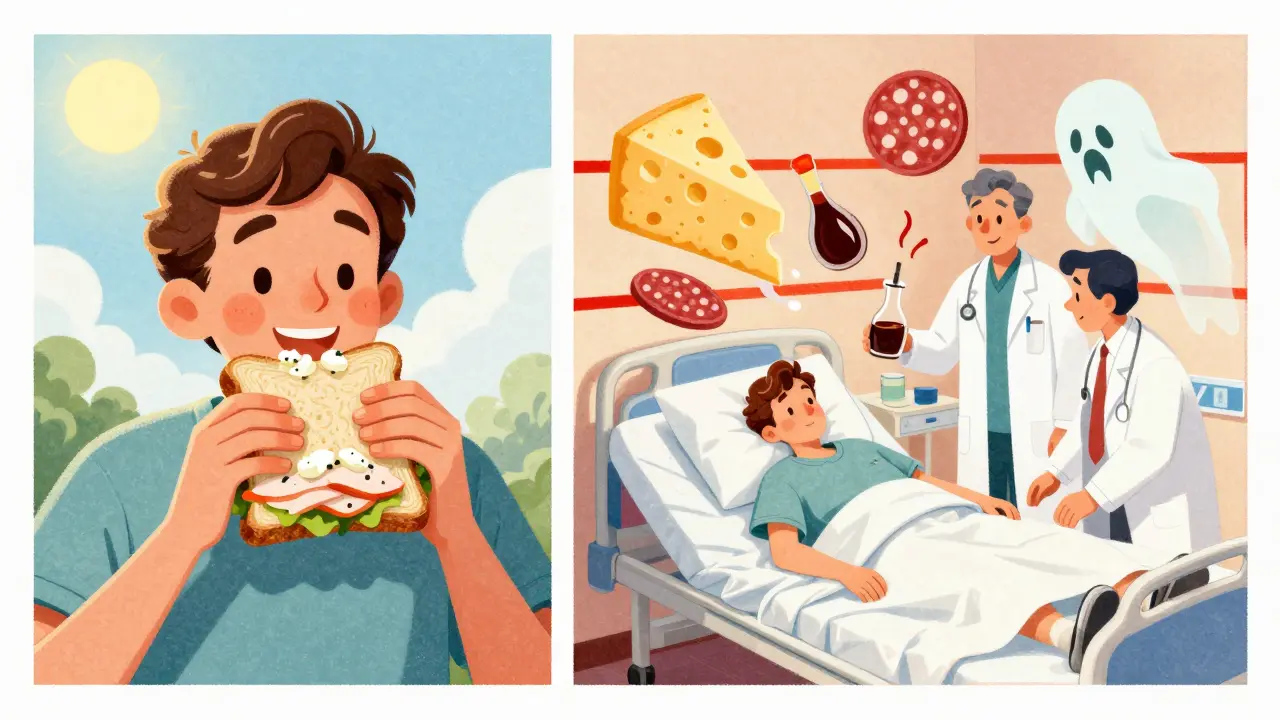
One user on Drugs.com took a salad with Parmesan while on Nardil. Within 20 minutes, their blood pressure hit 198/112. They ended up in the ER with a splitting headache and chest tightness. Another, on Reddit, survived five years on MAOIs by sticking to fresh cheese and measuring every bite. They learned their limit: 15g of aged cheddar - about one small cube - was safe. Anything more, and their pulse spiked. These aren’t outliers. The GoodRx tracker shows 68% of all MAOI-food reactions involve cheese. The rest? Mostly meats and sauces.What’s Changing?
The food industry is starting to respond. Sargento now sells “MAOI-safe” fresh mozzarella cups - labeled, refrigerated, and tested to contain under 20 mcg/g. Sales hit $14.7 million in 2022. In the EU, aged cheeses must now list tyramine content on labels. The FDA requires MAOI packaging to include clear warnings. And researchers are testing enzyme supplements that could break down tyramine before it enters your bloodstream. One day, genetically modified low-tyramine cheeses might be on the market.But for now? The rules haven’t changed. Tyramine still kills. And the only proven way to stay safe is to know what’s in your food - and avoid the ones that can turn your dinner into a crisis.
When to Call for Help
If you eat something risky and feel any of these:- Severe headache (especially at the back of your head)
- Rapid or pounding heartbeat
- Blurred vision or sensitivity to light
- Sweating, nausea, or chest pain
- call emergency services immediately. Don’t wait. Don’t try to “wait it out.” This isn’t indigestion. It’s a hypertensive emergency. Minutes matter.
Can I eat cheese if I’m on an MAOI?
Only fresh cheeses are safe - like mozzarella, ricotta, cottage cheese, and cream cheese. Avoid all aged, blue, or fermented cheeses, including cheddar, Parmesan, Gorgonzola, and feta. Even small amounts can trigger a dangerous reaction.
How long do I need to avoid these foods after stopping MAOIs?
You must continue avoiding high-tyramine foods for 2 to 3 weeks after your last dose. It takes that long for your body to fully restore the enzyme that breaks down tyramine. Stopping the drug doesn’t mean the risk is gone.
Is bacon safe on MAOIs?
Bacon has moderate tyramine levels (75-250 mcg/g). It’s not as risky as salami or pepperoni, but it’s not completely safe. If you must eat it, choose fresh, uncured bacon cooked at home, and limit portions. Avoid pre-packaged or smoked bacon - it’s more likely to contain tyramine.
Can I have soy sauce on MAOIs?
No. Soy sauce contains 1,000-2,500 mcg/g of tyramine. A single tablespoon can deliver 10-20 mg - enough to trigger a crisis. Use tamari labeled “low-sodium” or “fermentation-free,” or substitute with coconut aminos, which have no tyramine.
What if I accidentally eat something risky?
Monitor your symptoms closely. Check your blood pressure if you have a home monitor. If your systolic pressure rises above 160, or you develop a severe headache, rapid heartbeat, or sweating, seek emergency care immediately. Don’t wait - this reaction can become life-threatening within minutes.
Are there any new treatments to make this safer?
Yes. Researchers are testing enzyme supplements that break down tyramine in the gut before it enters the bloodstream. A clinical trial (NCT05214387) is underway, with results expected in late 2024. Some companies are also developing low-tyramine cheeses using modified fermentation. But these aren’t available yet - so don’t rely on them.
kabir das
January 29, 2026 AT 08:35Wait, so one bite of cheddar could kill me?? I just had a grilled cheese for lunch. I’m sweating just thinking about it. My doctor never mentioned this. I’m gonna need a new life plan. 😭
Laura Arnal
January 30, 2026 AT 08:46You’re not alone!! I’ve been on Parnate for 3 years and I’ve learned to love fresh mozzarella balls with basil and olive oil. It’s a whole new cuisine. And yes, I cry when I see blue cheese at parties… but I’m alive. 💪🧀
Eli In
January 30, 2026 AT 19:53As someone who grew up in a household where soy sauce was basically water, this hit different. My grandma used to make miso soup every Sunday. Now I feel like I’ve been unknowingly playing Russian roulette with my brain. 😅 Thanks for the clarity - I’ll swap it for coconut aminos tomorrow. 🌱
Ryan Pagan
January 31, 2026 AT 21:40Let me be blunt - this isn’t a diet. It’s a full-on biochemical minefield. You’re not just avoiding cheese, you’re avoiding centuries of human culinary tradition. Bacon? Fine in moderation. Pepperoni? A death sentence wrapped in fat. And don’t even get me started on fermented tofu - that stuff is basically tyramine in a velvet glove. But here’s the kicker: you don’t have to be miserable. You just have to be smarter than your cravings. And yes, I’ve survived 8 years on MAOIs. I still eat. I just don’t eat like a caveman with a cheese wheel.
Paul Adler
February 2, 2026 AT 08:59Thank you for this comprehensive and clinically accurate overview. The distinction between fresh and aged dairy is particularly well-articulated. Many patients assume all cheeses are equally dangerous, which is a dangerous misconception. The data on tyramine concentrations across product types is invaluable. I will be sharing this with my patients.
DHARMAN CHELLANI
February 4, 2026 AT 08:54lol u scared of cheese? grow a pair. i eat parmesan with my nardil. my bp is 120/80. u just weak. also soy sauce? pfft. my aunt in delhi uses it in everything. she’s 92. still walks. u just wanna be a victim.
Kacey Yates
February 4, 2026 AT 17:12Why is no one talking about the fact that the FDA only requires warnings on the pill bottle? No one reads that. And restaurants? They don’t even know what tyramine is. I’ve had servers say ‘it’s just cheese’ to my face. This system is broken. I carry a printed card now. I’m tired of being the weirdo who asks if the salami was aged for 6 months or 6 days.
ryan Sifontes
February 6, 2026 AT 15:25what if this is all a pharma scam to sell you expensive low tyramine cheese? what if the real danger is the drug? they want you scared so you keep buying pills and special mozzarella cups. i think they’re just selling fear. i’m gonna eat a pepperoni pizza and see what happens.
Jasneet Minhas
February 7, 2026 AT 16:34Wow. So I’ve been eating kimchi with my MAOI like it’s a snack. 😅 Guess I’ve been living on the edge. Maybe I’m the reason my cat stares at me like I’m a walking hazard. Anyway - thanks for the heads up. I’ll be swapping kimchi for pickled carrots now. 🥕🙏
Megan Brooks
February 9, 2026 AT 13:05This is a profound reminder that medicine doesn’t exist in a vacuum - it’s woven into the fabric of daily life. Food is culture, memory, comfort. To restrict it is not merely a clinical adjustment, but an existential recalibration. I admire those who navigate this with grace. It’s not about deprivation - it’s about intentionality. And perhaps, in this restraint, we find a deeper relationship with what we consume.
Doug Gray
February 10, 2026 AT 06:05It’s interesting how the pharmacokinetics of tyramine intersect with the ontological insecurity of modern dietary regimes. The MAOI user is positioned as a liminal subject - neither fully integrated into the food system nor entirely alienated from it. The ‘MAOI-safe’ mozzarella cup is a commodified palliative, a neoliberal solution to a biopolitical problem. We are not just avoiding cheese - we are performing medical subjectivity.
Kristie Horst
February 10, 2026 AT 12:52Oh, so you’re telling me that the one thing I love - a nice charcuterie board with aged gouda and prosciutto - is basically a slow-motion suicide pact? How poetic. I’m glad I’m not the only one who’s had to give up my adult pleasures. I now eat goat cheese that’s been refrigerated for three days. It’s like eating sadness. But hey - I’m alive. And that’s the goal, right? 😔
LOUIS YOUANES
February 11, 2026 AT 02:36I don’t care. I’m eating blue cheese. I’ve had it for 10 years. My BP is fine. You’re all just hyperventilating over a molecule. If you’re that fragile, maybe you shouldn’t be on MAOIs at all. I’m not changing my life for a 0.001% chance of something that might happen. I’ve got a life to live.
Andy Steenberge
February 12, 2026 AT 16:11One thing I’ve learned: it’s not about being perfect. It’s about being consistent. I used to sneak a slice of cheddar. Then I’d get the headache. Then I’d panic. Now? I stick to ricotta on toast. It’s boring. But I’ve been symptom-free for 4 years. That’s not luck - that’s discipline. And if you’re worried about missing out? Try making a fresh herb dip with yogurt and garlic. It’s delicious. And safe. You don’t need cheese to feel whole.
Alex Flores Gomez
February 13, 2026 AT 01:45bro i just ate parmesan with my nardil and nothing happened so ur post is fake. also soy sauce is fine. i live in nyc i eat everything. u just scared of flavor. go drink kale juice and cry.