
Balance Rehabilitation: Vestibular Exercises That Prevent Falls
 Nov, 23 2025
What Is Vestibular Rehabilitation Therapy?
When your inner ear sends mixed signals to your brain, you don’t just feel dizzy-you feel unsafe. Simple actions like turning your head, standing up too fast, or walking on uneven ground can trigger spinning sensations, nausea, or the fear of falling. This isn’t just discomfort. It’s a breakdown in your body’s balance system, called the vestibular system. Vestibular rehabilitation therapy (VRT) is the most effective, drug-free way to fix it.
VRT isn’t magic. It’s science. Developed in the 1980s by physical therapists who saw patients struggling with chronic dizziness, it uses movement to retrain the brain. When the inner ear is damaged-whether from aging, infection, or injury-the brain learns to ignore or misinterpret signals. VRT forces the brain to adapt. It’s like physical therapy for your balance nerves.
The goal? Four clear outcomes: better gaze stability (seeing clearly while moving), stronger posture, less vertigo, and the ability to do daily tasks without fear. Studies show patients reduce headaches by 37% and nausea by 42%. Gaze stability improves by 68%. Balance improves by 73%. These aren’t hopeful guesses. They’re measured results from clinical trials.
How Vestibular Exercises Actually Work
Your brain doesn’t rely on just one sense to keep you upright. It uses your inner ear, your eyes, your muscles, and your feet. When one system fails-say, your vestibular nerve gets inflamed-your brain should compensate. But sometimes, it doesn’t. That’s where exercises come in.
VRT works by triggering controlled dizziness. Yes, you read that right. You don’t avoid the spinning. You face it-on purpose, slowly, and safely. Each time you move your head while keeping your eyes locked on a target, you’re telling your brain: “This motion is normal. Don’t panic.” This is called vestibular adaptation.
Other exercises teach substitution. If your inner ear is weak, your brain starts using your eyes and body more. That’s why vision stability training is so important. Holding your gaze on a pen while you turn your head trains your eyes to stay focused despite head movement. This stops oscillopsia-the shaky vision that makes reading or walking impossible.
Habituation is another key mechanism. Repeated exposure to movements that once made you sick reduces their power. If walking in a grocery store used to trigger dizziness, doing it daily-starting slow, then increasing speed-teaches your brain to tune out the noise. You’re not curing the damage. You’re rewiring your brain to live with it.
The Core Exercises You’ll Do
VRT isn’t one-size-fits-all. But most programs include these five types of exercises:
- Gaze stability training: Sit or stand, hold a card with a letter or symbol at eye level. Turn your head side to side slowly while keeping your eyes locked on the letter. Do this for 30 seconds, 3-5 times a day.
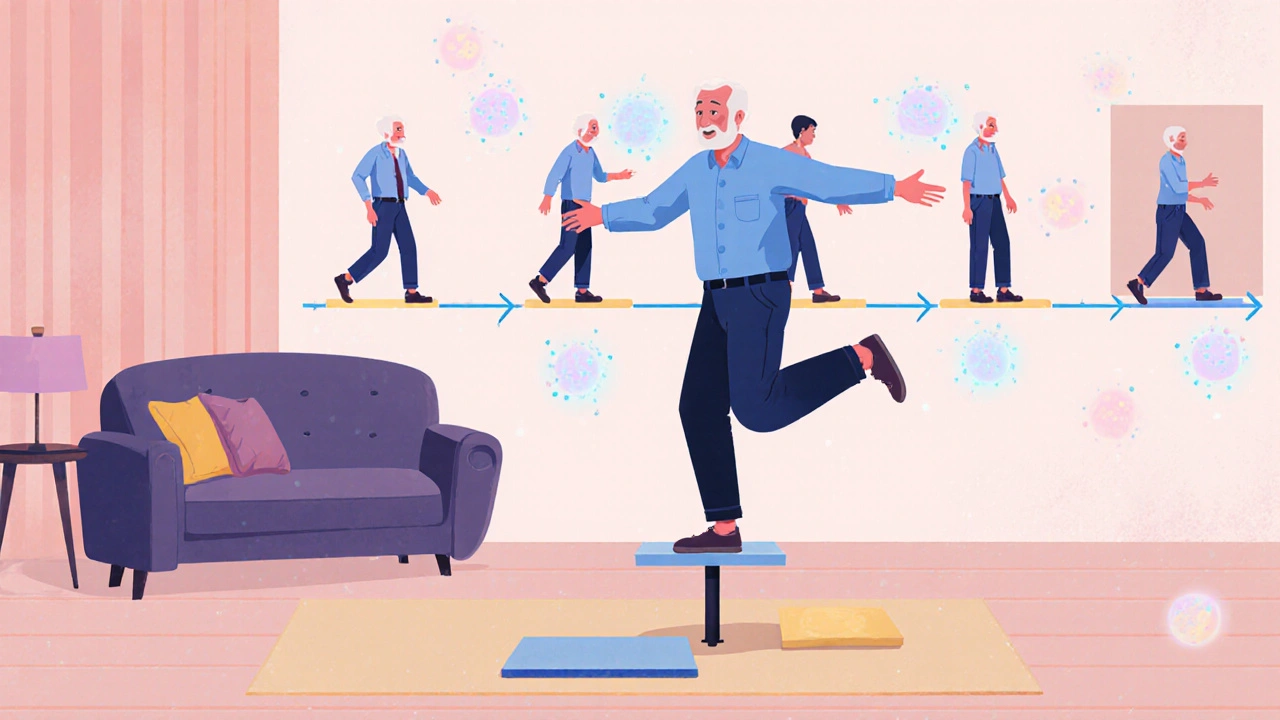
- Balance retraining: Stand with feet together, then narrow to heels together, then on one foot. Do this near a wall for safety. Add head turns or arm movements as you improve.
- Walking exercises: Walk forward, then backward, then sideways. Walk while turning your head. Walk on grass, foam, or uneven surfaces. Start with support, then remove it.
- Stretching and strengthening: Tight neck muscles can worsen dizziness. Gentle neck stretches and shoulder blade squeezes help. Core strength matters too-planks, bridges, and seated marches build the foundation for stability.
- Habituation drills: If spinning in a chair triggers dizziness, sit in a swivel chair and spin slowly for 10 seconds. Stop. Wait for dizziness to pass. Repeat 5 times. Do this daily. The goal isn’t to feel better immediately-it’s to feel less bad over time.
These aren’t gym workouts. They’re short-often just 5 to 10 minutes per session. But they need to be done several times a day. Consistency beats intensity. A 2023 study from Princeton Medicine found that even 5-minute sessions, done 3-5 times daily, led to measurable improvement in 6 weeks.
Who Benefits the Most?
VRT works for almost anyone with a balance disorder. Age doesn’t matter. Neither does how long you’ve been dizzy. You don’t need to be fit. You don’t need to be young.
Common conditions treated include:
- Benign Paroxysmal Positional Vertigo (BPPV): The most common cause of dizziness. Affects 2.4% of the population. Caused by loose crystals in the inner ear. VRT helps the brain adapt even if the crystals aren’t fully removed.
- Vestibular neuritis: A viral infection that attacks the balance nerve. Symptoms can last weeks. VRT speeds recovery by retraining the brain.
- Meniere’s Disease: Causes vertigo, hearing loss, and ringing. While VRT won’t stop the attacks, it helps you manage them better and reduces fall risk.
- Age-related balance decline: One in three adults over 65 falls each year. Dizziness is a major contributor. VRT reduces fall risk by 53%, according to Texas Health Resources data.
Even people with multiple health issues-diabetes, arthritis, neuropathy-benefit. VRT doesn’t replace medical treatment. It complements it. If you’re on medication for dizziness, VRT can help you reduce or even stop it.
Real Results: What Patients Actually Experience
Numbers are good. Stories are better.
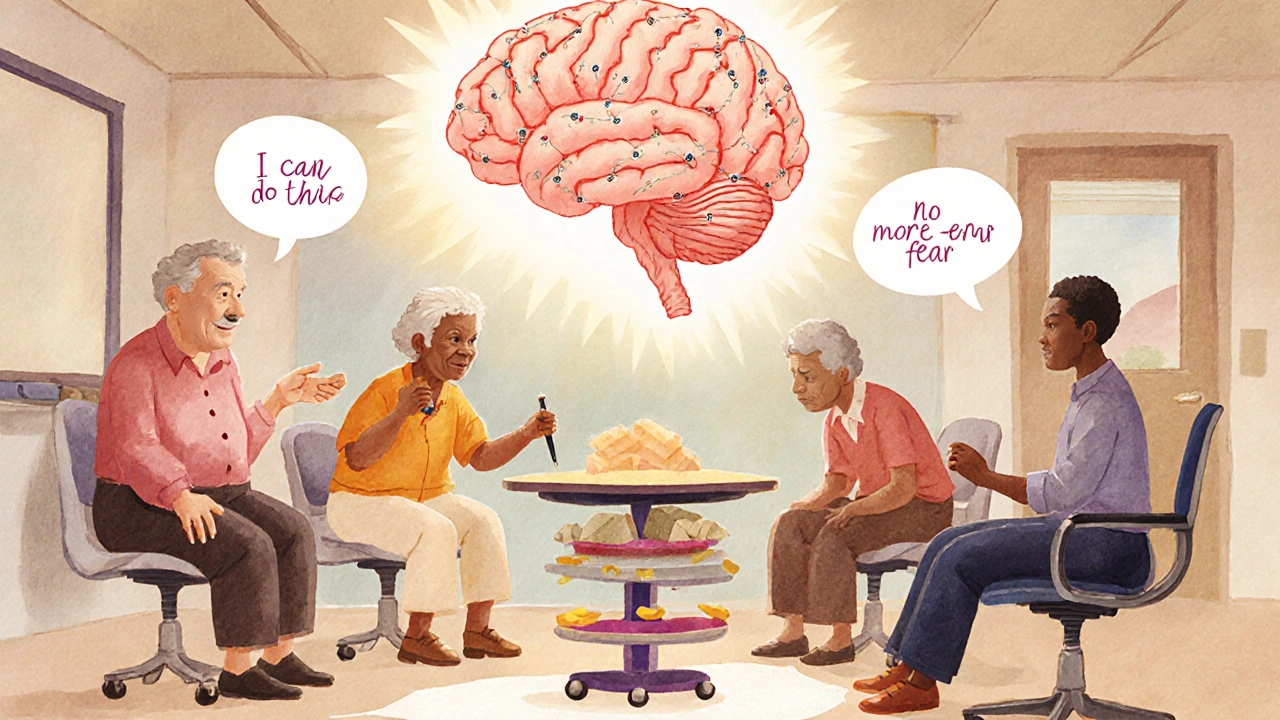
Rhonda, 71, used to avoid leaving her house. Dizzy spells hit three times a week. She’d grab the wall just to walk to the kitchen. After 8 weeks of VRT, she started walking her dog again. Then she went to the grocery store alone. Then she visited her granddaughter. “I didn’t realize how much I’d lost,” she said.
One Reddit user, after 12 weeks of daily exercises, went from 3-4 falls a week to zero. Another couldn’t read while walking because everything blurred. After VRT, reading on the subway became possible again.
SMART Sports Medicine reports 89% of patients regain the ability to do activities they’d given up-cooking, climbing stairs, driving, even dancing. These aren’t outliers. They’re typical outcomes.
The key? Showing up. Doing the exercises. Not waiting for dizziness to disappear before starting. The dizziness has to be provoked to heal.
How to Get Started
You don’t need a referral from a specialist to begin VRT, but you should. Start with your doctor. Ask if you have a vestibular disorder. They can refer you to a physical therapist trained in vestibular rehabilitation.
Look for clinics with certified vestibular therapists. Major hospitals like Penn Medicine, Texas Health Resources, and Princeton Sports and Family Medicine offer these programs. Insurance usually covers it.
Expect 6-8 weeks of treatment: one or two visits per week with your therapist, plus daily home exercises. Your therapist will customize your plan. You’ll get a written guide. You’ll be asked to track your symptoms.
Don’t expect instant results. Improvement takes weeks. But you’ll know you’re on the right track when:
- You feel less nauseous after movement
- You can turn your head without blurring vision
- You walk without holding onto furniture
- You stop avoiding stairs or crowded places
If you stop doing the exercises, symptoms can return. VRT isn’t a cure-it’s a lifelong maintenance skill. Think of it like brushing your teeth. You don’t stop after one week.
Why This Matters More Than Ever
By 2030, 20% of the U.S. population will be over 65. Falls are the leading cause of injury-related death in seniors. Hip fractures from falls cost the healthcare system over $50 billion a year. VRT is one of the few interventions proven to cut that risk by more than half.
It’s also cheap. A single fall can cost $30,000 in hospital bills. A full course of VRT? Usually under $1,000 with insurance. No drugs. No surgery. No side effects.
And the technology is getting better. Some clinics now use virtual reality to simulate real-world environments-busy streets, dim rooms, moving sidewalks-making exercises more realistic. Motion sensors track head movement with precision. But the core hasn’t changed: movement, repetition, and patience.
If you’re tired of feeling unsteady, scared to move, or dependent on others, VRT isn’t just an option. It’s your path back to independence.
Can vestibular exercises be done at home without a therapist?
Yes, but only after being evaluated by a trained therapist. Many exercises are safe to do at home, but starting without guidance can make symptoms worse. A therapist identifies which exercises match your specific problem. Once you know your plan, daily home practice is essential. Most patients do 3-5 short sessions per day, guided by a printed or digital routine.
How long until I see results from vestibular therapy?
Most people notice small improvements in 2-4 weeks. Significant changes-like walking without support or reducing falls-usually take 6-8 weeks. Progress isn’t linear. Some days feel worse before they get better. That’s normal. The key is consistency. Skipping days slows recovery. Doing exercises daily, even for just 5 minutes, builds momentum.
Do I need special equipment for vestibular exercises?
No. VRT requires no machines, apps, or gadgets. A wall for support, a chair, and a small object like a pen or card are all you need. Some therapists use visual targets or balance pads, but these are optional. The therapy works because of movement and repetition-not tools. You can do everything at home with no cost.
Will vestibular therapy cure my dizziness?
It won’t reverse damage to your inner ear. But it can make that damage irrelevant. VRT trains your brain to compensate. Many patients achieve near-complete symptom relief-even if the original cause remains. For example, someone with Meniere’s Disease may still have occasional attacks, but they won’t fall, won’t feel nauseous, and won’t avoid daily life. That’s a cure in practical terms.
Is vestibular therapy safe for older adults?
Yes, and it’s especially important for older adults. Studies show VRT reduces fall risk by 53% in seniors. Therapists adjust exercises for mobility limits, arthritis, or weak muscles. Safety is built in: you start with support, progress slowly, and never push into pain. The biggest risk? Not doing anything. Dizziness in older adults leads to isolation, fear, and decline. VRT breaks that cycle.
David Cunningham
November 23, 2025 AT 21:27Jessica Correa
November 25, 2025 AT 13:56Rahul Kanakarajan
November 26, 2025 AT 18:20New Yorkers
November 27, 2025 AT 01:28Holly Schumacher
November 28, 2025 AT 14:00ann smith
November 29, 2025 AT 22:24james lucas
November 30, 2025 AT 04:14manish chaturvedi
December 1, 2025 AT 14:07Ravi Kumar Gupta
December 1, 2025 AT 14:17Patrick Marsh
December 2, 2025 AT 09:05Michael Fitzpatrick
December 3, 2025 AT 11:25Nikhil Chaurasia
December 3, 2025 AT 19:44Julie Pulvino
December 4, 2025 AT 21:56luke young
December 6, 2025 AT 09:52