
Breast Cancer Screening and Treatment: What You Need to Know in 2026
 Jan, 1 2026
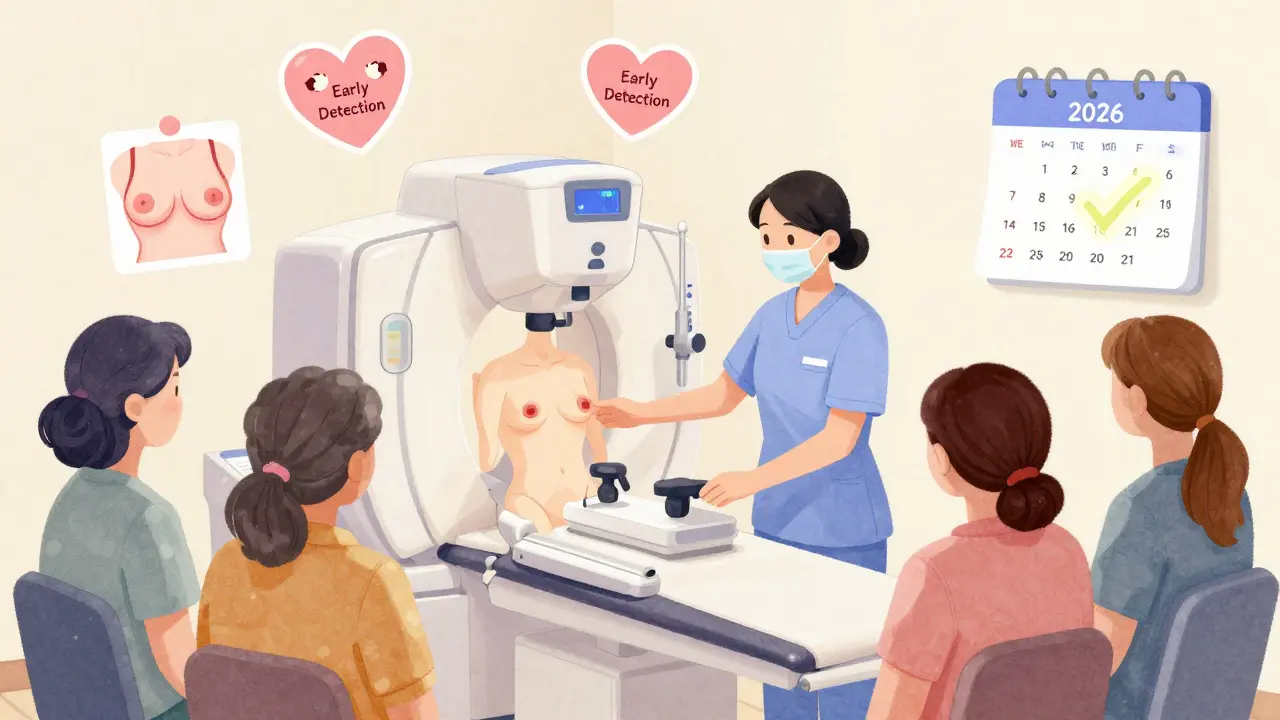
When it comes to breast cancer, catching it early can change everything. Screening mammography isn’t just a routine test-it’s one of the most effective tools we have to reduce deaths from this disease. But with so many guidelines, new technologies, and confusing advice, it’s hard to know what’s right for you. This isn’t about fear. It’s about clarity. Let’s break down what screening actually means today, who should get it, how often, and what happens after a diagnosis.
Who Should Be Screened and When?
The big shift in recent years? Screening now starts at 40 for everyone at average risk. In 2024, the American College of Obstetricians and Gynecologists updated its guidelines to match the U.S. Preventive Services Task Force, the American Cancer Society, and the American College of Radiology. All now agree: don’t wait until 50. Breast cancer is rising in women under 50, and early detection saves lives. If you’re 40 to 44, you have the option to start yearly mammograms. Between 45 and 54, annual screening is strongly recommended. After 55, you can switch to every two years-or keep going yearly if you prefer. The American Society of Breast Surgeons says: start at 40, keep going as long as you’re healthy and your life expectancy is over 10 years. No arbitrary cutoffs. No guessing. For women with a family history of breast cancer, BRCA mutations, or a personal history of chest radiation, screening starts earlier-often at 30. These women usually get both a mammogram and an MRI every year. The American Cancer Society recommends MRI if your lifetime risk is 20% to 25% or higher, based on tools like Tyrer-Cuzick or Gail model. If your risk is below 15%, MRI isn’t routinely advised.2D vs. 3D Mammography: What’s the Difference?
Most women still get 2D mammograms. They’re widely available, covered by insurance, and effective. But 3D mammography-also called digital breast tomosynthesis (DBT)-is becoming the new standard, especially for women with dense breasts. Here’s how they compare:| Feature | 2D Mammography | 3D Mammography (DBT) |
|---|---|---|
| Image Type | Flat, two-dimensional | Stacked 3D slices |
| Radiation Dose | Lower | Higher (but within safe limits) |
| Accuracy in Dense Breasts | Lower | Higher |
| False Positives | Higher | Reduced by up to 40% |
| Recommended For | General population | Dense breasts, high risk |
DBT doesn’t replace 2D-it works with it. Most machines now produce synthetic 2D images from the 3D scan, cutting radiation exposure. The American Society of Breast Surgeons says DBT should be the default for screening. Medicare covers one baseline mammogram and annual screening mammograms. Diagnostic mammograms (if something shows up) can be done more often.
What About Dense Breasts?
Dense breast tissue shows up white on a mammogram-just like tumors. That makes it harder to spot cancer. About half of women over 40 have dense breasts. But here’s the problem: most guidelines don’t recommend automatic extra testing just because your breasts are dense. The USPSTF says there’s not enough proof that adding ultrasound or MRI helps women with dense breasts but no other risk factors. The American Cancer Society agrees-unless you’re high risk, don’t assume extra scans will help. But if you have dense breasts AND a family history, or a prior biopsy showing atypical cells, then MRI should be part of your annual screening. Don’t rely on breast self-exams or clinical breast exams as screening tools. The Canadian Task Force and others have found they don’t reduce deaths. Mammography-2D or 3D-is still the gold standard.
How Much Does Screening Actually Save Lives?
A 2016 meta-analysis of nine major studies found that regular mammography reduces breast cancer deaths by about 12%. That’s not a huge number-but it’s meaningful. For every 1,000 women screened over 10 years, roughly 1 death is prevented. That’s not just statistics. That’s a mother, a sister, a friend. The benefit grows the longer you screen. Women who start at 40 and continue regularly have a better chance of catching cancer when it’s small and treatable. That’s why the push to start at 40 isn’t arbitrary. It’s data-driven. And it’s helping close gaps in survival rates, especially for Black women, who are more likely to die from breast cancer at younger ages.What Happens After a Diagnosis?
A mammogram doesn’t diagnose cancer-it finds something suspicious. If you get called back for more tests, it doesn’t mean you have cancer. About 10% of women are called back for additional imaging. Only about 1 in 5 of those turn out to be cancer. If cancer is confirmed, treatment starts with staging: tumor size (T), lymph node involvement (N), and spread (M). Then come the biological markers: estrogen receptor, progesterone receptor, HER2 status, and sometimes genomic tests like Oncotype DX. These decide if you need chemotherapy, hormone therapy, or targeted drugs. Surgery options include lumpectomy (breast-conserving) or mastectomy. Radiation usually follows lumpectomy. For early-stage cancers, chemotherapy isn’t always needed. Genomic tests can tell you if the risk of recurrence is low enough to skip it. Treatment isn’t one-size-fits-all. A 65-year-old with slow-growing, hormone-positive cancer might only need hormone pills for 5-10 years. A 42-year-old with aggressive, HER2-positive cancer might need chemo, surgery, radiation, and targeted drugs like trastuzumab.
What’s Not Covered
This article focuses on screening and the path from detection to diagnosis. Full treatment algorithms-chemotherapy regimens, radiation dosing, surgical techniques, clinical trial options-are beyond the scope. Those require oncology guidelines from the National Comprehensive Cancer Network or the American Society of Clinical Oncology. If you’re diagnosed, your care team will walk you through your options. But knowing what screening to expect and why it matters helps you ask better questions.What Should You Do Now?
If you’re 40 or older: schedule your mammogram. Don’t wait for your doctor to bring it up. If you’re under 40 and have a strong family history, talk to your doctor about risk assessment. If you’ve had a biopsy showing atypical cells, ask about MRI screening. If your breasts are dense, ask if 3D mammography is available. Screening isn’t perfect. It can lead to false alarms or overdiagnosis. But the evidence is clear: for most women, the benefits outweigh the risks. The goal isn’t to scare you. It’s to empower you. You don’t need to be an expert. You just need to show up.Should I start mammograms at 40 or wait until 50?
Start at 40. Major guidelines from the American College of Obstetricians and Gynecologists, U.S. Preventive Services Task Force, and American Cancer Society now agree: screening at 40 reduces breast cancer deaths. Waiting until 50 misses early cancers that are more common in younger women than previously thought. The earlier you start, the more time you have to catch problems when they’re easiest to treat.
Is 3D mammography better than 2D?
Yes, especially if you have dense breasts or are at higher risk. 3D mammography (DBT) reduces false positives by up to 40% and finds more cancers in dense tissue. It’s not always necessary for every woman, but it’s becoming the preferred method. Ask your imaging center if they offer it. Most major hospitals and breast centers now do.
Do I need an MRI if I have dense breasts?
Only if you’re also at higher risk-like a family history of breast cancer, a BRCA mutation, or a prior biopsy showing atypical cells. For dense breasts alone, without other risk factors, MRI isn’t routinely recommended. The added cost and false alarms often outweigh the benefit. Stick with 3D mammography unless your doctor says otherwise.
How often should I get screened after 55?
You can switch to every two years, but you don’t have to. Many women choose to keep annual screenings because they feel more secure. There’s no rule that says you must slow down. Talk to your doctor about your personal risk, how you feel about screening, and your life expectancy. If you’re healthy and active, continuing yearly is perfectly reasonable.
What if I’m over 75?
There’s no official cutoff. Screening should continue as long as you’re in good health and your life expectancy is over 10 years. If you’re 80 and active, with no major chronic illnesses, screening still makes sense. If you have serious health problems and limited life expectancy, the risks of false positives and unnecessary treatment may outweigh the benefit. Discuss this with your doctor based on your individual situation.
Screening mammography isn’t about perfection. It’s about progress. Every woman who gets screened gives herself a better shot at survival. You don’t need to be fearless. You just need to be informed-and willing to take the next step.
Philip Leth
January 2, 2026 AT 09:00Man, I just had my first 3D mammogram last month-no joke, the tech said it was like seeing a high-res MRI of my boobs. I’ve got dense tissue, and honestly? I felt way more confident walking out. No more ‘come back next week’ anxiety. Just straight facts. And yeah, it’s pricier, but my insurance covered it. If your clinic has it, just say yes. Your future self will thank you.
JUNE OHM
January 3, 2026 AT 11:01STOP lying to women!!! 🚨 The government and Big Pharma are pushing 3D mammograms because they make $$$ off false positives and biopsies. I know a nurse who got 5 unnecessary biopsies in 3 years-ALL from ‘suspicious shadows’ that vanished next year. They scare you into treatment. Mammograms don’t save lives-they save stock prices. 🤡💉 #FreeTheBreasts
Angela Goree
January 3, 2026 AT 19:38Look. I’m 47. I started at 40. I’ve had two callbacks. One was a cyst. One was a benign fibroadenoma. I didn’t die. I didn’t lose a breast. I got clarity. And yes, I cried in the parking lot both times. But I’m alive. And I’m not letting fear or some conspiracy theorist on Reddit tell me to skip my scan. I’m not a statistic-I’m a woman who shows up. And so should you.
Vincent Sunio
January 5, 2026 AT 08:57It is, of course, regrettable that the article fails to adequately distinguish between screening efficacy and overdiagnosis bias. The 12% mortality reduction cited is derived from studies predating the widespread adoption of hormonal therapies and targeted treatments-thus, the relative benefit is substantially attenuated in contemporary cohorts. Moreover, the recommendation to commence screening at 40 is not universally endorsed; the Nordic Cochrane Centre’s meta-analysis, for instance, concludes that the number needed to screen to prevent one death exceeds 2,000, with a 30% overdiagnosis rate. One must question whether the psychological and financial toll of false positives is ethically justified in asymptomatic populations.
veronica guillen giles
January 6, 2026 AT 14:02Oh, so now I’m supposed to be ‘empowered’ by being scared into a machine that squishes my boobs and then tells me I have a 10% chance of being called back for something that isn’t cancer? 🙄 I’m sorry, but ‘showing up’ shouldn’t mean submitting to a system that treats women like walking risk factors. My mom had a mammogram at 42. They found nothing. She died of breast cancer at 49. What’s the point of ‘clarity’ if it doesn’t save lives? Just… stop gaslighting us.
Shanahan Crowell
January 7, 2026 AT 22:03Listen-I get it. The system’s messy. The stats are confusing. The ads make you feel guilty if you skip it. But here’s the truth: I’m 52. I’ve been screening since 40. I had stage 1 cancer last year. Caught by a 3D mammogram. I didn’t need chemo. I didn’t lose my breast. I just needed surgery and a little radiation. I’m back to hiking, traveling, and annoying my grandkids. This isn’t about fear. It’s about giving yourself a shot. Don’t let the noise drown out the fact that this one thing? It saved me. Do it. Not for them-for you.
Ian Ring
January 8, 2026 AT 04:40Thank you for this comprehensive overview-truly, the clarity on DBT versus 2D is invaluable. I’m a GP in London, and I’ve had patients come in terrified because their GP told them ‘MRI is better’ for dense breasts. It’s refreshing to see evidence-based guidance laid out so plainly. I’ll be sharing this with my practice. One small note: the reference to ‘no arbitrary cutoffs’ at 75 is particularly wise. Age alone should never dictate care-frailty, comorbidities, and personal values matter far more. Well done.
Shruti Badhwar
January 8, 2026 AT 12:31As an oncology researcher from India, I must commend the article for its rigorous alignment with global consensus guidelines. However, in low-resource settings, access to 3D mammography remains a luxury. We rely on clinical breast exams and ultrasound triage, which, while imperfect, are pragmatic. The real issue isn’t screening modality-it’s equity. A woman in rural Bihar shouldn’t be denied early detection because her village lacks a digital tomosynthesis machine. Advocacy must extend beyond personal choice to systemic reform. Let’s not let privilege define survival.