
Cochlear Implants: How Surgical Hearing Restoration Works for Profound Deafness
 Dec, 21 2025
When someone loses their hearing so completely that hearing aids don’t help at all, life changes in ways most people never think about. You miss the sound of your child laughing, the doorbell ringing, even your own voice. For people with profound deafness, this isn’t just inconvenience-it’s isolation. That’s where cochlear implants come in. They don’t just make sounds louder. They give the brain a new way to hear.
What Exactly Is a Cochlear Implant?
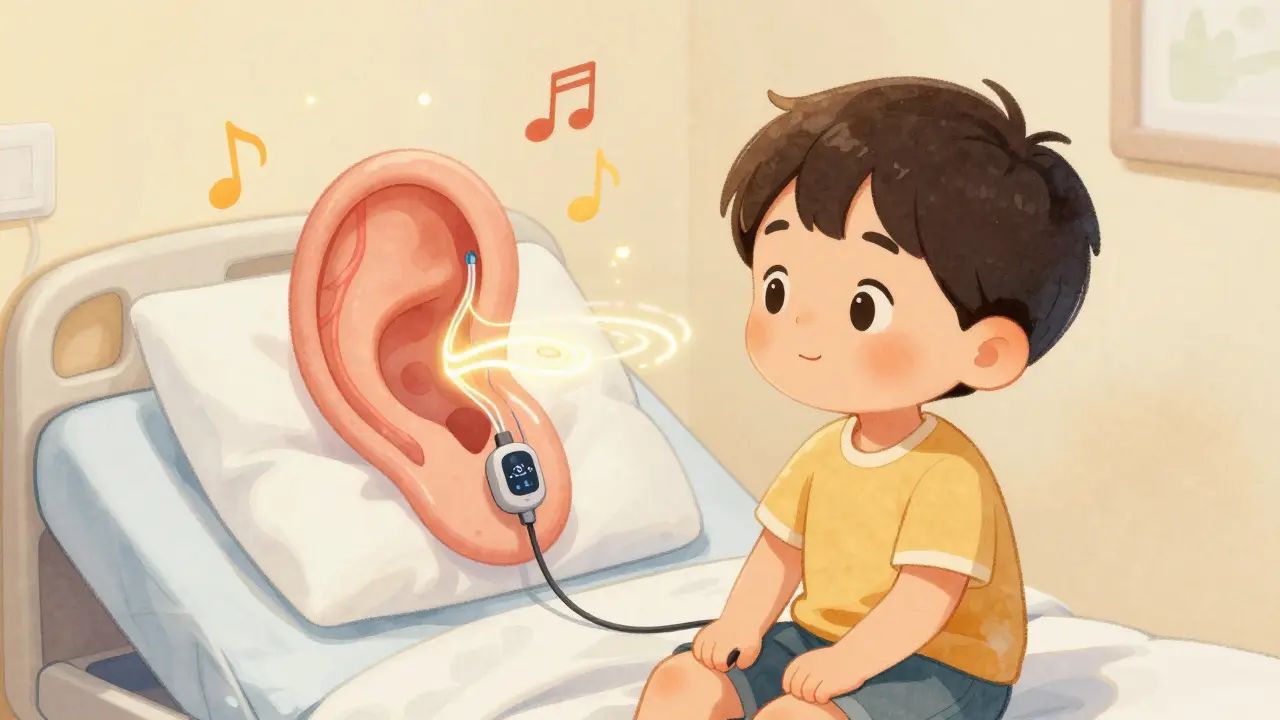
A cochlear implant is not a hearing aid. Hearing aids amplify sound, hoping the ear can still process it. Cochlear implants bypass the damaged parts of the ear entirely. They turn sound into electrical pulses that directly stimulate the auditory nerve. This nerve then sends signals to the brain, which learns to interpret them as sound.
The device has two main parts. The external part sits behind the ear. It includes a microphone that picks up sound, a processor that turns it into digital code, and a transmitter coil that sends the signal through the skin. The internal part is surgically placed under the skin. It has a receiver that gets the signal and an electrode array threaded into the cochlea-the snail-shaped part of the inner ear. This array has 12 to 22 tiny contacts, each delivering pulses to different parts of the cochlea based on sound frequency.
Modern implants like the SYNCHRONY 2 from MED-EL can even handle full 3.0 Tesla MRI scans without needing surgery to remove a magnet. That’s a big leap from older models, which required risky procedures just to get an MRI.
Who Is a Candidate?
Not everyone with hearing loss qualifies. Cochlear implants are meant for those with severe-to-profound sensorineural hearing loss-meaning the hair cells in the cochlea are too damaged to work, even with powerful hearing aids.
For adults, the standard is a pure-tone average of more than 70 dB HL and speech recognition scores under 50% with hearing aids. For children, the criteria are broader. The FDA approved implants for kids as young as 9 to 12 months in 1990. Today, babies as young as 6 months can be evaluated. The earlier the implant, the better the chance for normal speech development.
There are exceptions. People with non-functional auditory nerves won’t benefit. Those with auditory neuropathy might be candidates for bone conduction devices instead. But for the vast majority with profound deafness, this is the only option that restores access to spoken language.
The Surgery: What Happens Inside the Skull
The surgery takes about two hours. A surgeon makes a 4- to 6-centimeter cut behind the ear. They drill through the mastoid bone to reach the middle ear. Then comes the delicate part: opening the cochlea.
There are two ways to insert the electrode. One is through the round window-a natural opening. The other is a small hole called a cochleostomy, drilled just below it. Surgeons choose based on anatomy and preference. The goal is to place the electrode gently into the scala tympani, the lower chamber of the cochlea, so each contact lines up with the right frequency range.
During the procedure, the facial nerve is monitored constantly. If the nerve is accidentally touched, it can cause facial paralysis. Electrodes are set to trigger at 0.05 to 0.1 milliamperes-just enough to warn the surgeon before damage occurs.
The receiver-stimulator is then tucked into a small pocket in the skull bone. It’s held in place with screws or a custom fit. The incision is closed. Most patients go home the same day or the next.

Recovery and Activation
After surgery, there’s no rush to turn it on. The body needs time to heal. Swelling goes down. Scar tissue forms around the implant. Activation usually happens 2 to 4 weeks later.
When the device is first turned on, most recipients say the sound is strange-mechanical, robotic, like a cartoon character. That’s normal. The brain hasn’t heard anything in years, or maybe never. It doesn’t know what these electrical pulses mean.
Over the next few months, audiologists adjust the settings. Each electrode gets its own volume and pulse rate. These settings are called “maps.” The first map is basic. By the third or fourth, people start recognizing speech. After 6 months, most adults understand 80% of sentences in quiet rooms. That’s a huge jump from the 20% they got with hearing aids.
Children need more time. Those implanted before age 2 often develop speech on par with hearing peers. Kids implanted after age 7 usually need intensive therapy-sometimes for two years-to catch up. The brain’s ability to learn new sounds fades with age.
What You Can and Can’t Hear
Cochlear implants don’t restore natural hearing. Music sounds flat. Voices lack warmth. Background noise still overwhelms. In a crowded restaurant, speech understanding drops to 30-50%. That’s why many users still rely on lip-reading.
But the benefits are undeniable. People report hearing their own footsteps, the microwave beeping, birds outside the window. One adult, deaf for 15 years, said hearing his granddaughter say “Grandpa” for the first time made him cry. Another said she finally understood why people laughed at jokes she never got.
Studies show 90% of adult recipients see major improvements in communication. But 15-20% still struggle with music. That’s because music relies on fine pitch differences and harmonics-things cochlear implants still can’t fully reproduce.

Complications and Risks
Surgery is generally safe. Experienced teams have complication rates under 5%. Major risks like facial nerve damage happen in less than 1% of cases. Infection is rare. Device failure occurs in 5-10% of cases over 10 years, requiring revision surgery.
Some people get dizziness or ringing in the ears (tinnitus) after surgery. It usually fades. A small number report taste changes-because the chorda tympani nerve runs near the implant site. That’s often temporary.
Long-term, the internal device lasts 20-30 years. The external processor can be upgraded every few years without more surgery. That means you don’t outgrow the implant-you just get better sound.
Who’s Behind the Scenes?
A cochlear implant isn’t a one-time fix. It’s a team effort. An otolaryngologist (ear surgeon) does the operation. An audiologist maps the device. A speech-language pathologist helps with listening and speaking skills. A psychologist may help children or adults adjust emotionally.
Insurance in the U.S. covers it if you meet the criteria: severe hearing loss and poor performance with hearing aids. Medicaid and Medicare typically pay. Private insurers follow similar rules. In the UK, the NHS provides implants for qualifying patients.
As of 2022, around 324,000 people worldwide have them. In the U.S., about 96,000 have received implants-58,000 adults and 38,000 children. Those numbers are rising every year.
The Future of Cochlear Implants
Researchers are working on better sound processing. Some devices now use AI to reduce background noise and focus on speech. Others are testing electrodes that release drugs to prevent scar tissue buildup-this could improve signal quality over time.
Hybrid implants are another breakthrough. They combine a cochlear implant for high pitches with a hearing aid for low pitches. That’s perfect for people who still hear low notes but lose the high ones.
Miniaturization continues. Future processors may be as small as a hearing aid battery. Wireless charging and Bluetooth streaming to phones are already standard.
But the biggest change isn’t technical. It’s cultural. More people are choosing implants early. More schools are teaching listening and spoken language. More adults are speaking up about their experiences. Cochlear implants aren’t just a medical device anymore. They’re a doorway back into the world of sound.
Are cochlear implants the same as hearing aids?
No. Hearing aids amplify sound for ears that still have some working hair cells. Cochlear implants bypass damaged parts of the ear and send electrical signals directly to the auditory nerve. They’re only for people with profound deafness who get little to no benefit from hearing aids.
Can children get cochlear implants?
Yes. The FDA approved implants for children as young as 9-12 months in 1990. Today, babies as young as 6 months can be evaluated. Early implantation-before age 2-gives children the best chance to develop normal speech and language skills. Delaying beyond age 7 often means longer, more intensive therapy is needed.
How long does it take to hear well after surgery?
It takes time. The device is usually activated 2-4 weeks after surgery. At first, sounds seem robotic or artificial. Most adults understand simple speech within 3-6 months. Full adaptation can take up to a year. Children may need 1-2 years of therapy to reach age-appropriate speech levels. Consistent use and regular mapping sessions are key.
Do cochlear implants restore normal hearing?
No. They don’t restore natural hearing. Most users describe the sound as different-mechanical or synthetic. Music often sounds flat or distorted. Background noise still makes speech harder to understand. But for people who heard nothing before, even this artificial sound opens up communication, safety, and connection in ways hearing aids couldn’t.
Is the surgery risky?
It’s generally safe. Complication rates are below 5% with experienced teams. Major risks like facial nerve damage occur in less than 1% of cases. Infection, dizziness, and taste changes are possible but rare and often temporary. Device failure happens in 5-10% of cases over 10 years, requiring revision surgery. Most people recover fully within a few weeks.
Can I have an MRI with a cochlear implant?
Yes, but it depends on the model. Newer implants like the MED-EL SYNCHRONY 2 are fully compatible with 3.0 Tesla MRI scans without needing surgery to remove a magnet. Older models may require removal of the internal magnet before an MRI. Always check with your implant manufacturer and radiology team before scheduling a scan.
How long do cochlear implants last?
The internal part is designed to last 20-30 years. Most people never need to replace it. The external processor, however, is upgraded every few years as technology improves. You can swap out the processor without another surgery. This means your implant can keep getting better over time.
Ajay Brahmandam
December 22, 2025 AT 15:54Cochlear implants are wild when you think about it. You’re not just fixing a broken ear-you’re retraining a brain that’s forgotten how to listen. I’ve met people who heard their own voice for the first time at 40 and broke down crying. No hearing aid could ever do that.
jenny guachamboza
December 23, 2025 AT 00:48ok but what if the government is using these to track us?? 🤔 I heard the magnets can be hacked to send subliminal messages through your skull. Also, why do they use titanium? Are they trying to make us part robot?? 🤖💥
Gabriella da Silva Mendes
December 23, 2025 AT 19:46Look, I get it, but why are we spending billions on this when we could just teach everyone to read lips? America’s got enough problems. We don’t need to turn people into cyborgs just to hear birds chirp. Also, my cousin got one and now she won’t stop talking about how ‘the microwave beep sounds like a spaceship.’ Like… okay, cool? But we’re still paying for healthcare, right? 🇺🇸
Kiranjit Kaur
December 25, 2025 AT 03:30This gave me chills. 🥹 I work with deaf kids and seeing them light up when they hear their mom say ‘I love you’ for the first time? That’s the kind of magic no tech article can capture. It’s not just a device-it’s a second chance at connection. Keep pushing for early access, everyone. Every month counts.
Sam Black
December 26, 2025 AT 11:25Man, the part about the electrode array lining up with frequency ranges? That’s poetry disguised as engineering. It’s like the body’s own symphony, rewritten by silicon and wire. I’ve never heard a better metaphor for neuroplasticity-your brain doesn’t just adapt, it reinvents itself to make sense of a new language. And the fact that you can upgrade the external piece without another surgery? That’s the future right there: modular, humane, and endlessly improvable.
Johnnie R. Bailey
December 27, 2025 AT 17:46There’s a quiet revolution here. Not in the tech, but in the cultural shift. For decades, deafness was framed as a deficit to be ‘fixed.’ Now we’re seeing it as a different way of being-and implants as one tool among many. Some in the Deaf community reject them outright. Others embrace them as liberation. Both are valid. The real win is that we’re finally letting people choose their own path to connection.
Tony Du bled
December 28, 2025 AT 22:01My uncle got one 12 years ago. At first he said everything sounded like a robot dial-up. Now he listens to jazz. Not perfectly-but enough to smile when the trumpet hits. That’s all you need.
Art Van Gelder
December 29, 2025 AT 16:04I spent three hours reading this and I’m still not done processing it. The part about the facial nerve monitoring at 0.05 milliamperes? That’s insane precision. It’s like the surgeons are whispering to your nerves, ‘Hey, don’t panic, we’re just here to help.’ And the fact that kids implanted before age two grow up speaking like their hearing peers? That’s not medicine-that’s time travel. Imagine rewinding a child’s development just by inserting a tiny wire into a snail-shaped bone. We’re living in the future, folks.
Kathryn Weymouth
December 29, 2025 AT 19:09Just to clarify: the 90% improvement rate in communication applies to speech-in-quiet environments. In noisy settings, outcomes vary widely. Many users still rely on visual cues, which is why speech therapy and lip-reading remain critical. This isn’t a cure-it’s a bridge. And bridges need maintenance.
Nader Bsyouni
December 30, 2025 AT 14:28So we’re just gonna keep making people into machines because society can't be bothered to learn sign language? Cool. Next they'll implant wifi into your skull so you can stream TikTok without your hands
Julie Chavassieux
December 31, 2025 AT 22:58…I just… I can’t…