
Documentation Requirements for Record-Keeping in Manufacturing: A Practical Guide to GMP Compliance
 Dec, 19 2025
When you’re running a manufacturing line-whether it’s pills, medical devices, or baby formula-your paperwork isn’t just busywork. It’s the only thing standing between a safe product and a dangerous mistake. One missing signature, one unrecorded temperature spike, one unverified calculation, and you could be looking at a recall, a warning letter from the FDA, or worse. The truth is, documentation in manufacturing isn’t about filling out forms. It’s about proving, every single day, that you know what you’re doing and that you did it right.
Why Documentation Matters More Than You Think
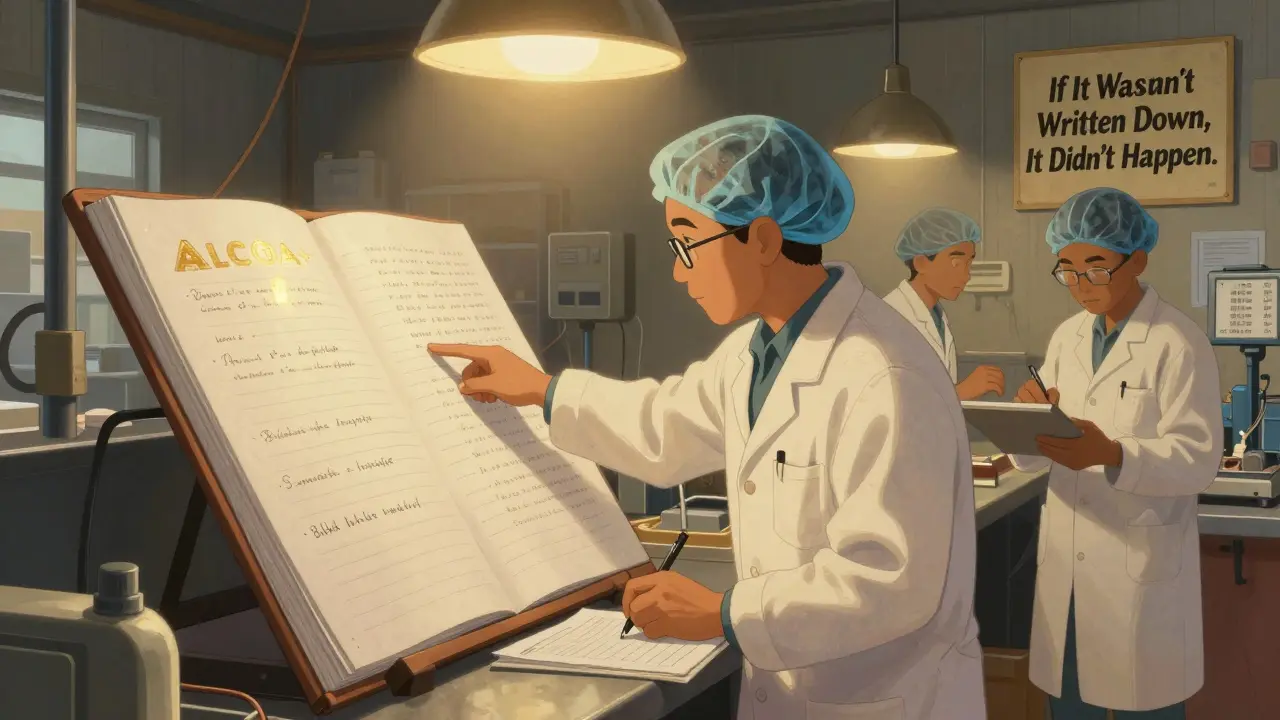
In 2022, Stericycle reported that a single product recall due to documentation failures cost manufacturers an average of $10 million. That’s not a typo. It’s not a worst-case scenario. It’s the norm. And most of those recalls weren’t caused by bad ingredients or broken machines. They were caused by missing records. The U.S. Food and Drug Administration (FDA) started pushing hard for documentation after the 1937 Elixir Sulfanilamide tragedy, where 107 people died because a toxic solvent wasn’t properly tested. Since then, rules have evolved-but the core idea hasn’t changed: if it wasn’t written down, it didn’t happen. And if it didn’t happen, you can’t prove it was safe. This isn’t just a U.S. rule. The European Union’s EudraLex Volume 4, the Pharmaceutical Inspection Co-operation Scheme (PIC/S) guidelines, and Japan’s PMDA all demand the same thing: complete, accurate, and timely records. And regulators aren’t just checking boxes anymore. In 2022, 41% of all FDA Form 483 observations were about documentation. That’s more than facility cleanliness, more than equipment calibration. It’s the #1 compliance issue.What Gets Documented? Two Types of Records
There are two kinds of records you need: procedural documents and compliance records. One tells people how to do the job. The other proves they did it. Procedural documents are your Standard Operating Procedures (SOPs). These aren’t vague guidelines. They’re step-by-step instructions written in active voice. For example: “Weigh 500 grams of active ingredient using calibrated Balance #7. Record the actual weight in Batch Log Section 3.1.” Not “The operator should weigh the ingredient.” That’s not an SOP. That’s a suggestion. These SOPs must include:- Exact tolerances: “Moisture content: 3.5% ± 0.2% w/w”
- Equipment IDs: “Use Mixer Model X-200, Serial #M200-114”
- Validation data: “Method validated per ICH Q2(R1), effective June 12, 2023”
- Emergency steps: “If temperature exceeds 40°C, stop process, notify QA, log deviation”
- Atttributable: Who did it? Name, date, signature.
- Legible: Can someone read it? No pencil, no smudges, no unclear handwriting.
- Contemporaneous: Written at the time of the action. Not later. Not the next day. Same shift.
- Original: Not a copy. Not a transcription. The real data.
- Accurate: No guesses. No rounding unless specified.
- + Complete, Consistent, Enduring, Available: Every field filled. No contradictions. Data lasts. Accessible when auditors show up.
Electronic Records and the Rules Around Them
Most manufacturers now use electronic systems-eQMS, MES, LIMS. But you can’t just switch from paper to Excel and call it done. The FDA’s 21 CFR Part 11 says electronic records must be:- Validated: Proven to work correctly before you use them.
- Secure: Only authorized people can access or change them.
- Auditable: Every change leaves a trail-what was changed, when, and by whom.
- Backed up: Data isn’t lost if the server crashes.

Regional Differences That Can Trip You Up
You might think global rules mean global consistency. They don’t. In the U.S., FDA 21 CFR Part 211 requires every calculation to be checked by a second qualified person. In the EU, under Annex 11, automated systems can verify calculations-no second person needed. So if you’re making a product for both markets, you either need two sets of procedures or a system that can switch modes. Japan’s PMDA requires all documentation to be in Japanese for local submissions. If your global SOP is in English, you need a certified translation-and proof the translation is accurate. Many companies miss this and get rejected at customs. Medical devices have their own rules. ISO 13485:2016 demands traceability matrices-linking every design requirement to a test result. The FDA doesn’t require that. So if you’re making a device, you’re doing more paperwork than your pharma peers. A 2022 study by Emergo by UL found manufacturers targeting both the U.S. and EU spend 37% longer getting approvals because they’re reconciling two sets of documentation. And it costs them an average of $2.1 million a year just to keep both versions updated.What Goes Wrong? The Top 5 Documentation Failures
Based on FDA warning letters and audit findings from 2021-2023, here’s what actually fails:- Untimely records (42% of issues): People wait until the end of the shift-or the next day-to fill out logs. Regulators call this “backdating.” It’s a red flag.
- Missing original data (18%): Someone writes a number on a sticky note, then transcribes it into the system. The sticky note gets thrown away. No original. No compliance.
- Incomplete batch records (32%): A field left blank. A temperature reading skipped. A signature missing. One blank field can sink a whole batch.
- Poor investigation documentation (27%): A machine overheated. They fixed it. But they didn’t write down why it happened, what they checked, or if it could happen again.
- Improper amendments (11%): Someone crosses out a wrong number and writes the right one-but doesn’t initial it, date it, or explain why. That’s not correction. That’s falsification.
How to Get It Right
You don’t need a $5 million system to fix documentation. You need discipline.- Write SOPs at an 8th-grade level. If your team has to read it three times to understand it, it’s too complex. The FDA says this explicitly.
- Use the four-eyes principle. Critical records get reviewed by a second person before the batch moves forward. Not optional.
- Designate documentation champions. Put one person in each department whose job is to make sure records are done right. Give them authority. Pay them extra.
- Follow the 5C rule: Clear, Concise, Complete, Correct, Compliant. If it doesn’t meet all five, it’s not good enough.
- Test your system. Run mock audits. Pretend the FDA is coming next week. See where the gaps are.

What’s Changing? The Future of Documentation
Regulators aren’t slowing down. In 2024, the EU will require risk-based documentation under ICH Q9(R1). That means you have to document your risk assessment for every critical record. Why is this form needed? What happens if it’s missing? How do you prevent errors? AI is starting to help. MIT found early adopters reduced documentation time by 45% by using AI to auto-generate batch records from machine data. But regulators aren’t approving these yet. Why? Because they can’t validate the AI’s logic. Until that changes, human oversight is still mandatory. The bottom line: Documentation is getting harder, not easier. But it’s also more important than ever. With FDA inspections up 44% since 2019, and 62% of critical EU findings tied to records, your paperwork isn’t a cost center. It’s your shield.Frequently Asked Questions
Do I need to document every single step in manufacturing?
Yes-if it affects product quality, safety, or identity. That includes weighing ingredients, cleaning equipment, environmental monitoring, in-process testing, and final release. If skipping it could cause harm, it must be documented. Regulators don’t care about minor administrative steps, but they care deeply about anything tied to product control.
Can I use handwritten records in 2025?
Yes, but only if they meet ALCOA+ standards. Handwritten records must be legible, dated, signed, and stored securely. Many companies are moving away from paper because it’s harder to audit, prone to loss, and doesn’t integrate with digital systems. But paper isn’t illegal-it’s just riskier.
What happens if I don’t have a record for a batch?
The batch is considered non-compliant and cannot be released. Regulators treat missing records as evidence of a systemic failure. Even if the product is fine, without proof, it’s treated as unsafe. In 2023, a company lost a $15 million product recall because warehouse temperature logs were missing for a 12-hour window.
How long do I need to keep manufacturing records?
At least one year beyond the product’s expiration date. For pharmaceuticals, that often means 5-7 years. For medical devices, EU MDR requires 10 years. Some countries require longer. Always check local regulations. If you’re exporting, follow the strictest rule.
Can I use cloud-based systems for documentation?
Yes, but the system must be validated under GAMP 5, and you must prove data integrity, security, and access controls. The cloud provider cannot be your only backup. You need your own encrypted, offsite copies. FDA and EMA have approved cloud-based eQMS systems-but only if they meet the same standards as on-premise systems.
What’s the biggest mistake companies make with documentation?
Treating it as a compliance task instead of a quality tool. The best manufacturers use documentation to spot trends-like repeated equipment failures or operator errors-and fix them before they cause problems. If you’re only documenting to pass an audit, you’re missing the point.
Next Steps
If you’re struggling with documentation:- Start with your top 3 most critical processes. Map out every step. Ask: “What happens if we don’t document this?”
- Train your team on ALCOA+. Don’t just hand them a policy-show them real examples of what failed.
- Review your last audit findings. Fix the top three issues first.
- Choose one department to pilot an electronic checklist. Measure the time saved and errors reduced.
- Don’t wait for a warning letter to act. Regulators are watching. And they’re not forgiving mistakes anymore.
Meenakshi Jaiswal
December 19, 2025 AT 20:20Just ran a mock audit last week using the ALCOA+ checklist from this post. Huge difference. Our techs started writing dates in real time instead of waiting till shift end. No more backdating. QA gave us a thumbs up. Small change, massive impact.
Also, we started using voice-to-text for batch logs on the floor. Works great if you're wearing gloves. Just say the number, the system timestamps it. No handwriting, no smudges.
Been using this for 3 months. Zero findings so far. Seriously, if you're still using sticky notes - stop.
Dorine Anthony
December 21, 2025 AT 17:55My team just got hit with a 483 for missing signatures on environmental logs. We thought it was fine since the temp readings were all good. Nope. FDA doesn't care if it was fine - they care if you documented it.
Now we have a little buzzer on the wall that goes off every 2 hours. You hear it? You log it. Right then. No excuses.
Danielle Stewart
December 21, 2025 AT 23:37Let’s be real - most of us aren’t doing this because we love paperwork. We do it because we don’t want to lose our jobs. Or worse, hurt someone.
I’ve seen a batch get held up because someone forgot to initial a humidity reading. One signature. One moment of laziness. Cost us $400K in lost production.
So yeah, the SOPs are tedious. The checklists are boring. But they’re the only thing keeping your plant open. Treat them like your life depends on it - because sometimes, they do.
Kinnaird Lynsey
December 22, 2025 AT 03:07So the FDA spends millions auditing docs while people starve and climate collapses. But hey, if your batch log has a smudge, you’re a criminal. Classic.
Meanwhile, the same regulators ignore supply chain fraud, counterfeit active ingredients, and labs that falsify stability data. But hey - at least your handwriting was legible.
Documentation isn’t safety. It’s theater. And we’re all just actors in a very expensive play.
shivam seo
December 23, 2025 AT 08:52USA gets it right. Everyone else is just copying us. Why does the EU think automated systems don’t need a second review? That’s how you get disasters.
And India? You think you can skip ALCOA+ because your labor is cheap? You’re just exporting risk. And one day, your product will kill someone - and then the world will blame the US for not stopping you.
Stop pretending compliance is optional. You’re not fooling anyone.
Andrew Kelly
December 23, 2025 AT 18:44Did you know the FDA’s own internal audit system has unpatched vulnerabilities? But they want you to validate your entire eQMS? That’s like a drunk cop demanding you pass a sobriety test.
And GAMP 5? That’s just a $200K shell game designed to keep consultants rich. I’ve seen systems validated that couldn’t even log in without a password reset every 15 minutes.
This isn’t safety. It’s corporate extortion dressed up as science.
Anna Sedervay
December 25, 2025 AT 01:06Actually, the 2023 draft guidance doesn’t require audit trails for hybrid systems if the paper copy is ‘sufficiently controlled’ - which, by the way, is defined in FDA’s 2003 guidance on electronic records, section 11.15(c), amended by 2007-03-12. You’re misquoting.
Also, ‘GAMP 5’ isn’t a standard - it’s a guide published by ISPE. You can’t cite it as a regulation. That’s like citing Wikipedia as a legal source.
And your Janssen example? They used a proprietary system with FDA pre-approval. Most companies don’t have that luxury. But thanks for the misinformation.
Ashley Bliss
December 25, 2025 AT 05:19We treat documentation like a sacred text because we’ve lost faith in human judgment. We don’t trust the operator. We don’t trust the machine. We don’t even trust ourselves.
So we create mountains of paper to prove we didn’t fail - even when we never really failed in the first place.
It’s not about safety. It’s about absolution.
We are not gods. We are not infallible. But we’ve built a religion out of ink and signatures, because admitting we’re flawed is too terrifying.
And so we write, and write, and write - not to protect the product, but to protect our souls from the guilt of being human.
Mahammad Muradov
December 25, 2025 AT 12:36India has better documentation systems than most US plants. You think we’re behind? We’ve been doing batch record reviews in real-time since 2018. Every operator has a tablet. Every step is scanned. Every signature is biometric.
And we do it for 1/10th the cost. Your problem isn’t compliance - it’s poor management. Stop blaming the rules. Fix your culture.
Also, ALCOA+? We call it ‘Bhagwan’s Law’. If it’s not written, it didn’t happen. Simple.
holly Sinclair
December 27, 2025 AT 06:37There’s a deeper question here: Why do we equate documentation with truth? A signature doesn’t make a temperature reading accurate. A validated system doesn’t prevent human error - it just makes it traceable.
Documentation is a mirror, not a shield. It reflects our anxiety, not our competence.
If we spent as much energy fixing root causes as we do filling out forms, we wouldn’t need half this paperwork.
But we’re afraid of chaos. So we build walls of data to keep the unknown out.
Ironically, the more we document, the less we learn. Because we’re not looking at the problem - we’re just checking boxes.
Maybe the real compliance failure isn’t the missing signature.
It’s the silence behind it.
Monte Pareek
December 29, 2025 AT 03:16Listen. I’ve worked in pharma for 27 years. From Ohio to Bangalore. I’ve seen plants shut down. I’ve seen people go to jail. I’ve seen kids die because someone didn’t log a temperature.
You want to know the secret? It’s not the software. It’s not the SOPs. It’s not even the audits.
It’s respect.
Respect for the person who’s holding the pipette. Respect for the patient who’s going to take the pill. Respect for the fact that your job isn’t just a job - it’s a promise.
So stop treating documentation like a chore. Treat it like your oath.
And if you’re still using pencil? Throw it away. And then go thank the person who cleaned the line last night. They didn’t get a signature. But they saved lives anyway.
That’s what this is really about.