
EMA vs FDA Drug Labeling: Key Differences, Risks, and Strategies for 2026
 Jul, 3 2026
EMA vs FDA Labeling Impact Estimator
Input Parameters
FDA Impact
USAEMA Impact
EUStrategic Recommendation
Key Factors Considered:
- Language translation requirements (24 EU languages)
- Risk management infrastructure (REMS vs RMP)
- Clinical data interpretation differences
- Regulatory review timelines
Configure parameters to estimate regulatory impact
Analyzing regulatory requirements...
Imagine spending millions developing a life-saving drug, only to find that the label you get in Europe tells doctors something completely different than the one you receive in the United States. This isn’t a hypothetical nightmare; it’s the daily reality for pharmaceutical companies navigating the divergent worlds of the European Medicines Agency (EMA) and the U.S. Food and Drug Administration (FDA). While both agencies aim to ensure patient safety, their approaches to drug labeling remain surprisingly distinct despite decades of efforts to align them.
If you are involved in regulatory affairs, clinical development, or even just curious about why medication instructions vary by border, understanding these nuances is critical. The gap between EMA and FDA labeling affects everything from pregnancy warnings to risk management strategies. Let’s break down exactly where these differences lie, why they persist, and what they mean for the future of global drug approval.
The Core Divide: Legal Frameworks and Agency Structures
To understand the labels, you first have to understand the regulators. The FDA operates as a centralized federal agency under the Federal Food, Drug, and Cosmetic Act, amended significantly by the 2007 FDAAA. It has direct authority over the entire U.S. market. In contrast, the EMA functions as a decentralized network, coordinating with national competent authorities across the EU under Regulation (EC) No 726/2004. This structural difference creates a fundamental philosophical split: the FDA often acts as a single gatekeeper, while the EMA facilitates consensus among diverse European nations.
This decentralization impacts how evidence is interpreted. Research by Kashoki et al. (2019) highlights that while marketing approval decisions show high concordance (91-98%), the approved indications often diverge. In nearly half of the cases studied, the disagreement stemmed not from whether the drug worked, but from differing conclusions on the strength of efficacy evidence. The FDA tends to require more robust data upfront, leading to a higher rate of initial non-approval (13%) compared to the EMA (3%). However, this doesn't mean the EMA is "easier"; rather, its pathway allows for approvals based on exceptional circumstances or conditional licenses that might be rejected initially by the FDA's stricter evidentiary bars.
Risk Management: REMS vs. RMPs
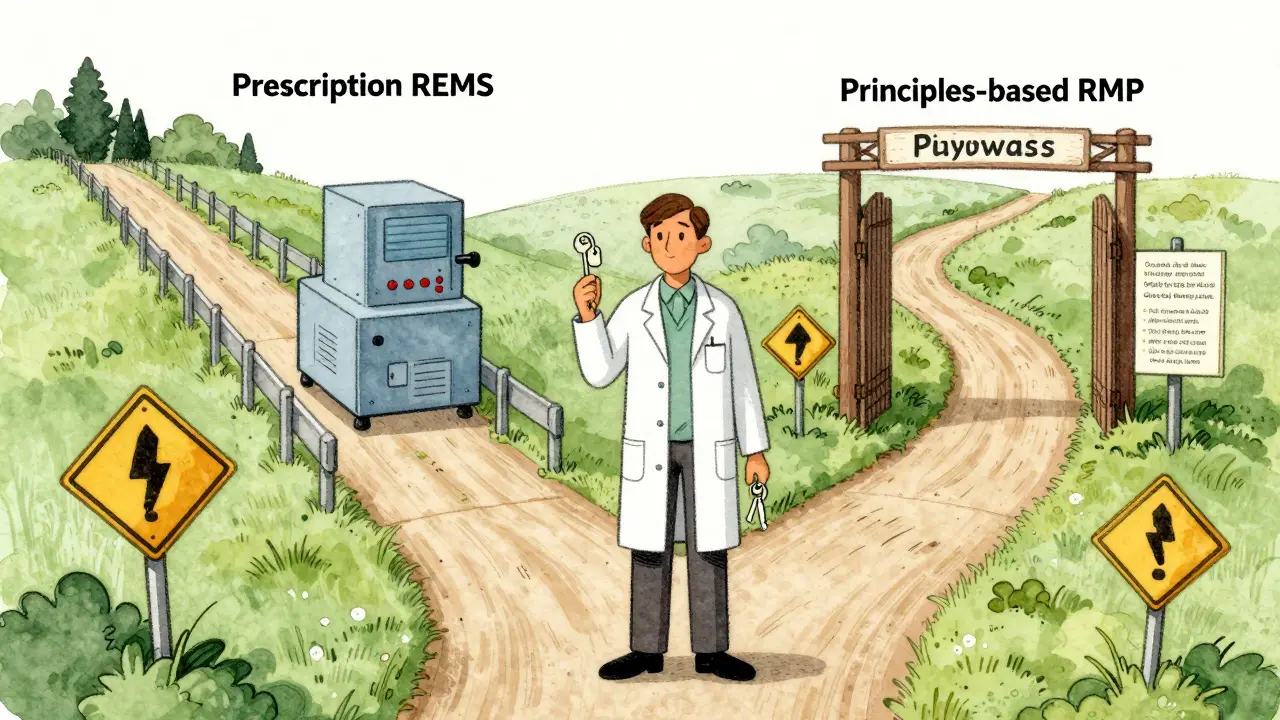
One of the most practical differences for manufacturers lies in how risks are managed after approval. The FDA utilizes Risk Evaluation and Mitigation Strategies (REMS), which are prescriptive and often require specific implementation systems. These can include mandatory training for healthcare providers, restricted distribution networks, or patient registries. If a drug carries significant risk, the FDA mandates a concrete plan to mitigate it before it reaches the shelf.
The EMA, conversely, relies on Risk Management Plans (RMPs). As documented by Biomapas (2023), RMPs are more principles-based and flexible. They outline potential risks and propose measures to minimize them, but they don't always demand the rigid infrastructure required by a REMS. For a pharmaceutical company, this means designing two different operational models for post-market surveillance. A drug might need a complex, costly REMS program in the U.S., while operating under a lighter-touch RMP in Europe. This divergence complicates global supply chains and increases compliance costs, with industry estimates suggesting dual submissions require roughly 30% more documentation effort.
| Feature | FDA (United States) | EMA (Europe) |
|---|---|---|
| Primary Tool | REMS (Risk Evaluation and Mitigation Strategies) | RMP (Risk Management Plan) |
| Nature | Prescriptive, mandatory systems | Principles-based, flexible execution |
| Implementation | Often requires specific infrastructure (e.g., restricted distributors) | Focuses on proposed mitigation measures |
| Regulatory Basis | FDAAA 2007 Amendments | EU Pharmacovigilance Legislation |
Pregnancy, Lactation, and Patient-Centric Data
The way safety information is communicated to patients and providers reveals deep cultural and regulatory divides. Pregnancy labeling is a prime example. Historically, the FDA used letter categories (A, B, C, D, X), which were often misinterpreted. Although the FDA moved to narrative labeling to improve clarity, Kappel et al. (2023) found that significant differences remain. In some cases, the FDA may recommend against use during pregnancy due to conservative risk interpretation, while the EMA uses standard statements that allow for more nuanced clinical judgment. For drugs with human data, the agencies often communicate risk differently, impacting how doctors counsel expectant mothers.
Another area of divergence is Patient-Reported Outcomes (PROs). You might assume that if a patient feels better, both agencies would label it so. Surprisingly, an RTI Health Solutions analysis (2011) showed that 47% of products approved by both agencies received at least one PRO claim from the EMA, compared to only 19% from the FDA. Only 11% had identical claims. The EMA appears more willing to incorporate subjective patient experiences into the official label, whereas the FDA traditionally prioritizes objective clinical endpoints. This matters because PRO claims can influence prescribing habits and patient expectations significantly.
The Language Barrier and Operational Complexity
Let’s talk about logistics. The FDA accepts submissions solely in English. The EMA requires all labeling to be translated into all 24 official EU languages. This isn’t just a translation job; it’s a regulatory hurdle. EC Innovations (2022) notes that while both agencies use the electronic Common Technical Document (eCTD) format, the regional specifications differ. Mabion (2023) estimates that multilingual labeling increases development costs by 15-20% compared to FDA-only submissions. For smaller biotech firms, this cost burden can be prohibitive, potentially limiting access to the European market for niche therapies.
This complexity extends to vaccine labeling. Seo et al. (2020) analyzed 12 vaccines approved by both agencies between 2006 and 2018 and found little to no harmonization over time. Comparing CDC Vaccine Information Statements (VISs) to EMA Product Labels (PLs) showed even less alignment. Despite the global nature of pandemics and the urgent need for standardized communication, the labeling elements remained distinct. This lack of pattern challenges the assumption that international crises naturally drive regulatory convergence.

Harmonization Efforts: Progress or Illusion?
You’ve likely heard of the International Council for Harmonisation (ICH). Established to unify technical requirements, the ICH has made strides, particularly with guidelines like E17 on multi-regional clinical trials. Yet, experts argue that true labeling harmonization remains elusive. Dr. Yurim Seo concluded that "no pattern was observed in the number of labeling elements harmonized over time." Why? Because legal frameworks and societal risk tolerances differ. The U.S. has a litigious environment that drives the FDA toward explicit, defensive labeling. Europe, with its socialized healthcare systems, often emphasizes broader public health considerations and proportionality in risk communication.
However, cooperation is evolving. The FDA-EMA Confidentiality Commitment Agreement, renewed in 2020, has facilitated greater information sharing. Joint scientific advice procedures increased by 47% between 2018 and 2022, according to EFPIA. This suggests a shift toward parallel reviews rather than independent silos. Emerging technologies, such as AI in pharmacovigilance, may further accelerate this process. Both agencies have issued similar positions on AI/ML-enabled tools, indicating a shared vision for the future of regulatory science. Deloitte’s 2023 Life Sciences Regulatory Outlook predicts a "persistent but narrowing gap," suggesting that while complete harmonization is unlikely, the friction will decrease.
Strategic Implications for Pharmaceutical Companies
So, what should you do if you’re developing a drug for both markets? First, abandon the hope of a "one-size-fits-all" label. Instead, adopt a dual-track strategy from day one. Engage with both agencies early through pre-submission meetings. Understand that the FDA may demand more complete data packages upfront, while the EMA might offer faster initial approval with longer-term post-marketing commitments. Second, invest in regulatory intelligence. PwC (2022) reports that 65% of companies now employ dedicated teams to navigate these differences. These teams help identify when a surrogate endpoint acceptable to the EMA might need additional validation for the FDA, or vice versa.
Finally, consider the economic impact. With the U.S. representing 45% of global prescription drug sales and the EU 25%, missing either market is costly. IMS Institute data shows labeling differences contribute to an average 18-month delay in EU market access compared to the U.S. for novel therapeutics. By proactively addressing labeling discrepancies-such as preparing multiple language versions and designing flexible risk management plans-you can mitigate delays and protect revenue streams. The goal isn’t just compliance; it’s strategic agility in a fragmented regulatory landscape.
Why do EMA and FDA labels differ for the same drug?
Labels differ primarily due to distinct legal frameworks, cultural attitudes toward risk, and independent interpretation of clinical data. The FDA operates under U.S. federal law with a focus on explicit risk mitigation, while the EMA coordinates across EU member states with a more flexible, principles-based approach. Even when using identical trial data, the agencies may draw different conclusions about efficacy strength or safety profiles.
What is the difference between REMS and RMP?
REMS (Risk Evaluation and Mitigation Strategies) is the FDA’s tool for managing serious risks, often requiring specific systems like restricted distribution or provider certification. RMP (Risk Management Plan) is the EMA’s equivalent, which is more flexible and focuses on proposing measures to minimize risks without mandating rigid infrastructure. REMS is generally more prescriptive and operationally intensive.
Does the EMA approve drugs faster than the FDA?
The EMA often has higher first-cycle approval rates (92% vs. FDA’s 85%) and may grant conditional approvals under exceptional circumstances. However, this doesn’t necessarily mean faster overall market access, as post-marketing requirements and language translation delays can offset initial speed. The FDA typically demands more comprehensive data upfront, leading to fewer initial rejections but potentially longer review times for complex dossiers.
How do pregnancy labeling differences impact patients?
Pregnancy labeling varies significantly, with the FDA often taking a more conservative stance based on historical risk aversion, while the EMA may provide more nuanced statements allowing for clinical judgment. These differences can lead to variations in how doctors counsel pregnant women, potentially affecting treatment choices and outcomes depending on the country of residence.
Will EMA and FDA labeling ever fully harmonize?
Complete harmonization is unlikely due to fundamental differences in legal structures and societal values. However, the gap is narrowing through initiatives like the ICH and increased information sharing via the FDA-EMA Confidentiality Commitment Agreement. Experts predict continued convergence in technical areas, but persistent divergence in risk communication and indication scope will remain.