
Generic Copays vs Brand Copays: Average 2024 Costs Explained
 Dec, 6 2025
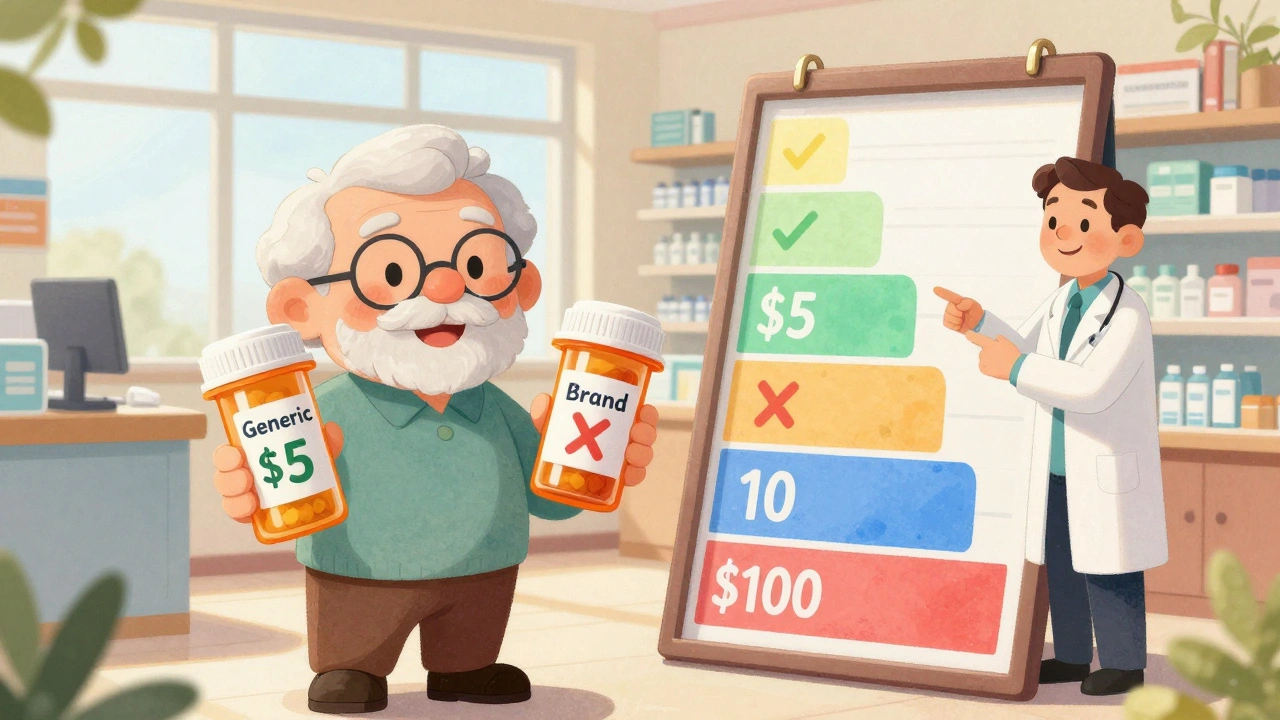
When you pick up a prescription, the price you pay at the counter isn’t the full cost of the drug. It’s your copay - the fixed amount you owe before insurance kicks in. But here’s the thing: if you’re taking a generic drug, you might pay $5. If you’re taking the brand-name version of the same medicine, you could pay $100. That’s not a typo. In 2024, the difference between generic and brand copays isn’t just noticeable - it’s life-changing for millions of people on Medicare and private insurance.
How Copay Tiers Work in 2024
Most prescription drug plans in the U.S. use a tiered system. Think of it like a pricing ladder. The lower the tier, the cheaper the drug. In 2024, you’ll typically see four or five tiers:- Tier 1: Preferred Generic - These are the cheapest. Often $0 to $5.
- Tier 2: Non-Preferred Generic - Slightly more expensive, usually $7 to $10.
- Tier 3: Preferred Brand - Brand-name drugs your plan encourages. Copays range from $40 to $50.
- Tier 4: Non-Preferred Brand - The most expensive brand drugs. Copays hit $90 to $110.
- Tier 5: Specialty - For complex, high-cost drugs like those for cancer or MS. Copays can be $150 or more, or you pay a percentage of the total cost.
This system isn’t random. It’s designed to nudge you toward cheaper, equally effective options. A generic version of a brand drug has the same active ingredient, same dosage, same safety profile. But it costs 80% less to make. So insurers reward you for choosing it.
Average 2024 Copay Numbers
Here’s what people actually paid out of pocket in 2024, based on real Medicare and commercial plan data:| Drug Type | Average Copay (Medicare Part D) | Average Copay (Commercial Plans) |
|---|---|---|
| Preferred Generic | $4.50 | 10-20% of drug cost (often under $10) |
| Non-Preferred Generic | $7.00 | 15-25% of drug cost |
| Preferred Brand | $47 | 30-40% of drug cost |
| Non-Preferred Brand | $100 | 40-50% of drug cost |
These numbers aren’t guesses. They come from CMS, KFF, and Blue Cross Blue Shield plan documents. For example, if you’re on a Medicare Advantage plan and take a preferred brand like lisinopril (for blood pressure), you’ll likely pay $47 for a 30-day supply. But if you switch to the generic - which is chemically identical - you’ll pay $5. That’s $42 saved per month. Over a year, that’s over $500.
Medicare Advantage vs. Standalone Drug Plans
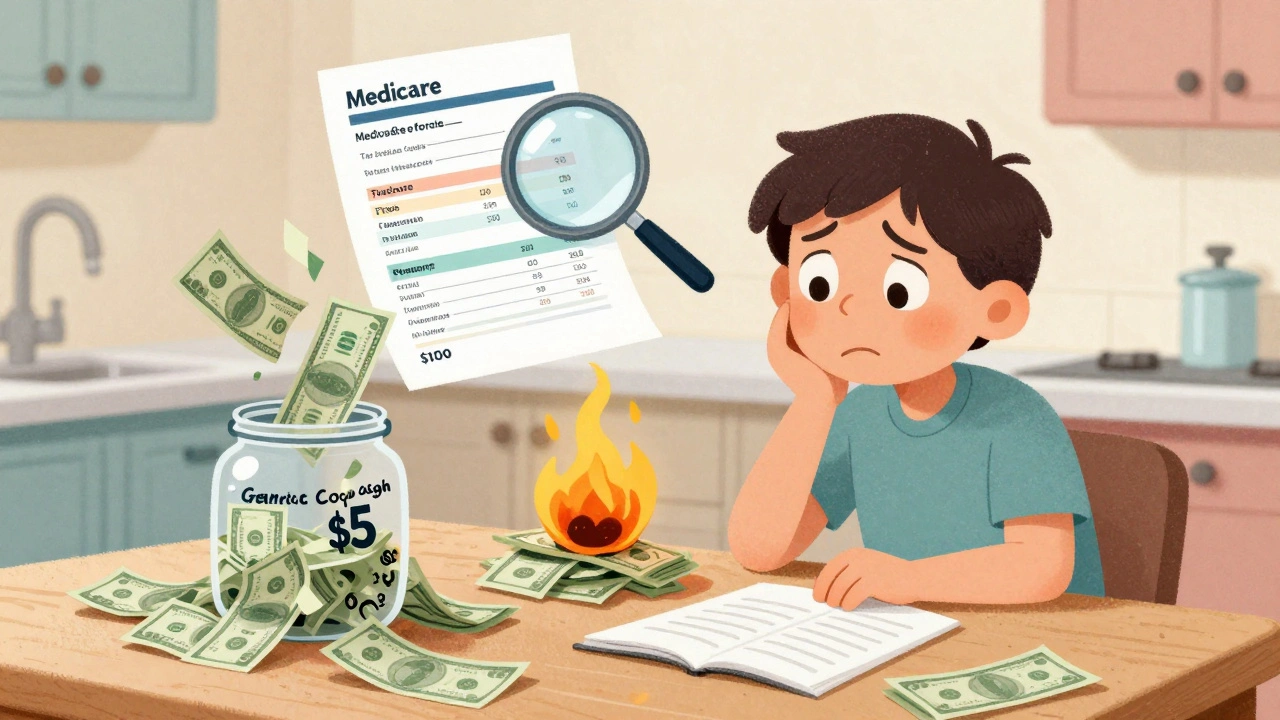
Not all plans work the same. If you’re on a Medicare Advantage plan (which bundles medical and drug coverage), you’re more likely to have fixed copays. That means you know exactly what you’ll pay each time you fill a prescription.But if you’re on a standalone Medicare Part D plan, you’re more likely to pay coinsurance - a percentage of the drug’s total cost. That can be dangerous. If your brand drug costs $300, and your coinsurance is 47%, you pay $141. That’s way more than the $100 fixed copay you’d pay on an Advantage plan.
Here’s the catch: Medicare Advantage plans often have tighter networks and stricter rules. You might need prior authorization just to get a brand drug approved. Standalone plans give you more flexibility - but less predictability in cost.
What Happens When You Choose Brand Over Generic?
Some people think, “My doctor prescribed the brand, so it must be better.” But that’s not always true. In 2024, 72% of Medicare plans offered a preferred generic alternative for at least 80% of commonly prescribed brand drugs.Still, sometimes you can’t switch. Maybe the generic gives you a rash. Maybe your body reacts differently. That’s when things get expensive - and confusing.
Some commercial plans have a “Member Pay the Difference” rule. Here’s how it works: if your plan covers a generic version of your drug, but your doctor writes “dispense as written” for the brand, you don’t just pay your normal copay. You pay your copay plus the full price difference between the brand and the generic.
Example: Your generic atorvastatin costs $12. The brand Lipitor costs $120. Your copay for brand drugs is $42. But under “Member Pay the Difference,” you pay $42 + ($120 - $12) = $150. That’s $108 extra just because your doctor didn’t change the script.
People on Reddit and Medicare forums are furious about this. One user wrote: “I paid $95 for a brand drug that had a $15 generic. My doctor said I couldn’t switch - but my plan made me pay $80 extra on top of my copay.”
Extra Help and Low-Income Savings
If your income is low, you might qualify for Medicare’s Extra Help program. In 2024, this program capped your copays at:- $4.50 for generic drugs
- $11.20 for brand drugs
That’s a massive difference from the standard $100 copay. And if you’re on Extra Help, you don’t face the coverage gap - you’re protected from high costs all year.
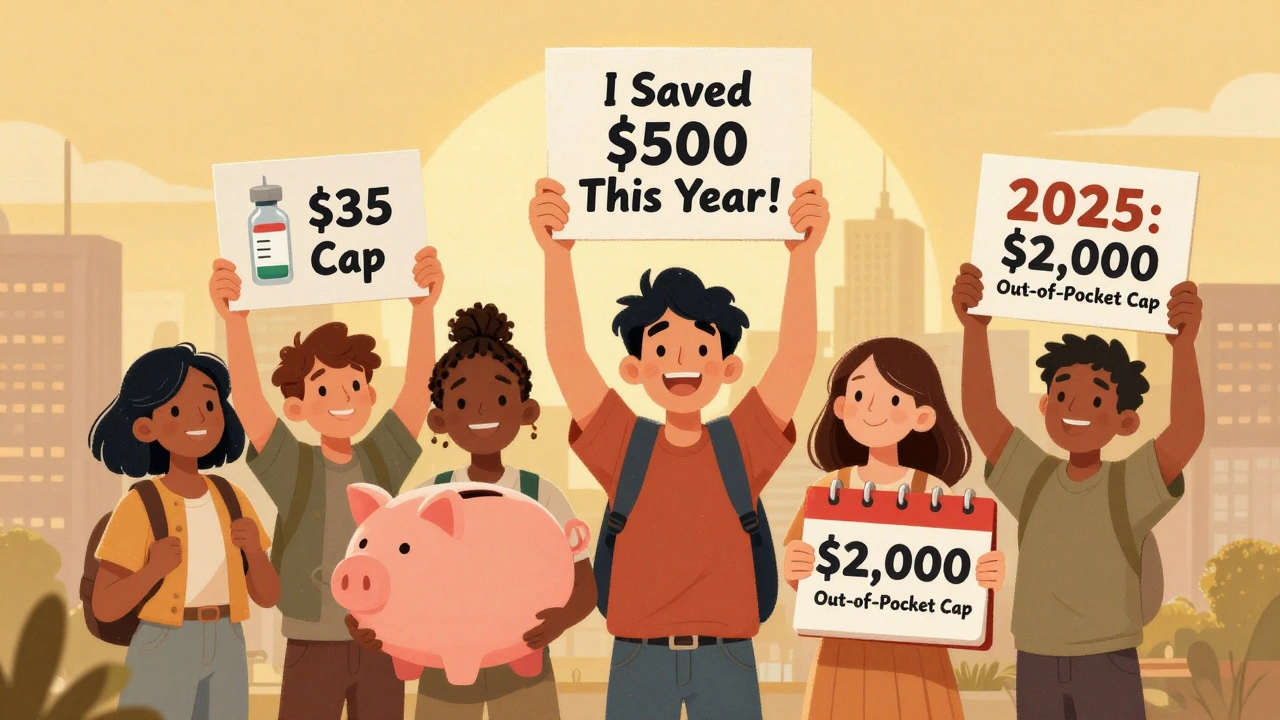
Even if you don’t qualify for Extra Help, the Inflation Reduction Act capped insulin at $35 per month - no matter if it’s generic or brand. That change alone saved millions of people over $100 a month.
What’s Changing in 2025?
The biggest shift is coming in 2025. The Inflation Reduction Act is capping total out-of-pocket drug spending at $2,000 per year - no matter how many brand drugs you take. That’s a game-changer.Right now, people who need expensive medications can hit catastrophic coverage after spending $8,000. Then they pay 5% coinsurance. But in 2025, once you hit $2,000, your drug costs drop to $0 for the rest of the year.
Also, 98% of Medicare Part D plans in 2025 will offer $0 copays for preferred generics. That’s up from 87% in 2024. The message is clear: insurers are pushing generics harder than ever.
How to Save Money Right Now
You don’t have to wait for 2025 to save. Here’s what to do today:- Check your plan’s formulary - It’s online. Search for your exact drug. Look at the tier. If it’s Tier 4, ask your doctor if there’s a Tier 1 or 2 alternative.
- Use the Medicare Plan Finder - Enter your drugs, zip code, and pharmacy. It shows you which plan gives you the lowest total cost for the year.
- Ask about cash prices - Sometimes, paying cash at Walmart or Costco is cheaper than your copay. A 30-day supply of metformin might cost $10 cash but $15 with insurance.
- Call your pharmacy - Ask if they can switch you to a different generic brand. Not all generics are priced the same.
- Consider a plan review - A Medicare counselor can save you $400+ a year. It costs $75-$150, but the savings usually pay for it.
Why This Matters
In 2024, 92.7% of all prescriptions filled in the U.S. were generics. But those generics made up only 17% of total drug spending. The other 83%? That’s brand-name drugs. That’s not because brand drugs are better. It’s because people don’t know the difference - or they’re stuck with them.One survey found 63% of people taking brand drugs struggled to afford them. Only 28% of people on generics had the same problem.
It’s not about choosing between cheap and effective. It’s about choosing between cheap and equally effective. And when you do, you’re not just saving money - you’re keeping your health on track.
Why are brand name drugs so much more expensive than generics?
Brand name drugs cost more because the manufacturer paid for research, clinical trials, and marketing to get FDA approval. Once the patent expires, other companies can make the same drug without those costs. Generics don’t need to repeat expensive studies - they just prove they work the same way. That’s why they’re 80-90% cheaper.
Can I switch from a brand drug to a generic without asking my doctor?
Your pharmacist can usually substitute a generic unless your doctor wrote “dispense as written” or “no substitution.” Even then, you can call your doctor and ask if a switch is safe. Most doctors are open to it - especially if it saves you hundreds a year.
What if my generic gives me side effects?
Not all generics are identical in how they’re made. Some use different fillers or coatings. If you notice new side effects, talk to your doctor. They can request a specific generic brand or stick with the brand. You can also ask your pharmacist if another generic version might work better.
Do all insurance plans have the same copay structure?
No. Medicare Advantage plans usually have fixed copays. Standalone Part D plans often use coinsurance. Commercial plans vary widely - some use copays, others use percentages, and some add “pay the difference” fees. Always check your plan’s formulary before filling a prescription.
Is it worth switching plans just to save on copays?
Yes - if you take regular medications. A plan with a $0 generic copay and a $40 brand copay can save you over $600 a year compared to a plan with $10 generics and $100 brands. Use the Medicare Plan Finder tool. Enter your drugs and pharmacy. It shows you the real annual cost - not just the monthly premium.
What to Do Next
If you’re on Medicare, open your plan’s formulary PDF right now. Look up your top three medications. Write down their tiers and copays. Then search for the generic version. If the generic is on a lower tier, talk to your doctor. If you’re on private insurance, call your pharmacy and ask: “What’s the cash price for this generic?” Often, it’s cheaper than your copay.Don’t assume your prescription is set in stone. In 2024, the system is designed to reward smart choices. You just have to make them.
Olivia Hand
December 7, 2025 AT 00:29I had no idea generics were this cheap. I’ve been paying $47 for lisinopril for years, thinking it was the only option. Switched to generic last month-$5. I cried. Not because I was sad, but because I realized I’d been overpaying for a chemical identical to the brand. My pharmacist didn’t even mention it. Why? Because they get paid the same either way.
Insurers aren’t helping us-they’re just letting us wander blind through a pricing maze. And then they pat themselves on the back for ‘cost containment.’
Desmond Khoo
December 7, 2025 AT 22:22YESSSS this is the kind of post I need to see 😭💸
Just switched my dad to generic metformin-he’s been on brand for 8 years because ‘he’s always taken it.’ Now he’s saving $120/month. He’s mad he didn’t know sooner, but also kinda proud he’s a ‘generic warrior.’
PS: Walmart cash price for 90-day supply? $10. My insurance copay was $28. Wtf.
🙏🙏🙏
Louis Llaine
December 9, 2025 AT 19:53Wow. A post that doesn’t just say ‘switch to generic’ like it’s some moral victory. Real talk: this system is rigged. You’re not ‘saving money’-you’re being nudged like a lab rat pressing a lever for a pellet.
And don’t get me started on ‘Member Pay the Difference.’ That’s not a policy. That’s a trapdoor labeled ‘We Know You’re Too Tired to Fight Us.’
Also, why does every article on this topic ignore the fact that generics are sometimes made in the same factory as the brand? Same machine. Same chemist. Different label. $115 difference. 🤡
Jane Quitain
December 10, 2025 AT 19:54OMG I JUST REALIZED I’M PAYING $100 FOR A DRUG THAT COSTS $5 AS A GENERIC 😭 I’M SO SORRY TO MYSELF I’VE BEEN SO STUPID
but like… i’m gonna do better! i’m gonna call my doc tomorrow and ask for the generic and maybe even check cash prices!! i believe in me!! 💪💖
also i think we should all be more aware and share this with our families!! we can do this together!! 🌈
Kyle Oksten
December 12, 2025 AT 09:58This isn’t just about drug pricing-it’s about the erosion of patient autonomy under the guise of cost efficiency. The tiered system doesn’t empower choice; it coerces compliance.
There’s a moral hazard here: when insurers profit from steering patients toward cheaper alternatives, the line between fiscal responsibility and medical paternalism blurs. The fact that 72% of plans offer generic alternatives doesn’t mean patients are informed. It means the system is optimized to exploit ignorance.
And yet, the real injustice isn’t the price gap-it’s that the burden of navigating this labyrinth falls entirely on the sick, the elderly, the overworked, the under-resourced. The system doesn’t fail us because it’s broken. It fails us because it was never designed to help.
Knowledge is power. But power without access is just a cruel joke.
Sam Mathew Cheriyan
December 12, 2025 AT 15:52wait hold up… what if generics are secretly made by the same companies that make the brand drugs? like… what if big pharma just rebrands the same pill as ‘generic’ to make more money??
i heard on a forum that Pfizer owns like 80% of all ‘generic’ pills. they just change the color and call it ‘metformin’ and charge $5… but the real brand? that’s the one they want you to buy because they get the profit.
so… we’re being played. the whole thing is a scam. the ‘savings’ are just a trick to make you feel good while they still get paid the same.
they even put different fillers in generics to make you feel side effects so you go back to the brand. it’s all psychology. i’m not switching.
also… the government is in on it. they’re paid off.
jk… maybe. 🤔
Ernie Blevins
December 12, 2025 AT 23:58Everyone’s acting like this is some big revelation. It’s not. It’s capitalism.
People pay $100 because they’re lazy. They don’t want to call their doctor. They don’t want to look up the formulary. They just want the pill they’ve always had.
And guess what? That’s on them. The system isn’t broken. People are.
Also, if you can’t afford $100, you shouldn’t be on the drug. There are charities. There are coupons. There’s Medicaid. Stop whining.
Also, generics are sometimes slower to work. Don’t pretend they’re identical. I’ve seen people crash because they switched. You think that’s worth $95?
Stacy here
December 13, 2025 AT 21:36Okay, but let’s talk about the real elephant in the room-why does Big Pharma get to charge $300 for a drug that costs $2 to make? And why do we let them?
This isn’t about generics vs. brand. This is about a system that turns medicine into a commodity. We treat health like a luxury. We let CEOs buy yachts while grandmas ration pills.
And now they’re capping out-of-pocket costs at $2,000? That’s not a win. That’s damage control after 20 years of exploitation.
They’re not saving us. They’re just trying to keep us alive long enough to keep paying premiums.
I’m not grateful for crumbs. I’m angry for the decades we lost.
And if you think this is just about copays… you’re not looking deep enough.
They own the patents. They own the media. They own your doctor’s continuing education. And now they own your hope.
Who’s next? Your insulin? Your cancer drug? Your mental health med?
Wake up. We’re not patients. We’re revenue streams.