
Hemodialysis vs. Peritoneal Dialysis: What You Need to Know
 Dec, 7 2025
When your kidneys fail, you don’t have many options. Dialysis becomes your lifeline. Two main types exist: hemodialysis and peritoneal dialysis. Both do the same job-clean your blood when your kidneys can’t-but they do it in completely different ways. Choosing between them isn’t just about medical facts. It’s about your lifestyle, your body, and what you can handle day to day.
How Hemodialysis Works
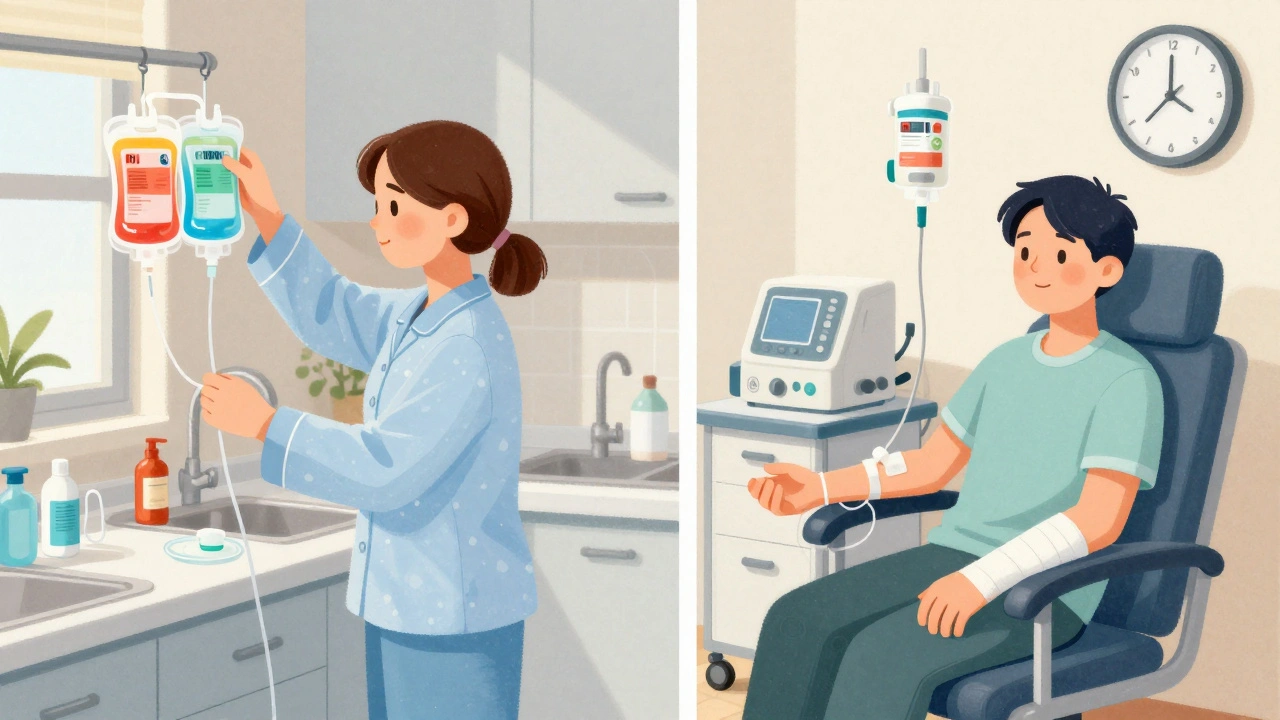
Hemodialysis uses a machine to filter your blood outside your body. Think of it like an artificial kidney. During treatment, your blood flows through tubes into a dialyzer-a filter that removes waste, extra salt, and fluid. Then it’s returned to your body. This happens in a clinic, usually three times a week, for about 3 to 5 hours each session.To make this work, doctors need a way to get your blood out and back in. That’s where vascular access comes in. The best option is an arteriovenous (AV) fistula-a direct connection between an artery and a vein, usually in your arm. It takes 6 to 8 weeks to mature before it can be used. If that’s not possible, a graft or a central venous catheter might be used instead. Catheters are faster to set up but carry higher infection risks.
Most people on hemodialysis feel drained after treatment. It’s common to feel tired, nauseous, or crampy. That’s because the machine pulls fluid and toxins out fast. Your body doesn’t get time to adjust. Blood pressure can drop sharply during sessions, especially if you’ve gained a lot of fluid between treatments.
How Peritoneal Dialysis Works
Peritoneal dialysis uses your own belly lining-the peritoneum-as a natural filter. A soft tube called a Tenckhoff catheter is surgically placed in your abdomen. Through this tube, a special fluid called dialysate is introduced. It sits in your belly for 4 to 6 hours, drawing out waste and extra fluid through your peritoneal membrane. Then you drain it out.There are two types: Continuous Ambulatory Peritoneal Dialysis (CAPD) and Automated Peritoneal Dialysis (APD). CAPD is done by hand, usually 3 to 5 times a day. You connect a bag of fluid, let it sit, then drain it. APD uses a machine (a cycler) that does the exchanges while you sleep. Many people prefer APD because it frees up their daytime.
Unlike hemodialysis, peritoneal dialysis runs continuously. That means fewer spikes and crashes in your body. Blood pressure tends to stay more stable. Potassium and fluid build up less between treatments. Studies show PD patients often have better control over these numbers than those on hemodialysis.
Which One Is More Effective?
It’s easy to think one is simply better. But the truth is more nuanced.Hemodialysis clears toxins faster in a single session. Its Kt/V (a measure of dialysis efficiency) per treatment is 1.2 to 1.4. Peritoneal dialysis clears less per exchange, but because it runs 24/7, the weekly Kt/V reaches 1.7 to 2.1-comparable to hemodialysis over time.
A 2023 study from the National Center for Biotechnology Information tracked 77 PD patients and 74 HD patients. The PD group had significantly lower blood pressure, better heart rate stability, and fewer complications overall. They also kept more of their own kidney function longer. That’s important. Even a little leftover kidney function improves survival and quality of life.
But PD isn’t perfect. It’s slower at removing large toxins. It can’t handle sudden fluid overload like severe heart failure or acute kidney injury. That’s why hemodialysis is often chosen for emergencies or very unstable patients.

Who Is a Better Candidate for Each?
Not everyone can do both. Your body, your lifestyle, and your health history matter.Peritoneal dialysis works best for people who are:
- Medically stable
- Want to avoid frequent clinic visits
- Have good manual dexterity (to handle bags and tubing)
- Have no major abdominal scarring or hernias
- Can manage sterile technique daily
It’s not ideal for people with:
- BMI over 35 (too much belly fat makes fluid flow harder)
- History of multiple abdominal surgeries
- Severe arthritis or tremors that make handling equipment difficult
Hemodialysis is often chosen for:
- Patients with advanced heart disease or unstable blood pressure
- Those who can’t or don’t want to manage daily treatments
- People with limited space at home for dialysis supplies
- Those with cognitive impairments or who need help from caregivers
Age alone isn’t a barrier. Many older adults do well on either option. But if you’re frail or live alone, having a trained professional handle your dialysis might feel safer.
Quality of Life and Daily Impact
This is where the real difference shows up.People on peritoneal dialysis often say they feel more in control. They can work, travel, or sleep in their own bed. No fixed clinic schedule. No need to block out 15 hours a week for appointments. One patient in the UK told me, “I do my exchanges while watching TV. I don’t miss work.”
But PD comes with its own stress. Every day, you’re handling tubes, bags, and sterile procedures. One slip-up can lead to peritonitis-an infection in your belly. About 0.3 to 0.7 episodes happen per patient per year. That’s not rare. It’s a real risk. And the catheter stays in forever. You can’t just forget it’s there.
Hemodialysis patients often complain about the schedule. “I feel wiped out for hours after,” said one Reddit user. Another said, “I can’t change my job because I need to be at the clinic on Tuesdays, Thursdays, and Saturdays.”
But once you’re done, you’re done. No more dialysis until next time. No daily cleaning. No constant fear of infection. You hand it off to the nurses.
Cost, Access, and Global Differences
In the U.S., about 70% of dialysis patients are on hemodialysis. Only 12% use peritoneal dialysis. That’s not because PD is worse. It’s because the system was built around clinics. Hospitals, insurance, and training programs all focus on in-center care.But that’s changing. The UK has a 22% PD rate. Hong Kong? 77%. Why? Because those places train doctors in PD, reimburse it well, and encourage home therapies. In the U.S., only 34% of nephrology fellows get proper PD training. That means many doctors don’t feel confident offering it.
Cost-wise, PD is cheaper. Fewer clinic visits, less staffing, less equipment. A 2023 study in the Journal of Peritoneal Therapy and Clinical Practice found PD offers better value for money and higher early patient satisfaction. The Centers for Medicare & Medicaid Services now push for home dialysis or transplant education for 80% of new patients by 2025. That’s a big shift.
Technologies are improving too. New dialysate fluids with icodextrin last longer and don’t damage the peritoneum like older glucose-based solutions. Cycler machines are quieter, smaller, and easier to use.
What Happens After You Start?
Starting either type means learning a new routine.For hemodialysis, you’ll need to:
- Stick to fluid and diet limits between sessions
- Protect your vascular access-no blood pressure checks or IVs on that arm
- Watch for signs of infection at the access site
For peritoneal dialysis, you’ll need to:
- Learn sterile technique-handwashing, mask use, clean workspace
- Store dialysate bags properly (cool, dry, away from pets)
- Track your exchanges and fluid output daily
- Recognize early signs of peritonitis: cloudy fluid, belly pain, fever
Training for PD takes 10 to 14 days. You’ll practice with a nurse until you’re confident. It’s intense. But once you’re trained, you’re independent.
Many patients switch modalities over time. Someone might start with hemodialysis because they’re too sick for PD, then move to PD later. Or a PD patient might switch to HD after repeated infections. It’s not a life sentence.
Final Thoughts: It’s Personal
There’s no single best dialysis. The right choice depends on you.If you value freedom, independence, and steady daily rhythms-PD might be your fit. You’ll need discipline, good hands, and a clean home environment.
If you prefer someone else to handle the machines, hate daily routines, or have unstable health-hemodialysis might feel safer. But you’ll trade flexibility for structure.
The goal isn’t to pick the most popular option. It’s to pick the one that lets you live your life-with the least disruption, the fewest complications, and the most dignity.
Ask your nephrologist: “Which option gives me the best chance to stay healthy and keep doing the things I love?” Don’t settle for the default. You have a voice in this.
ian septian
December 8, 2025 AT 19:24Chris Marel
December 10, 2025 AT 07:48Elliot Barrett
December 10, 2025 AT 21:51Ajit Kumar Singh
December 12, 2025 AT 07:44Maria Elisha
December 13, 2025 AT 11:20Lisa Whitesel
December 15, 2025 AT 08:02Larry Lieberman
December 17, 2025 AT 00:16Sabrina Thurn
December 17, 2025 AT 10:56Simran Chettiar
December 19, 2025 AT 07:00Richard Eite
December 20, 2025 AT 03:57Katherine Chan
December 20, 2025 AT 16:01Shubham Mathur
December 22, 2025 AT 00:48