
How Generic Drugs Are Made: The Manufacturing Process Explained
 Apr, 26 2026
Ever wondered why some medications cost a fortune while others, with the exact same name on the label, are incredibly cheap? The secret isn't that the cheaper ones are "watered down" or lower quality. It's all about the path they take to get to your pharmacy shelf. While a brand-name drug spends a decade in labs and costs billions to develop, a generic version focuses on one thing: proving it does the exact same job for a fraction of the price.
Getting a generic drugs manufacturing operation off the ground is a high-stakes game of reverse engineering. It's not as simple as copying a recipe; it's about matching the biological performance of a drug in the human body without having to repeat the massive clinical trials the original creator already did. If you've ever wondered how a company can launch a version of a blockbuster drug so quickly after a patent expires, it all comes down to a specific regulatory shortcut called the ANDA.
| Feature | Brand-Name Drug | Generic Drug |
|---|---|---|
| Development Time | 10-15 Years | 3-4 Years |
| Average Cost | ~$2.6 Billion | $5-10 Million |
| Regulatory Path | NDA (New Drug Application) | ANDA (Abbreviated NDA) |
| Clinical Trials | Extensive (Phases I, II, III) | Bioequivalence Studies |
The Blueprint: Reverse Engineering the Reference Drug
Before a single pill is pressed, manufacturers start with the Reference Listed Drug (RLD), which is the brand-name version currently on the market. Think of this as the gold standard. The goal is to create a "therapeutic equivalent," meaning the generic must have the same active ingredient, strength, dosage form, and route of administration.
This process starts with deep chemical analysis. Scientists break down the RLD to identify the Active Pharmaceutical Ingredient (API)-the part of the medicine that actually treats the condition. However, a pill isn't just pure medicine; it contains inactive ingredients called excipients, like binders, fillers, and coatings, that ensure the drug dissolves at the right time and stays stable on the shelf.
Manufacturers use a framework called Quality by Design (QbD). Instead of just testing the final product and hoping for the best, they identify "Critical Quality Attributes" (CQAs). These are the specific characteristics, like how fast a tablet dissolves in the stomach, that directly impact whether the patient gets better. If a manufacturer misses a critical material attribute-like using a lactose filler with the wrong particle size-the whole batch could fail a dissolution test, meaning the drug doesn't enter the bloodstream fast enough to work.
Step-by-Step: The Physical Manufacturing Process
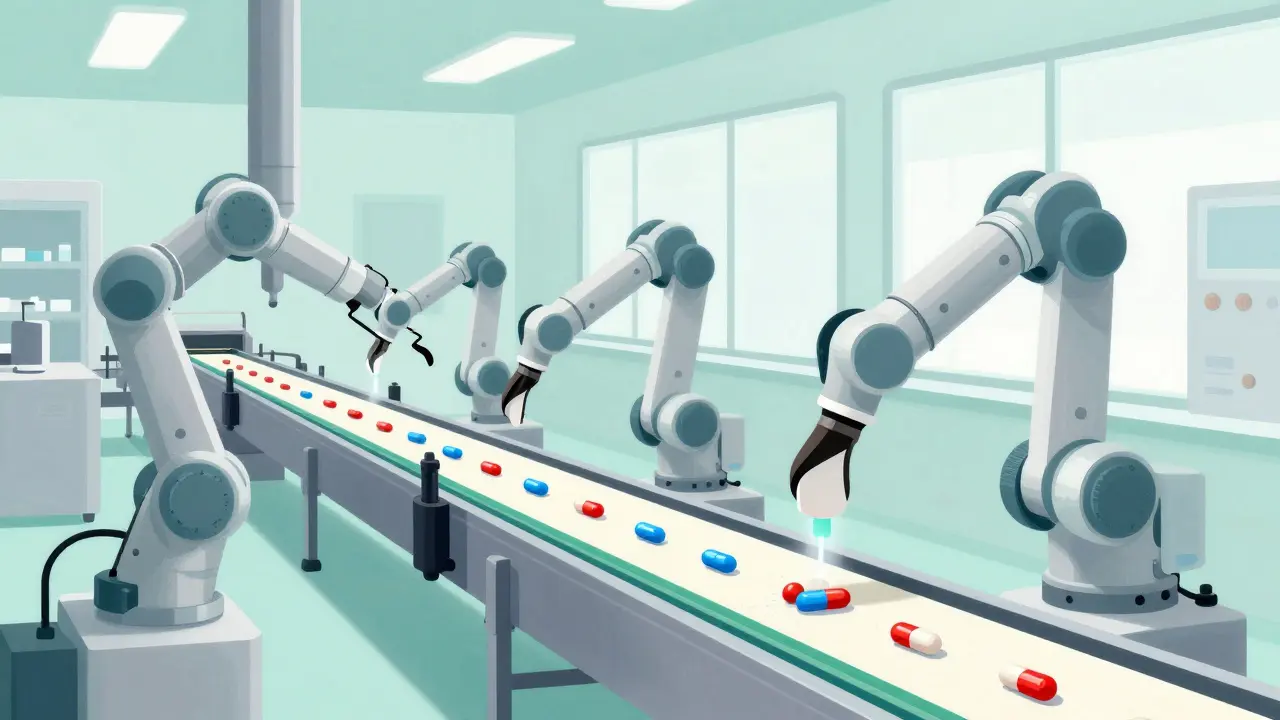
Once the formula is locked in, the actual production moves into highly controlled environments known as ISO Class cleanrooms. These spaces are strictly monitored for temperature (typically 20-25°C) and humidity to prevent the chemicals from degrading.
- Formulation: The API is precisely measured and mixed with the selected excipients. This is a delicate balance; too much binder and the pill won't dissolve; too little and it crumbles in the bottle.
- Mixing and Granulation: Raw powders are combined into a consistent mixture. Often, they are turned into small granules to ensure the API is evenly distributed across every single tablet.
- Drying: Moisture is removed to ensure the drug remains stable and doesn't grow bacteria or degrade chemically over time.
- Compression and Encapsulation: Dry granules are pressed into tablets using high-pressure machinery or filled into gelatin or cellulose capsules. The FDA is strict here: a tablet weighing less than 130mg cannot vary by more than ±5% in weight.
- Coating: A thin layer is applied to the tablet. This isn't just for color; coatings can protect the drug from stomach acid or mask a bitter taste.
- Quality Control (QC): This happens at every stage, not just the end. Technicians test for purity, strength, and identity.
- Packaging and Labeling: The drugs are sealed in blister packs or bottles. Interestingly, trademark laws prevent generics from looking exactly like the brand-name version, which is why your generic pill might be blue while the brand-name one is red.
Proving It Works: The Bioequivalence Hurdle
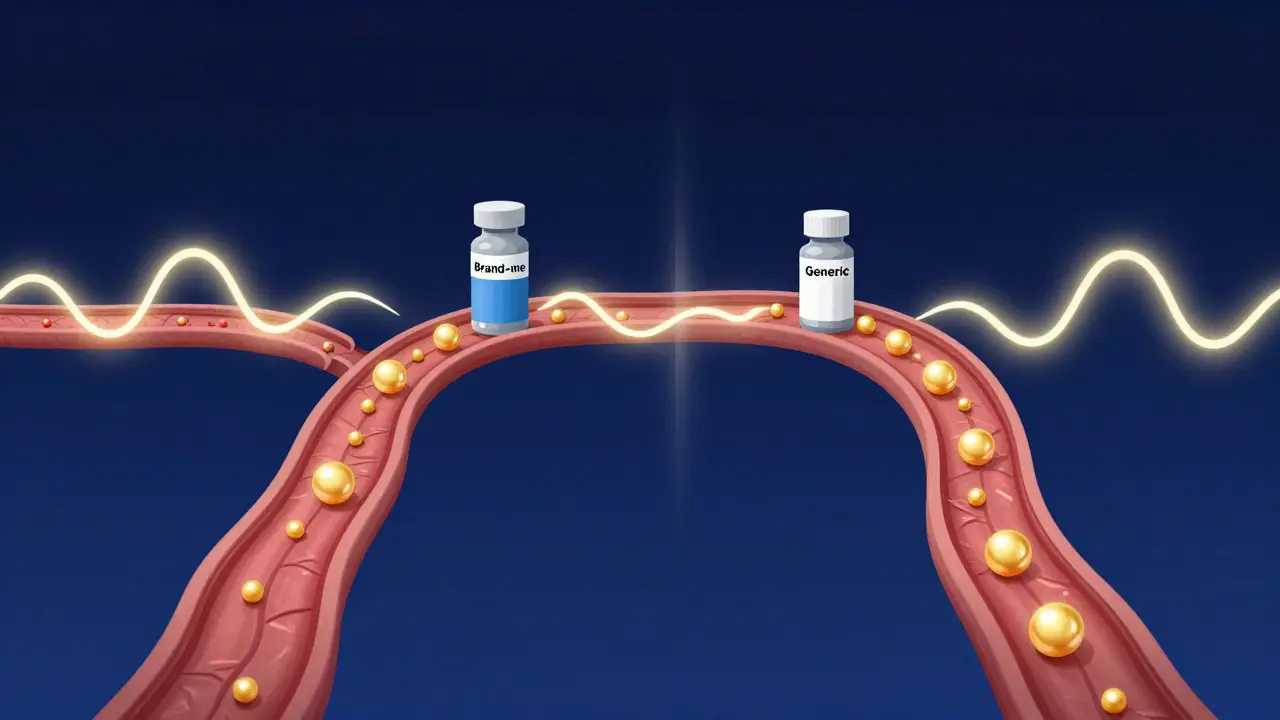
Because generic makers don't do full clinical trials, they use the Abbreviated New Drug Application (ANDA) pathway. The core of this application is Bioequivalence. This is the scientific proof that the generic drug delivers the same amount of active ingredient into the patient's bloodstream at the same rate as the brand-name drug.
To prove this, manufacturers conduct pharmacokinetic studies with a small group of healthy volunteers (usually 24-36 people). They measure two key metrics: the maximum concentration (Cmax) the drug reaches in the blood and the Area Under the Curve (AUC), which represents the total exposure to the drug over time. For the FDA to approve the generic, these values must fall within a strict 80% to 125% confidence interval of the brand-name product. If the generic hits the blood too fast or too slow, it fails, and the manufacturer has to go back to the formulation stage.
The Complexity Gap: Simple vs. Complex Generics
Not all generics are created equal. A simple tablet (like a standard pain reliever) is relatively easy to replicate. However, Complex Generics-such as inhalers, topical creams, or long-acting injections-are a different beast. These often require more than just a blood test to prove equivalence.
For a topical cream, for example, a manufacturer might spend years trying to match the skin permeation profile of the original. If the cream doesn't penetrate the skin at the exact same depth as the brand-name version, it won't be effective, even if the chemical composition is identical. Because of this difficulty, complex generics often have fewer competitors and higher prices than simple tablets, as the barrier to entry is much higher.
Maintaining Standards: CGMPs and Oversight
Quality isn't a one-time event; it's a continuous requirement. All facilities must follow Current Good Manufacturing Practices (CGMPs). This is a set of regulations enforced by the FDA to ensure that the drug is produced in a clean, controlled, and documented manner.
One of the biggest pitfalls in this process is "out-of-specification" (OOS) results. If a batch of medicine fails a purity test, the company can't just throw it away and start over. They are required to conduct a full investigation within 24 hours to figure out why it failed. Common failures often stem from poor process validation or a lack of oversight in the quality unit. This is why companies like Dr. Reddy's Laboratories implement massive training programs, requiring hundreds of hours of GMP training for staff to avoid costly recalls.
The Future of Making Medicine
The industry is currently moving away from "batch processing"-where you make one giant vat of medicine at a time-toward Continuous Manufacturing. In this model, raw materials are fed into a system that constantly produces the final product. This reduces production time from weeks to hours and significantly cuts down on human error. Some facilities have seen batch acceptance rates jump to 99.98% using this method.
We're also seeing the rise of AI in quality control. Instead of a human technician glancing at thousands of pills to find a cracked one, AI-driven visual inspection systems can spot defects with far greater accuracy, reducing errors by up to 40% in some pilot programs. These advancements, combined with the expiration of multi-billion dollar patents on drugs like Eliquis, mean that the pipeline for affordable medicine will only continue to grow.
Are generic drugs less effective than brand-name drugs?
No. By law, generic drugs must be bioequivalent to the brand-name product. This means they must deliver the same amount of active ingredient into the bloodstream at the same rate. While they can use different inactive ingredients (like colors or fillers), the therapeutic effect remains the same.
Why are generics so much cheaper?
Generic manufacturers don't have to pay for the initial research, development, and massive clinical trials that the original company funded. They skip the most expensive part of the process by using the ANDA pathway, allowing them to pass those savings (often 80-85%) to the consumer.
What is an ANDA application?
An Abbreviated New Drug Application (ANDA) is a request for the FDA to approve a generic drug. It is "abbreviated" because it doesn't require the original safety and efficacy data-it simply references the data from the brand-name drug and provides proof of bioequivalence.
Can generic drugs look different from the original?
Yes. In fact, U.S. trademark law prohibits generic drugs from looking exactly like the brand-name version. They can differ in color, shape, and flavoring, as long as the active ingredients and strength are identical.
What happens if a generic drug fails a quality test?
Under CGMP regulations, any result that falls outside the specified limits (out-of-specification) must be investigated within 24 hours. If the issue isn't resolved, the batch must be discarded. Serious or systemic failures can lead to FDA warning letters or product recalls.
What to do if you're switching to a generic
If you're moving from a brand-name medication to a generic, the most important step is to talk to your pharmacist. While the active ingredients are the same, the inactive excipients can differ. For a small number of people, a specific filler or dye in a generic version might cause a mild reaction or affect how they absorb the medication.
If you are taking a drug with a "narrow therapeutic index"-meaning a tiny change in dose can be dangerous-be extra vigilant. Note any changes in how you feel during the first two weeks of the switch. If you notice a difference, don't stop the medication; instead, ask your doctor if a different generic manufacturer's version might be a better fit for your body's chemistry.
Dale Kensok
April 28, 2026 AT 08:36The reductionist approach to bioequivalence is quaint, but let's be real about the pharmacokinetic volatility. Cmax and AUC are mere proxies for systemic efficacy; the real issue is the stochastic nature of excipient interaction in a non-homogenous biological environment. If you aren't accounting for the polymorphic stability of the API during the granulation phase, you're basically gambling with the dissolution rate. The industry's obsession with a 80-125% confidence interval is a regulatory convenience, not a scientific absolute. We're talking about complex solute-solvent dynamics that the ANDA process barely scratches the surface of. Most practitioners ignore the nuanced interplay between the API's crystalline form and the sheer force of compression during encapsulation. It's an ontological failure to assume that identical chemistry equals identical biological destiny. The shift to continuous manufacturing is a mere operational optimization, not a fundamental shift in pharmaceutical epistemology. We are essentially treating the human body as a static vessel rather than a dynamic chemical reactor. The jargon of 'Quality by Design' is often just a corporate shield to mask the inherent instability of mass-produced synthetics. It's an exercise in mediocrity masquerading as precision.
Sharon Mathew
April 28, 2026 AT 11:36Oh please! Like these 'equivalents' actually work the same way! I switched to a generic last year and I swear I could feel the difference in my veins immediately! It's absolutely outrageous that we just trust a 'confidence interval' with our lives!
lalit adesara
April 29, 2026 AT 06:05Indian pharma leads the world. Westerners just complain while we provide the actual medicine. Simple truth.
Angela Cook
April 30, 2026 AT 00:29Exactly! We need to stop relying on overseas plants and bring all this manufacturing back to American soil where we can actually trust the quality control!
Kali Murray
May 1, 2026 AT 13:44wow so cool i never knew about the colors 🌈 thanks for sharing ✨
Nigel Gosling
May 1, 2026 AT 13:55The sheer audacity of the pharmaceutical industry to charge billions for something that can be reverse-engineered in three years is a moral vacuum of epic proportions. It's a systemic theft of human health in the name of 'innovation' which is really just a code word for 'monopoly'. We are living in a dystopia where a patent is worth more than a patient's life. Truly tragic.
Raymond Lipanog
May 2, 2026 AT 06:38It is perhaps worth considering that the initial investment in research provides the very blueprint that allows generics to exist. There is a delicate balance between the necessity of affordable access and the requirement for incentive in scientific discovery.
Aubrey Johnson
May 2, 2026 AT 14:09The logic is sound. One should simply follow the data provided by the FDA.
Jenna Riordan
May 3, 2026 AT 07:05I bet the people making these just cut corners in the cleanrooms when the inspectors aren't looking. I've seen how these factories run in documentaries and it's honestly gross.
Trish Perry
May 4, 2026 AT 00:29It's wild how much the inactive stuff can actually change how you feel. It makes you realize the body is just one big chemical reaction.
Kat G
May 4, 2026 AT 20:10The information about the tablet weight is very interesting.