
How Pharmacists Prevent Prescription Medication Errors Every Day
 Jan, 3 2026
Every time you pick up a prescription, a pharmacist is quietly checking it-again and again-before it reaches your hands. Not because they don’t trust the doctor, but because medication errors are more common than most people realize. In the U.S. alone, over 1.5 million people are harmed by medication mistakes each year. But here’s the thing: pharmacists stop about 215,000 of those errors before they ever reach patients. That’s not luck. It’s training, systems, and relentless attention to detail.
The Final Check Before the Medicine Reaches You
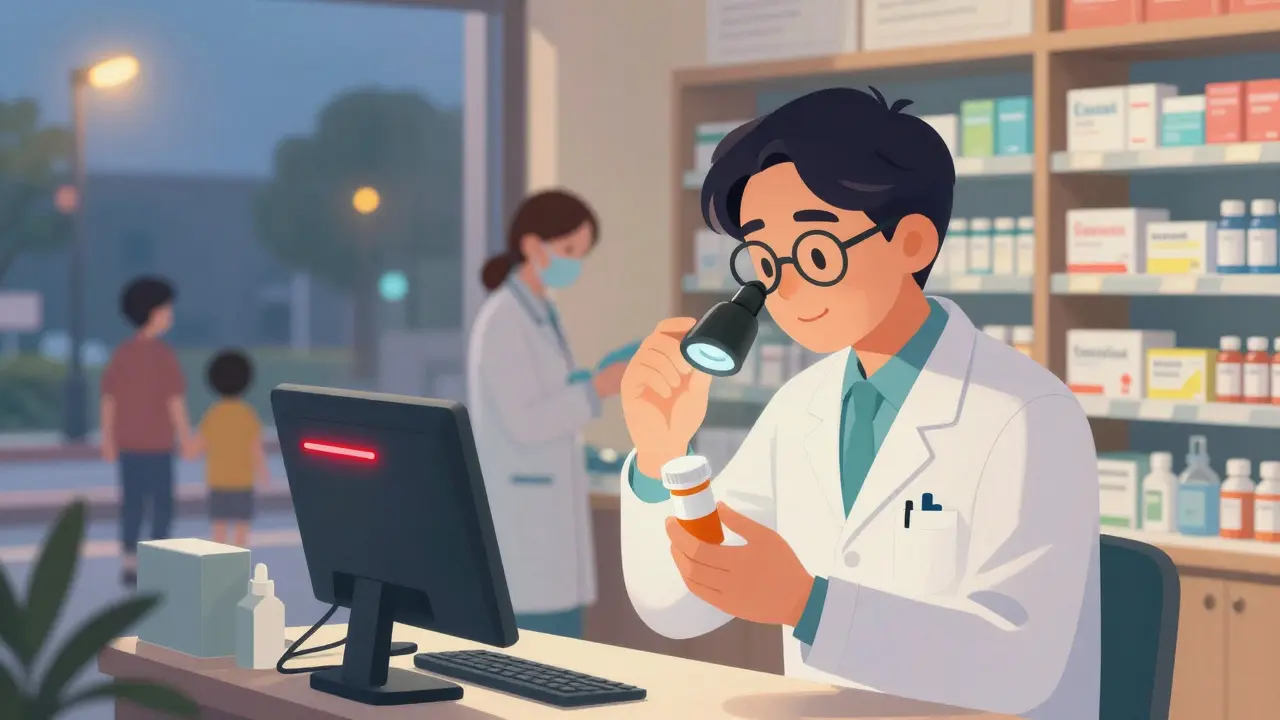
Pharmacists are the last human checkpoint in the medication journey. After a doctor writes a prescription, it goes through a pharmacy’s electronic system, then a technician fills it, and finally, the pharmacist reviews it. This isn’t just a formality. It’s a critical safety step. The Institute of Medicine called pharmacists essential to preventing medication errors back in 2006-and today, 96% of U.S. hospitals have clinical pharmacists dedicated to this role.Why is this step so important? Because mistakes happen at every stage. A doctor might write the wrong dose. A nurse might misread the label. A computer might mix up similar-sounding drugs like hydroxyzine and hydralazine. Even patients sometimes misunderstand instructions. The pharmacist catches all of it.
How Pharmacists Spot Errors
It’s not just about counting pills. Pharmacists use a mix of technology and clinical judgment to catch problems. Here’s how:- Drug Utilization Reviews (DUR): Before dispensing, pharmacists check your full medication list against the new prescription. They look for dangerous interactions-like mixing blood thinners with certain antibiotics-or doses that are too high for your age or kidney function.
- Barcode Scanning: Every bottle has a barcode. When the pharmacist scans it, the system compares the drug, dose, and patient name. If it doesn’t match, the system alerts them. This alone cuts dispensing errors by over half.
- Electronic Prescribing: Handwritten scripts are rare now. Digital prescriptions eliminate the classic “what does this say?” problem. Studies show this reduces errors from illegible handwriting by 95%.
- Double Checks for High-Risk Drugs: Insulin, heparin, warfarin, opioids-these drugs can kill if given wrong. In hospitals and many pharmacies, two trained professionals verify them before they leave the counter.
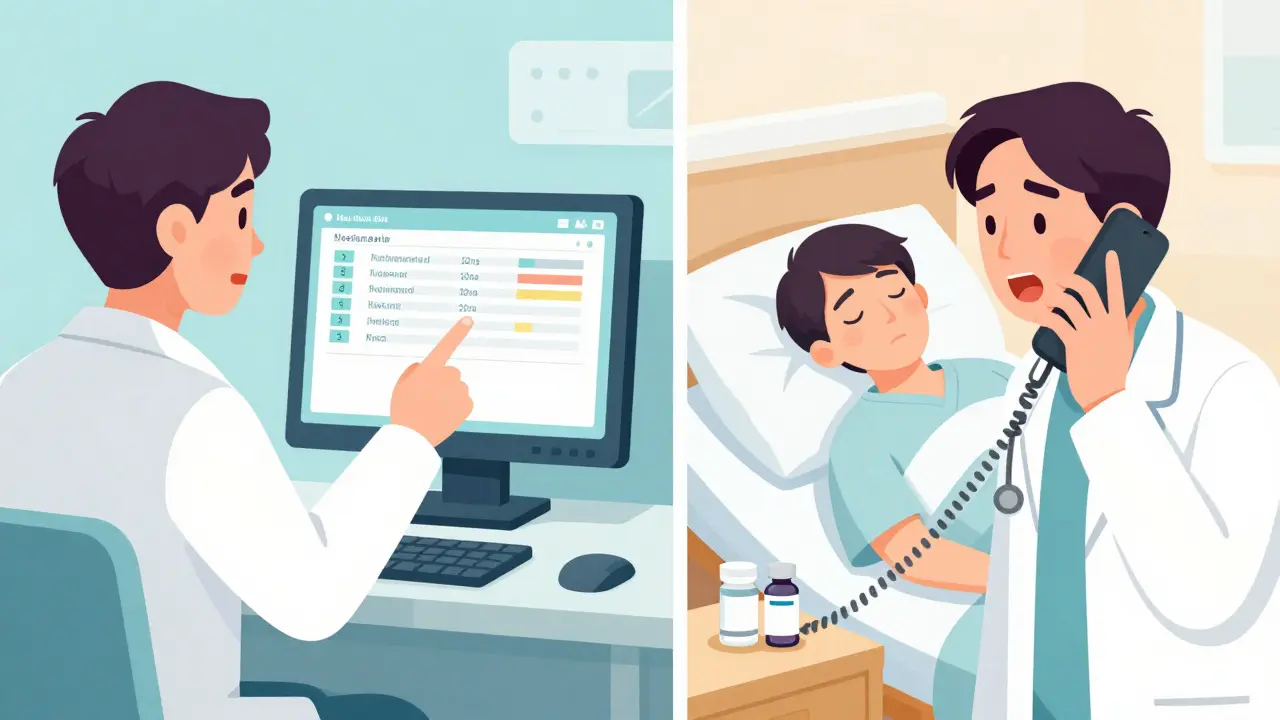
One real example: a patient in Texas was prescribed 10 mg of warfarin daily. The doctor meant 1 mg. The pharmacy’s system flagged it because the patient’s INR levels were already high. The pharmacist called the doctor, confirmed the error, and prevented a life-threatening bleed. That’s not rare-it happens dozens of times a day in busy pharmacies.
Technology Helps, But Humans Still Win
You might think computers alone could catch all errors. They can’t. Computerized systems catch about 17-25% of mistakes. But when a pharmacist adds their review, that number jumps to 45-65%. Why? Because algorithms don’t understand context.Let’s say a patient has chronic kidney disease. A computer might flag a drug interaction, but it won’t know the patient has been on that combo for three years without issue. The pharmacist does. They know when to override a low-risk alert-and when to insist on a change.
Even the best systems have flaws. Pharmacists override nearly half of all drug interaction alerts because they’re too noisy. But smarter systems are fixing this. New AI tools now prioritize only the most dangerous alerts, reducing unnecessary warnings by 35% while keeping error detection at 98%.
The Hidden Heroes: Pharmacy Technicians
Pharmacists don’t work alone. Pharmacy technicians are the first line of defense. They pull the medication, count it, label it, and run initial checks. Studies show that when technicians use a systematic double-check before handing the script to the pharmacist, they catch 78% of potential errors.One technician in a community pharmacy in Ohio noticed a prescription for “Lisinopril 5 mg” was actually meant to be “Lisinopril/HCTZ 5/12.5 mg.” The doctor had written the wrong form. The technician flagged it. The pharmacist confirmed. The patient got the right medicine. That’s teamwork.
Where the System Breaks Down
It’s not perfect. In busy pharmacies, especially in rural or underfunded areas, pharmacists can be overwhelmed. One study found that in low-income countries, pharmacists are responsible for 500+ patients each. At that volume, even the most careful person misses things.Even in the U.S., workflow pressure is real. A Reddit post from a pharmacy tech in Michigan described seeing 3-4 serious errors per week that slipped past pharmacists because they were rushing between patients. One error? A 10-fold overdose on a diabetes drug. The patient was lucky-the pharmacist caught it during a follow-up call.
Another problem? Poor documentation. Hospitals have solid systems to log errors. Community pharmacies? Not so much. Only 2.8 out of 5 on a reporting scale. That means many mistakes go unrecorded-and unlearned from.
Why Pharmacists Are More Than Error Catchers
Their job isn’t just to say “no.” It’s to say “here’s better.” Pharmacists don’t just stop bad prescriptions-they improve good ones. After reviewing a patient’s full medication list, they often suggest:- Switching from a drug that causes dizziness to a safer alternative
- Reducing the number of pills taken daily to improve adherence
- Removing duplicate therapies (like two different blood pressure meds doing the same job)
Studies show pharmacist-led reviews improve medication appropriateness by 28%. That means patients feel better, take fewer side effects, and end up in the hospital less often.
The Real Cost of Getting It Wrong
A single preventable medication error can cost over $13,800 in extra hospital care, tests, and recovery time. Multiply that by 215,000 errors prevented each year, and you get $2.7 billion saved annually in the U.S. alone.But money isn’t the only thing at stake. One patient wrote on Yelp: “My pharmacist called me the day after I picked up my new warfarin prescription. She said, ‘This dose is ten times what you should be on.’ I almost took it. I would’ve bled out in my sleep.”
That’s the real value. It’s not about rules or systems. It’s about people going home safe.
What’s Changing Now?
The role of pharmacists is expanding. More states are passing laws that let pharmacists adjust medications under collaborative agreements with doctors-especially for chronic conditions like diabetes or hypertension. By 2026, the number of dedicated medication safety pharmacists is expected to grow by 22%.Hospitals are forming medication safety committees led by pharmacists. AI tools are helping prioritize the riskiest cases. And the Joint Commission now requires medication reconciliation at every hospital admission and discharge-something pharmacists lead.
Still, there’s a looming problem: a shortage of pharmacists. By 2025, the U.S. could be short 15,000. If staffing doesn’t improve, even the best systems won’t be enough.
What You Can Do
You’re not powerless. Here’s how to help:- Always bring a full list of your medications-including supplements and over-the-counter drugs-to every appointment.
- Ask your pharmacist: “Is this the right dose for me? Are there any interactions with what I’m already taking?”
- Don’t be shy about asking them to double-check a new prescription.
- If you notice a mistake-like the wrong name on the bottle-speak up. They’ll thank you.
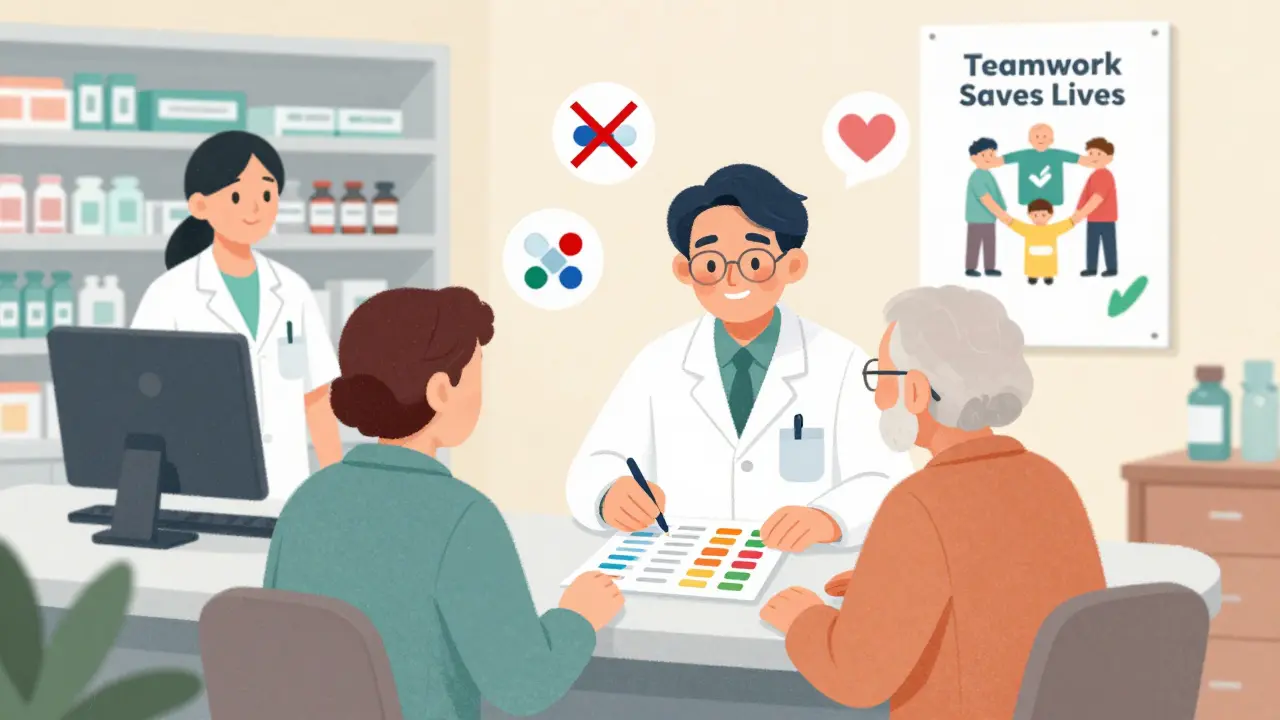
Medication safety isn’t just the pharmacist’s job. It’s a team sport. And you’re part of the team.
How often do pharmacists catch prescription errors?
Pharmacists prevent an estimated 215,000 medication errors each year in the U.S. alone. In hospitals, they catch about 1 in 4 potentially harmful errors before they reach patients. In community pharmacies, they intercept mistakes in about 1 out of every 20 prescriptions filled.
What types of errors do pharmacists catch?
They catch wrong doses, drug interactions, allergies, duplicate therapies, incorrect drug choices for age or kidney function, and mislabeled prescriptions. They also spot errors from illegible handwriting, sound-alike names (like Celebrex and Celexa), and incorrect patient identification.
Can technology replace pharmacists in catching errors?
No. Computer systems catch 17-25% of errors, but pharmacists add another 20-40% by using clinical judgment. Algorithms don’t understand a patient’s full history, lifestyle, or subtle symptoms. A pharmacist knows when to trust a system-and when to question it.
Why do some errors still get through?
Workload pressure, understaffing, and alert fatigue can cause mistakes to slip through. In high-volume pharmacies, pharmacists may review 100+ prescriptions in a single shift. Even the most careful person can miss something under stress. That’s why double-checks and team-based systems are critical.
What’s the difference between a pharmacy technician and a pharmacist in error prevention?
Technicians handle the physical preparation of prescriptions-counting, labeling, scanning. They’re often the first to spot obvious errors like wrong names or doses. Pharmacists review the clinical safety: interactions, appropriateness, dosing logic, and patient history. Technicians catch about 78% of errors before the pharmacist even sees it. Together, they form a powerful safety net.
Wren Hamley
January 4, 2026 AT 08:32Man, I never realized how much goes into just getting a pill. It’s not just counting tablets-it’s cross-referencing your entire medical history, knowing when an alert is a false alarm, and having the guts to call a doctor out on a 10x overdose. That Texas warfarin story? That’s not luck. That’s someone who actually gave a damn.
And the tech? Don’t get me wrong-barcode scanners and E-prescribing are lifesavers. But algorithms don’t know that Mrs. Johnson’s ‘dizziness’ is just her new cat jumping on her lap at 3 a.m. Pharmacists do. They’re the last human filter in a system that’s trying to automate everything into oblivion.
Tru Vista
January 4, 2026 AT 20:33Pharmacists catch 215k errors? lol. More like 215k alerts they ignore because they’re overworked and on their 7th coffee. I’ve seen ‘em rush. One guy handed me my script and said ‘you’re fine’ without even looking at the name. 😴
JUNE OHM
January 4, 2026 AT 20:50EVERYTHING IS A GOVERNMENT CONTROL TRAP. 🤡
Why do you think they make you bring a FULL LIST of meds? So they can build your ‘health profile’ for the CDC database. And those ‘double checks’? Nah. They’re just scanning your DNA via the barcode. I read it on a forum. They’re putting microchips in insulin pens now. 💉👁️
Also, why do pharmacists get paid more than teachers? 🤔
Philip Leth
January 5, 2026 AT 07:45Yo, I’m from Nigeria, and we don’t have this luxury. Pharmacies here? You hand over a scrip, they read it, and if they’re not sure, they call the doctor… if they can get through on the one landline.
Back home, we call it ‘pharmacy roulette.’ But I’m telling you-this system you guys have? It’s beautiful. Even if it’s messy. Even if they’re overworked. You’ve got layers. We’ve got hope and a prayer.
Respect to every pharmacist reading this. You’re the real MVPs.
Shanahan Crowell
January 5, 2026 AT 17:25THIS IS WHY WE NEED TO INVEST IN PHARMACISTS-NOT CUT THEIR STAFFING!!
Every time we underfund community pharmacies, we’re gambling with lives. That Michigan tech who saw 3-4 errors a week? That’s a red flag. A giant, flashing, neon-red flag. And we’re still acting like this is just ‘part of the job.’ NO. IT’S A SYSTEM FAILURE.
Let’s pay them more. Let’s cap their daily scripts. Let’s give them real breaks. Because if we don’t, the next ‘lucky’ catch won’t be a near-miss-it’ll be a funeral.
Kerry Howarth
January 7, 2026 AT 00:09Great post. One small correction: the 96% hospital statistic includes clinical pharmacists in ICUs, oncology, and ID teams-not just dispensing roles. The real impact is in direct patient care, not just checking bottles.
Ian Detrick
January 7, 2026 AT 05:30It’s funny how we treat pharmacists like gatekeepers when they’re really the only ones who care enough to ask, ‘Wait… why is this here?’
We’ve outsourced trust to algorithms, to automation, to ‘efficiency.’ But the moment something goes wrong, we point at the human. The pharmacist. The one who stayed late, who double-checked, who ignored the system’s noise because they knew your grandma’s kidneys were failing.
Maybe the real error isn’t the dose. It’s that we stopped seeing them as people.
Just a thought.
Shruti Badhwar
January 7, 2026 AT 21:23While the U.S. system demonstrates commendable structural safeguards, the underlying issue of workforce sustainability remains unaddressed. In resource-constrained environments, such as those in low-income nations, the absence of standardized protocols and digital infrastructure renders even the most rudimentary checks unfeasible. The disparity in healthcare equity is not merely logistical-it is existential. Until global frameworks are implemented to support pharmacist-led safety nets, the 215,000 prevented errors statistic remains a privileged metric.
Liam Tanner
January 8, 2026 AT 16:33Shoutout to pharmacy techs. Seriously. They’re the unsung heroes who catch the dumb stuff before it even gets to the pharmacist. I once saw one stop a prescription for ‘Amoxicillin 500mg’ that was actually meant for ‘Amoxicillin 875mg’-the doctor’s handwriting was barely legible, but the tech noticed the dosage didn’t match the patient’s weight.
They’re not just ‘fillers.’ They’re the first line of defense. Treat them like it.
Palesa Makuru
January 8, 2026 AT 17:19Oh please. You’re romanticizing pharmacists like they’re saints. Most of them just scan, dispense, and collect their paycheck. I’ve been to pharmacies where the person behind the counter couldn’t tell you what warfarin does. And don’t get me started on the ‘clinical judgment’-it’s just guesswork with a title.
Also, why do you think the AI alerts are ‘too noisy’? Because they’re right. You’re just too lazy to read the drug monograph.
Lori Jackson
January 8, 2026 AT 17:59Let’s be real: pharmacists are just corporate gatekeepers for Big Pharma. They ‘catch errors’ only when it benefits the system. Did you know that 80% of the ‘interactions’ they flag are for drugs that cost more? They push you toward the pricier alternative and call it ‘safety.’
And those ‘double checks’? Just a PR stunt to make you feel safe while they’re still under pressure to fill 120 scripts/hour. Wake up. This isn’t medicine-it’s a supply chain.
Sarah Little
January 10, 2026 AT 12:13AI is now prioritizing alerts based on patient history and real-time vitals. The new systems use federated learning models trained on millions of EHRs to reduce false positives by 35% while maintaining 98% sensitivity. The future is here-it’s just not evenly distributed yet.
innocent massawe
January 10, 2026 AT 18:21Thank you for this. In my village, we have no pharmacist. Only a man with a shop and a box of pills. I used to think he was brave. Now I know he’s desperate.
God bless the pharmacists who do this right. You’re doing the work God meant for humans to do.