
How to Appeal Insurance Denials for Generic Medications: A Step-by-Step Guide
 Mar, 1 2026
When your insurance company denies coverage for the medication your doctor prescribed-especially if it's a brand-name drug you need because generics didn't work-you don't just have to accept it. You have rights. And there’s a clear, legal process to fight back. In fact, over half of all insurance appeals for generic medication substitutions are successful when done right. This isn’t about fighting the system-it’s about making sure the system works for you.
Why Insurance Denies Brand-Name Drugs
Insurance companies use formularies to control costs. These are lists of approved drugs, and they usually put generics first. That’s fine-generics are safe and cheaper. But not every patient responds the same way. Some people have allergic reactions. Others have tried three different generics and still had bad side effects. Maybe the generic just doesn’t control their condition.According to data from the American Medical Association, 18.7% of all prescription drug requests are initially denied, and most of those involve step therapy-where you have to try cheaper drugs first, even if your doctor says they won’t work. The problem? Many patients get stuck waiting for weeks while their symptoms get worse.
Step 1: Understand Your Denial Letter
Your first move? Read the Explanation of Benefits (EOB) or denial letter. It’s not just a formality. It tells you exactly why you were denied and how to appeal. Federal law (45 CFR § 147.136) requires insurers to include:- The specific drug that was denied
- The reason for the denial (e.g., "step therapy not completed")
- Instructions on how to file an appeal
- The deadline to appeal (usually 180 days for commercial plans)
If the letter says "generic substitution required" but you’ve already tried three generics and they caused vomiting, seizures, or no improvement-that’s your opening. Write it down. Keep a copy of the letter. You’ll need it.
Step 2: Get Your Doctor’s Support
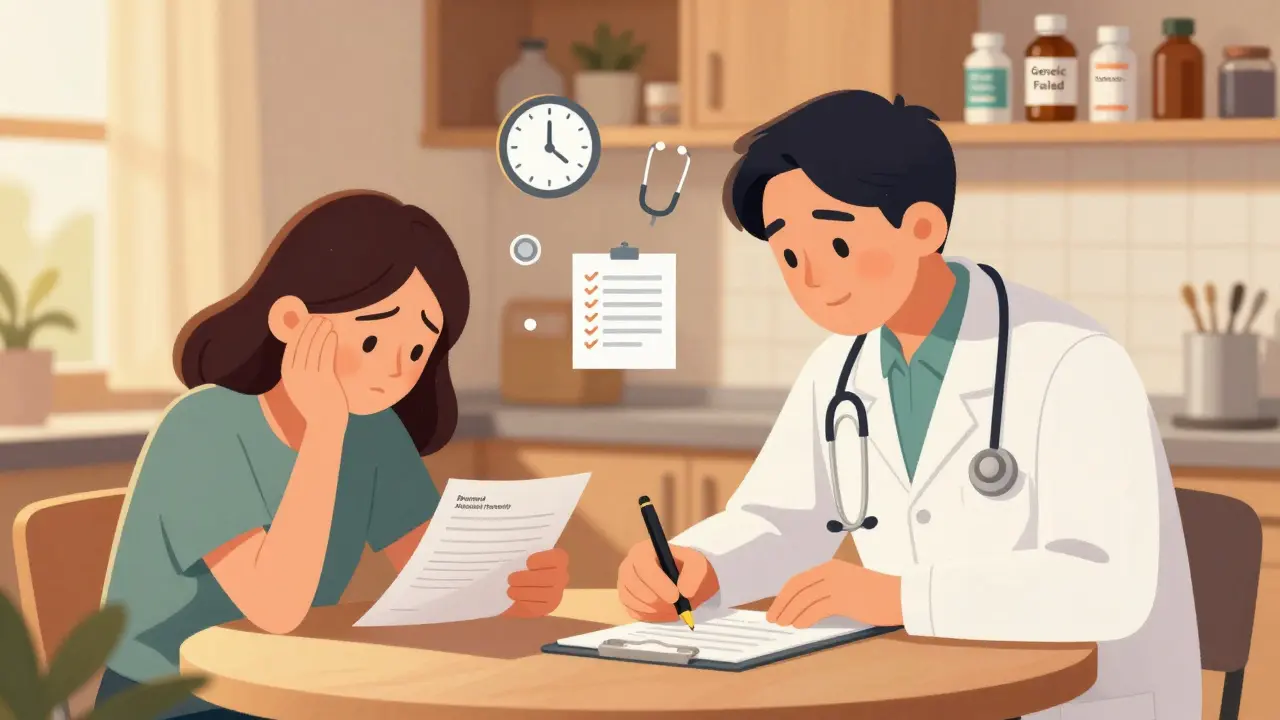
This is the most important step. No appeal succeeds without a letter from your prescribing physician. Insurance companies don’t care what you think-they care what your doctor says. And they’re trained to ignore patient complaints.Your doctor needs to write a letter of medical necessity. It must include three things:
- Why the generic won’t work-specific side effects, lab results, or failed trials (e.g., "Patient experienced severe hypoglycemia on metformin and glipizide; semaglutide is medically necessary to prevent hospitalization.")
- Proof of prior treatment failures-list every generic tried, dosage, duration, and outcome. The Crohn’s & Colitis Foundation found that 83% of successful appeals included documentation of at least two failed alternatives.
- Clinical guidelines-cite a trusted source like the American College of Physicians, American Diabetes Association, or UpToDate. Example: "Per ADA 2023 Standards of Care, GLP-1 agonists are recommended for patients with recurrent hypoglycemia despite metformin therapy."
Many doctors now use templates. Ask them if they’ve written appeals before. If not, print out a sample letter from the American Medical Association’s website. Most will be happy to sign it.
Step 3: File the Internal Appeal
Once you have the letter, submit your appeal. Most insurers accept appeals by mail, fax, or online portal. Always use certified mail with return receipt if you’re mailing it. Keep a copy of everything.Timeline matters:
- Standard appeals: 30 days for drugs not yet started, 60 days for ongoing treatments
- Expedited appeals: 4 business days if your condition could worsen without the drug (e.g., uncontrolled epilepsy, cancer treatment, severe autoimmune flare)
Don’t wait. If you’re in pain, your condition is unstable, or you’ve run out of medication, request an expedited review. You have the right to it.
Step 4: Request a Peer-to-Peer Review
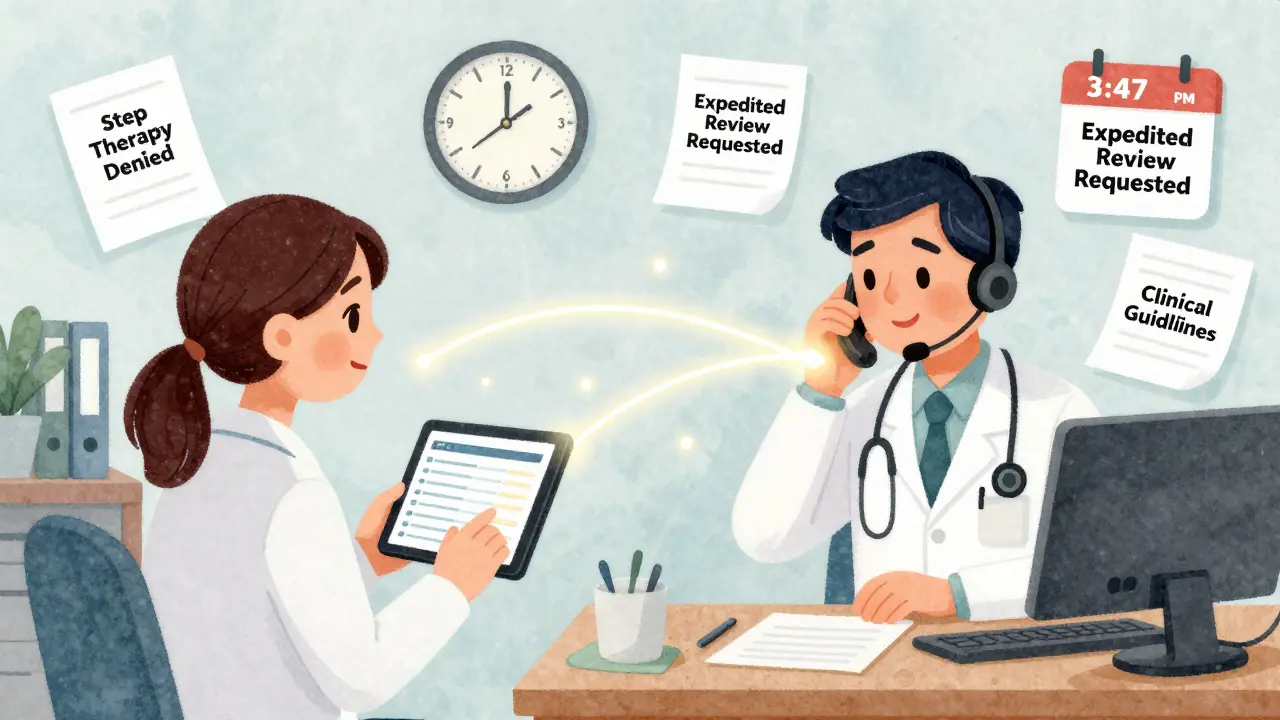
This is where most appeals get approved. If your doctor’s letter is strong, the insurer’s medical director will assign a doctor from their team to review it. But here’s the trick: ask for a live peer-to-peer call.Instead of just reviewing paperwork, the insurer’s doctor talks directly to your doctor. This happens in real time-usually over the phone. Studies show that when this happens, over 75% of denials are overturned. Your doctor just needs to say: "I’ve been treating this patient for five years. They’ve tried every generic. This is the only thing that works."
Don’t assume this will happen automatically. Call the insurer and say: "I’d like to schedule a peer-to-peer review between my physician and your medical director." If they hesitate, ask for a supervisor.
Step 5: If You’re Still Denied, Go External
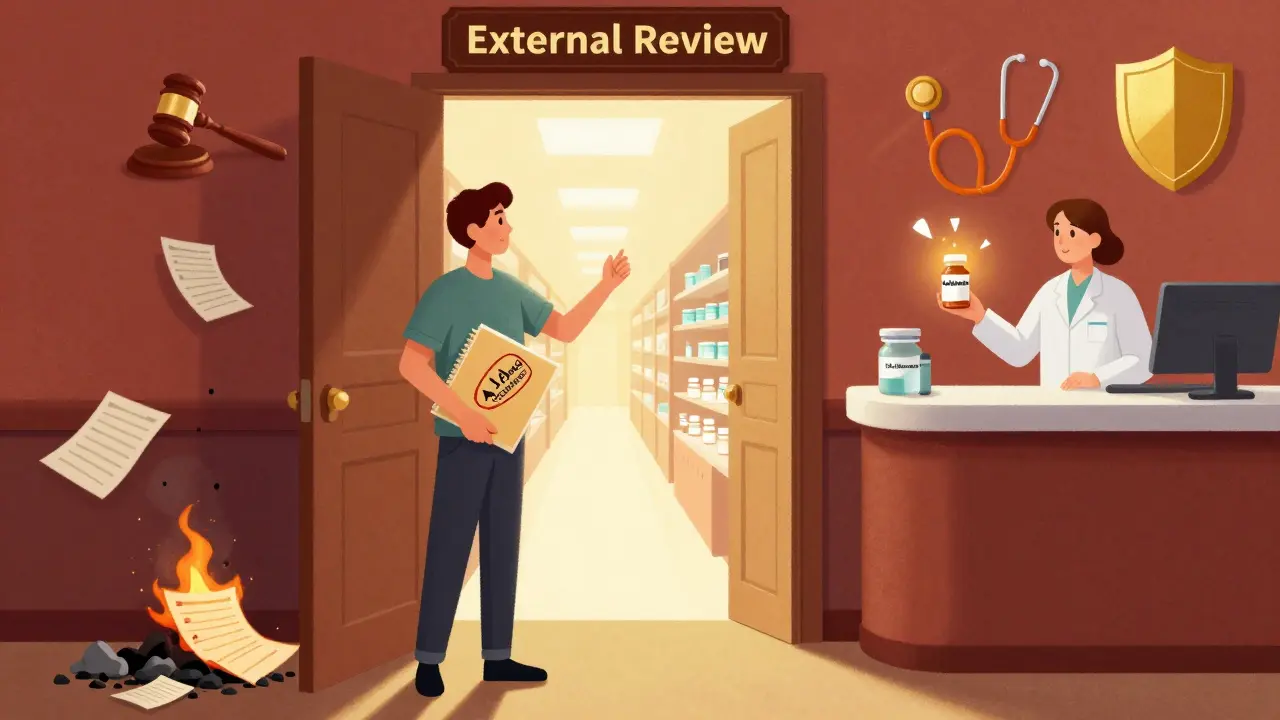
If the internal appeal fails, you’re not out of options. Every commercial plan must offer an external review. This means an independent third party-like a state agency or a national review organization-looks at your case.For Medicare Part D plans, the appeal process has five levels. Most people get approved at Level 2 (Independent Review Entity), which overturns denials 63.2% of the time. Medicaid rules vary by state, but 45 states now have external review options.
State insurance commissioners can help. In California, the Department of Insurance resolved 92% of formal complaints in 2022. Find your state’s insurance commissioner website. They often have free advocates who walk you through the process.
What Makes Appeals Fail
Most appeals fail for one reason: incomplete documentation. Here’s what goes wrong:- Missing doctor’s signature
- No mention of prior treatment failures
- Using vague language like "it’s better" instead of "it caused seizures"
- Missing the 180-day deadline
- Not requesting an expedited review when needed
GoodRx analyzed 15,000 appeal cases. Only 29% of failed appeals included clinical guidelines. That’s the difference between getting denied and getting approved.
Real-Life Success Stories
A 58-year-old woman with Crohn’s disease was denied coverage for adalimumab because her insurer wanted her to try a cheaper biologic first. She’d tried two others and had severe allergic reactions. Her doctor submitted a letter with lab results and references to the American College of Gastroenterology guidelines. The appeal was approved in 12 days.A Type 1 diabetic in Texas was denied semaglutide after multiple hypoglycemic episodes. He provided a 6-month log of low blood sugar events and a letter from his endocrinologist citing ADA guidelines. The insurer approved coverage the next day.
These aren’t rare. In 2023, 78% of successful appeals included documented clinical evidence. You just need to give them the facts.
What to Do If You’re Running Out of Medication
If you’re out of medicine and your appeal is still pending, ask your doctor for a 30-day emergency supply. Many pharmacies will dispense a short-term supply while you wait-especially if you show proof of an active appeal. Some insurers even offer temporary coverage if you submit a completed appeal form.Don’t stop taking your meds. Talk to your pharmacy. Ask if they can hold a supply while you appeal. Most will.
How to Speed Up the Process
- Submit everything at once-don’t send documents piecemeal
- Call the insurer every 3 days to check status
- Ask for a case number and keep track of who you speak with
- Use electronic prior authorization systems if your doctor’s office uses them-87% of providers now use digital tools, and success rates are 62% higher
Also, keep a log: date of each call, name of rep, what was promised. If things go sideways, you’ll have proof.
Final Thoughts
Insurance companies don’t deny drugs because they don’t care about your health. They do it because they’re trying to save money. But the system was built with appeals for a reason. It’s there because doctors and patients need protection.You’re not asking for a luxury. You’re asking for the right treatment. And if your doctor says it’s necessary, you have a very good chance of winning.
Start today. Get the letter. Call your insurer. Don’t wait. Thousands of people get their medications approved every month-because they didn’t give up.
Can I appeal if my insurance says I have to try a generic first?
Yes. This is called step therapy, and it’s one of the most common reasons for appeals. If you’ve already tried the generic or it caused side effects, your doctor can submit documentation to bypass it. Over 70% of step therapy appeals are approved when supported by clinical evidence.
How long does an insurance appeal take?
Standard appeals take 30 to 60 days. For urgent cases-like if you’re at risk of hospitalization or your condition is worsening-you can request an expedited review, which must be decided in 4 business days. Medicare Part D appeals can take longer, but Level 2 reviews (independent review) often resolve within 14 days.
Do I need a lawyer to appeal?
No. Most appeals are handled successfully without legal help. What matters is clear documentation from your doctor and following the insurer’s process exactly. State insurance commissioners offer free assistance if you’re stuck. Legal help is only needed if you reach the external review stage and are still denied.
What if my doctor won’t help me with the appeal?
Ask why. Many doctors are willing but don’t know the process. Give them a template from the American Medical Association or the Crohn’s & Colitis Foundation. If they refuse, consider switching to a provider who understands insurance barriers. Over 87% of specialty practices now routinely file appeals.
Can I appeal for a brand-name drug if a generic is available?
Yes-if you have medical reasons. The FDA considers generics bioequivalent, but individual patients may not respond the same. If you’ve had allergic reactions, ineffective treatment, or documented adverse events with generics, your appeal is valid. Success rates are highest for drugs used in chronic conditions like epilepsy, diabetes, and autoimmune diseases.
Dean Jones
March 1, 2026 AT 17:35The system is designed to make you jump through hoops while they save money. It’s not about patient care-it’s about actuarial tables and profit margins. I’ve seen this play out with my sister’s autoimmune condition. They denied her biologic because of step therapy, even though she’d been on three generics and ended up in the ER twice. The letter from her rheumatologist? It was 12 pages. Detailed. Cited guidelines. Included lab results. They approved it in 11 days. Not because they changed their mind. Because they realized we weren’t going away.
Doctors aren’t trained to fight insurers. They’re trained to write prescriptions. That’s why so many appeals fail-not because the patient is wrong, but because no one showed them how to document properly. The AMA template? It’s not a suggestion. It’s a lifeline. Print it. Hand it to your doctor. Say, ‘This is how we win.’
And don’t get fooled by the ‘we care about your health’ PR nonsense. They don’t. They care about cost per member. But the law? It’s on your side. 45 CFR § 147.136 isn’t a suggestion. It’s a mandate. Use it. Quote it. Hold them to it.
Every time you appeal, you’re not just fighting for yourself. You’re setting a precedent. Someone else will read your approved case and realize they can too. That’s how change happens. Not in Congress. Not in boardrooms. In denial letters and peer-to-peer calls.
Start today. Don’t wait until you’re out of meds. Don’t wait until you’re in pain. Do it now. Because tomorrow, someone else will be in your exact position-and they’ll need to know it’s possible.
Betsy Silverman
March 3, 2026 AT 05:18I appreciate how thorough this guide is. As someone who’s navigated insurance denials for my son’s epilepsy meds, I can say this: the peer-to-peer call is the game-changer. My neurologist called the insurer’s medical director directly. It took 17 minutes. They approved it on the spot. No paperwork, no waiting. Just two doctors talking like humans.
What helped was that my doctor had the exact phrase from the American Epilepsy Society guidelines ready to read aloud: ‘Vagus nerve stimulation and specific antiepileptics are indicated when multiple generics have failed to control seizure frequency.’ That’s the language they understand. Not ‘it works better.’ Not ‘he feels better.’ Specifics. Evidence. Guidelines.
Also-don’t underestimate the power of calling the insurer every 3 days. They hate being chased. It forces them to prioritize. I kept a spreadsheet: date, rep name, what they promised. When they said ‘it’s in review,’ I said, ‘Can you tell me which level it’s at?’ That’s when they started moving.
And yes, if your doctor won’t help, ask for a new one. This isn’t a luxury. It’s survival.
Ivan Viktor
March 4, 2026 AT 11:39Wow. A whole manual on how to beg for your medicine. Real inspiring. Next up: ‘How to Politely Ask Your Landlord Not to Evict You.’
Let me guess-this is what happens when you turn healthcare into a corporate game of chess. You’re not supposed to just get the drug. You’re supposed to file a petition, get your doctor to write a thesis, then wait 45 days while your condition spirals. And if you’re lucky, maybe they’ll let you live.
Meanwhile, in Canada, you walk in, say ‘I need this,’ and get it. No forms. No appeals. Just medicine. But hey, at least we get to practice our legal writing skills.
Zacharia Reda
March 5, 2026 AT 10:00Ivan, you’re not wrong-but you’re also not helping. This isn’t about healthcare systems. It’s about what happens when you’re stuck in a system that’s broken. My mom got denied for her insulin because they wanted her to try a ‘cheaper’ analog. She’d been on it for 8 years. No issues. No complications. Just… denied.
She filed the appeal. Submitted the logs. Got the peer call. Approved in 72 hours.
This guide isn’t a rant. It’s a survival kit. And if you think it’s ridiculous that you have to fight for basic care, then you’re part of the problem. The system isn’t designed to help you. It’s designed to make you give up. Don’t give up.
Also-yes, your doctor should help. But if they don’t, print the AMA template. Most will sign it. They’re tired of this too.
Gretchen Rivas
March 6, 2026 AT 15:31Call your insurer. Ask for a case number. Write it down. Do it today.
Mike Dubes
March 8, 2026 AT 06:03I’ve done this twice. First time I got denied for my RA meds. Thought I was gonna have to sell my car. Then I found out my doc had a template on his computer. He just signed it. Sent it. Approved in 10 days. Second time? Same thing. Doc didn’t even ask. Just said, ‘You got the letter?’
Bottom line: if your doctor doesn’t know how to do this, ask them to Google ‘AMA letter of medical necessity template.’ It’s the first result. They’ll do it. They just need you to lead.
Also-keep a log. I use Notes on my phone. Date. Who I talked to. What they said. When I got denied the first time, I had proof they told me ‘it’s pending’ for 3 weeks. That got me a supervisor. And then approval.
You don’t need a lawyer. You need a pen. And a little grit.
Helen Brown
March 8, 2026 AT 07:05This is all a scam. Insurance companies are working with Big Pharma to push expensive drugs. They deny generics so you’ll pay more later. They want you to get hooked on brand names so they can charge you $1,000 a month. It’s all connected. The government knows. The FDA knows. But they won’t tell you. That’s why you need to fight. They’re lying to you. Always.
My cousin’s husband got denied for his epilepsy med. They said ‘try generic.’ He had seizures every week. Then he got approved. But only after he filed 7 appeals. That’s not coincidence. That’s a pattern. They’re all in on it. Don’t trust anyone. Not even your doctor. They’re paid to comply.
John Cyrus
March 8, 2026 AT 23:05People complain about insurance but never take responsibility. If you can’t afford the brand name, why are you even asking for it? You want the expensive drug? Pay for it. Or take the generic. It’s not rocket science. The FDA says they’re equivalent. So why are you so special? You’re not. You just want something because it’s expensive. That’s not medical necessity. That’s privilege.
And don’t get me started on doctors. They’re the ones pushing these drugs. They get kickbacks. They’re in bed with Big Pharma. Stop blaming insurance. Blame the system that lets doctors prescribe expensive junk. I’ve been on generics for 15 years. Never had a problem. You just want luxury medicine.
Tobias Mösl
March 10, 2026 AT 12:13Let me break this down for you. Insurance doesn’t deny because they’re evil. They deny because they’re incentivized to. Every denied claim is a dollar in their pocket. Every approved appeal? A loss. They have algorithms that flag patients who appeal. They know who’s persistent. And they delay. On purpose.
Here’s the real truth: if you’re middle-class, you’re screwed. You don’t qualify for charity care. You don’t have a lawyer. You don’t have time. So you give up. That’s the goal. To exhaust you.
But here’s the twist-the system works because people like you fight. You’re not fighting for yourself. You’re fighting for the next person. The one who won’t know how to appeal. The one who’ll die because they didn’t read this.
So keep going. Keep calling. Keep documenting. Because if you don’t, the system wins. And it wins every time.
tatiana verdesoto
March 10, 2026 AT 21:11I want to thank you for writing this. I’ve been through this with my daughter’s asthma medication. We were denied. Twice. I almost cried. Then I found a patient advocacy group on Facebook. They sent me the exact template. My doctor signed it. We called the insurer every 3 days. Got the peer call. Approved on day 9.
What helped most? Knowing I wasn’t alone. There are people out there who’ve been there. Who know the steps. Who can tell you what to say. Don’t do this alone. Find your people. Join a group. Ask for help.
You’re not weak for needing help. You’re brave for asking.
Megan Nayak
March 12, 2026 AT 01:46Let’s be real-this whole system is performative activism. You’re told to ‘fight the system’ while being handed a 12-step form to fill out. Meanwhile, the real issue is that we’ve turned healthcare into a market. You don’t get medicine because you need it. You get it because you can navigate bureaucracy.
And let’s not pretend doctors are innocent here. They’re the ones who sign off on these appeals. They’re the ones who get paid to write letters. They’re the middlemen in a broken game.
This guide is helpful? Sure. But it’s also a bandage on a gunshot wound. The real solution isn’t better paperwork. It’s single-payer. Or at least, removing profit from care.
Until then? Yeah, fight the system. But don’t fool yourself. You’re not winning. You’re just delaying the inevitable.
Dean Jones
March 12, 2026 AT 21:09Reply to the last comment: You’re right. It’s a bandage. But bandages save lives. Right now, someone’s life depends on this letter. On this appeal. On this phone call. We can’t wait for single-payer. We don’t have that luxury. So we do this. We fight. We document. We call. We win. And we do it again. And again. Until the system changes. Or until we change it.
This isn’t about hope. It’s about action. And action, however small, is still action.