
How to Build a Daily Medication Routine You Can Actually Stick To
 Aug, 18 2026
Missed doses are not just an inconvenience; they are a silent threat to your long-term health. If you have ever felt overwhelmed by the number of pills in your hand or forgotten whether you took your morning dose, you are in good company. Research from Stanford Medicine indicates that patients who skip their medication face a 30-40% higher chance of disease flare-ups. The goal here is not to add another rigid rule to your day, but to create a daily medication routine that fits naturally into your life, reducing stress and improving outcomes.
Key Takeaways
- Pairing habits: Linking medication to existing daily actions like brushing teeth boosts adherence by up to 78%.
- Simplify first: Ask your doctor if doses can be consolidated; simpler regimens reduce complexity by 40%.
- Use visual tools: Weekly pill organizers cut missed doses by 25% compared to standard bottles.
- Technology has limits: Smartphone alarms work well for under-65s but drop to 45% effectiveness for those over 75.
- Personalization wins: Routines designed with patient input increase adherence by 37% versus provider-only schedules.
Why Your Current Approach Might Be Failing
Most people fail at medication adherence not because they don't care, but because the system is too complex. The World Health Organization defines adherence as the extent to which behavior aligns with medical recommendations. However, when a regimen involves multiple times a day, specific food requirements, and strict timing, the cognitive load becomes heavy. A 2012 analysis in the New England Journal of Medicine found that approximately 50% of patients with chronic diseases do not take their medications as prescribed. This isn't about willpower; it's about design. If your routine requires you to remember three different times, check if you've eaten, and locate the right bottle, you are setting yourself up for failure.
The economic impact of this gap is massive. The National Community Pharmacists Association estimates that non-adherence costs the U.S. healthcare system between $100 and $289 billion annually. For you personally, the cost is higher: preventable hospitalizations, worsening symptoms, and reduced quality of life. The solution lies in shifting from 'remembering to take meds' to 'building a system that takes them for you.'
Step 1: Simplify Your Regimen Before Adding Tools
Before buying any gadgets or apps, talk to your healthcare provider about simplifying your schedule. Dr. Robert L. Page II, a medication adherence specialist at the University of Colorado, notes that successful routines are often simplified to once-daily dosing where possible. This single change reduces complexity by 40%. If you are currently taking five or more medications, ask if any can be switched to extended-release versions or combined. Data from Medicare shows that adherence rates drop from 75% for single-medication regimens to just 50% for four or more medications. Reducing the number of decision points is the most powerful step you can take.
Also, clarify food requirements. Some medications must be taken on an empty stomach, while others require food to prevent nausea. MedlinePlus recommends confirming these details directly with your pharmacist. Knowing exactly what you need to eat (or avoid) removes a major source of anxiety and error during your routine.
Step 2: Anchor Your Doses to Existing Habits
The most effective strategy for building a habit is 'habit stacking.' Instead of creating a new time slot, attach your medication to something you already do every day without thinking. Stanford Medicine research from 2022 showed that pairing medication with consistent activities like brushing teeth or feeding pets resulted in improved adherence for 78% of patients.
Here is how to choose the right anchor:
- Morning doses: Pair with brushing your teeth or making your first cup of coffee.
- Midday doses: Link to lunchtime or a specific break in your workday.
- Evening doses: Associate with washing your face or charging your phone before bed.
Step 3: Choose the Right Organizational Tool
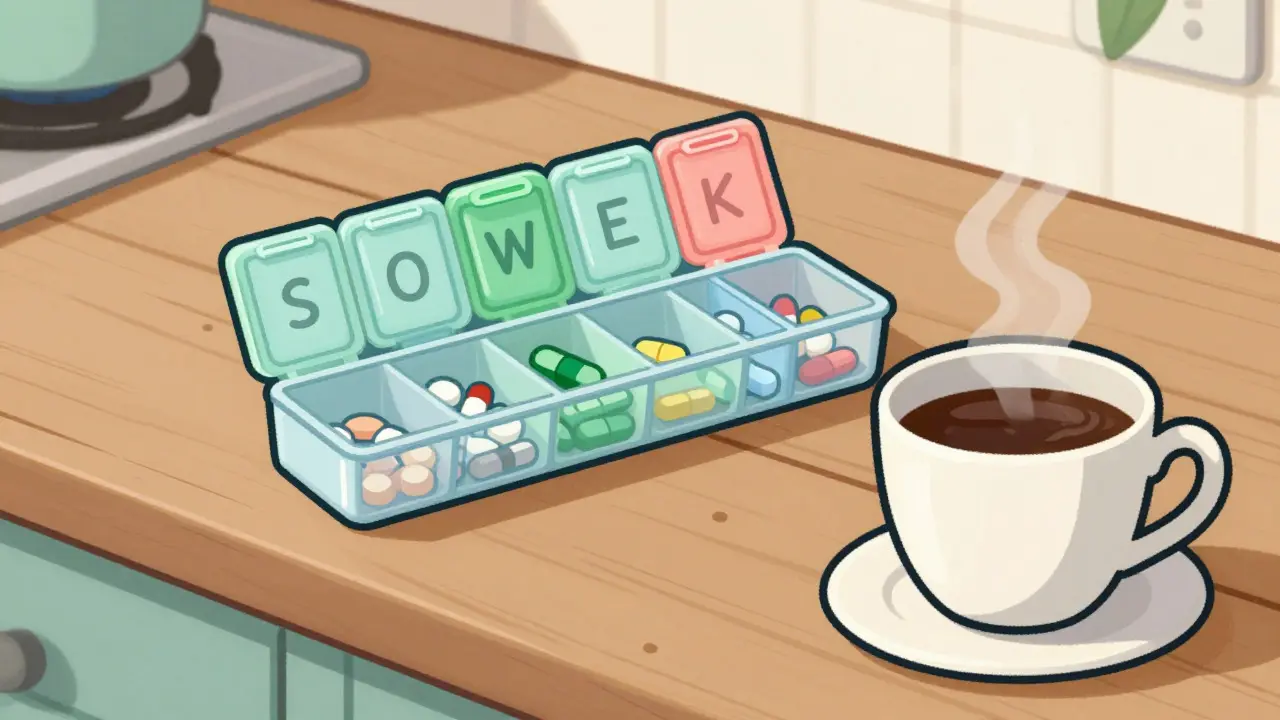
Visual organization is critical. While smartphone apps are popular, they aren't always the best fit for everyone. The American Heart Association data from 2021 reveals that weekly pill organizers with compartments for each day and dosing time reduce missed doses by up to 25%. For many, especially those over 65, the physical act of placing pills into a box provides a tangible sense of completion that digital notifications lack.
| Strategy | Effectiveness Rate | Best For | Limitations |
|---|---|---|---|
| Habit Stacking (e.g., toothbrushing) | 72-78% | All ages, simple regimens | Requires consistent anchor activity |
| Weekly Pill Organizer | 35% improvement over bottles | Older adults, multi-dose regimens | Requires weekly setup time (~20 mins) |
| Smartphone Alarms | 75% (under 65), 45% (over 75) | Tech-savvy users, young adults | Can be silenced accidentally; battery dependent |
| Medication Journals | 78% | Highly motivated, no memory impairment | High cognitive load; tedious for some |
| Buddy System | 58% | Socially connected individuals | Depends on partner's reliability |
If you choose a pill organizer, designate a specific time to fill it. Many patients find Friday evenings ideal, as it allows them to prepare for the upcoming week after their weekend rest. This ritual takes about 20 minutes and ensures you never start Monday wondering if you have enough pills.

Step 4: Leverage Technology Wisely
Technology can support your routine, but it shouldn't replace it entirely. A 2020 study by MedStar Health found that 63% of patients aged 50-75 reported improved adherence using phone reminders. However, Dr. Niteesh K. Choudhry of Brigham and Women's Hospital warns that over-reliance on tech can widen health disparities for elderly patients who may struggle with digital interfaces. In fact, 42% of elderly users on Medicare Rights Center boards reported accidentally silencing their reminders.
For those who use technology, consider these options:
- Standard Alarms: Set multiple alarms for backup. Use distinct sounds for different doses.
- Timer Caps: These devices beep when the cap is opened. They maintain 62% effectiveness across all age groups, making them a robust middle ground.
- Smart Bottles: New FDA-approved devices like AdhereTech track adherence automatically. A 2023 JAMA study showed 35% higher adherence among Medicare patients using these compared to standard bottles.
Step 5: Handle Disruptions and Side Effects
Life happens. Travel, illness, and side effects are the top reasons routines break down. ProMedica’s 2022 analysis identified travel disruptions as a factor for 63% of patients. To mitigate this, keep a small 'travel kit' of your medications in your bag whenever you leave home. Label it clearly so you know exactly what you're carrying.
Side effects are another major hurdle. 49% of patients cite side effects as a reason for intentional non-adherence. If a medication makes you nauseous, don't just stop taking it-talk to your doctor. There may be alternative formulations or timing adjustments that help. Intentional skipping is dangerous because it leads to inconsistent drug levels in your body, potentially causing withdrawal or resistance.
For patients with memory impairment, the 'flip bottle method' is surprisingly effective. Simply turn your medication bottle upside down after taking a dose. This visual cue prevents double-dosing, which ProMedica found reduced incidents by 22%. It’s a low-tech, high-impact solution that requires zero extra effort.
Building Your Personalized Plan
There is no one-size-fits-all routine. Dr. Elizabeth Stuart from Johns Hopkins Bloomberg School of Public Health found that collaborative approaches, where patients help design their own schedules, increase adherence by 37%. So, experiment. Try habit stacking for two weeks. If it fails, switch to a pill organizer. If that feels too fiddly, try a timer cap. The goal is to find the system that feels least intrusive to your life.
Remember, the most sustainable medication routines are those that adapt to your life, not the other way around. Start small. Pick one anchor habit. Get one organizer. Set one alarm. Master that before adding complexity. Consistency beats perfection every time.
What is the best time to take my medications?
The best time is the one you can consistently stick to. Generally, morning doses pair well with breakfast or brushing teeth, while evening doses align with dinner or bedtime routines. Always check with your pharmacist if a specific medication requires an empty stomach or should be taken with food.
Are pill organizers worth it?
Yes, for most people. Data from the American Heart Association shows that weekly organizers reduce missed doses by up to 25% compared to standard bottles. They provide a clear visual overview of your remaining doses, reducing the risk of double-dosing or forgetting entirely.
What if I forget to take a dose?
Check your specific medication guidelines. Generally, if it's close to the next dose, skip the missed one and resume your regular schedule. Do not double up unless instructed by your doctor. Keep a log of missed doses to discuss patterns with your healthcare provider.
Do smartphone apps really help with adherence?
They can be very effective for tech-savvy users, with studies showing up to 75% adherence rates for those under 65. However, effectiveness drops to 45% for older adults who may struggle with the interface. Consider using simple alarms or hardware-based reminders like timer caps if you find apps distracting or confusing.
How do I handle medication side effects?
Never stop taking medication abruptly due to side effects without consulting your doctor. Side effects often diminish over time. Your provider may adjust the dosage, change the timing, or switch to an alternative medication. Keeping a symptom diary can help identify patterns and trigger conversations with your healthcare team.