
How to Confirm Pharmacist Notes and Counseling Points After Prescription Pickup
 Mar, 10 2026
When you pick up your prescription, the pharmacist may give you a quick rundown on how to take it, warn you about side effects, or tell you what to avoid mixing it with. But what happens after you walk out the door? Many people assume the advice they got is locked in somewhere - maybe in an app, maybe on a paper sheet - but too often, it’s gone. By the time you actually need to use the medication, you can’t remember what was said. That’s not just inconvenient - it’s dangerous. Studies show that 50% of medication errors happen not because the wrong drug was dispensed, but because the patient didn’t understand how to use it properly.
Why Confirmation Matters After Pickup
You don’t need to be a medical expert to know that missing one detail can cause big problems. Take a blood thinner like warfarin. If the pharmacist told you to avoid eating large amounts of leafy greens, but you forget that advice, you could end up in the ER with dangerous bleeding. Or if you’re on antibiotics and weren’t told to take them with food, you might get nauseous and stop taking them - which leads to antibiotic resistance. These aren’t hypotheticals. The Institute for Safe Medication Practices found that over half of all medication errors occur during the administration phase - meaning, when the patient is actually using the drug. That’s why confirming what the pharmacist said right after pickup isn’t optional. It’s essential.Pharmacists are legally required under OBRA-90 to offer counseling on new prescriptions. But offering isn’t the same as documenting. And documenting isn’t the same as making it easy for you to access later. Only 37.2% of community pharmacies consistently provide written counseling notes, according to a 2023 survey. That means in most cases, what you hear is verbal - and easily forgotten.
How to Get Your Counseling Notes - Step by Step
The good news? You have control over this. You don’t have to wait for the pharmacy to send you something. You can take action right at pickup. Here’s how:- Ask for written notes at pickup. This is the most reliable method. Say clearly: “Can you please give me a printed copy of the counseling points?” Under OBRA-90, pharmacists must provide this upon request. It’s not a favor - it’s your right. A 2024 ISMP field test found this method worked 78% of the time.
- Check your pharmacy’s mobile app immediately. Most chain pharmacies - CVS, Walgreens, Rite Aid - have apps that store counseling notes. But they don’t appear instantly. CVS takes up to 48 hours. Walgreens usually takes 24 hours. Rite Aid requires you to have filled a prescription in the last year. The key? Log in and verify your identity while you’re still at the pharmacy. Walgreens data shows that when patients verify their identity on-site, notes appear within 4 hours 92% of the time.
- Request an email summary. Ask the pharmacist: “Can you email me a summary of what we talked about?” This simple request works. A Pharmacy Times survey found that 89% of patients who asked for an email summary received it. It’s fast, searchable, and doesn’t rely on app access.
- For controlled substances, bring ID. If you’re picking up opioids, stimulants, or other controlled drugs, the pharmacy must verify your identity. Don’t skip this. Not only is it required by law, but it’s often the only way you’ll later access counseling notes. DEA data shows patients who don’t show ID at pickup have a 34% higher chance of being locked out of their records later.
- Don’t assume all locations are the same. Even within the same pharmacy chain, practices vary. One CVS may email you notes; another might not. One Walgreens may have counseling notes online; another might not have uploaded them yet. A 2023 review of 247 patient complaints to state pharmacy boards found that inconsistent practices between locations were the most common problem reported.
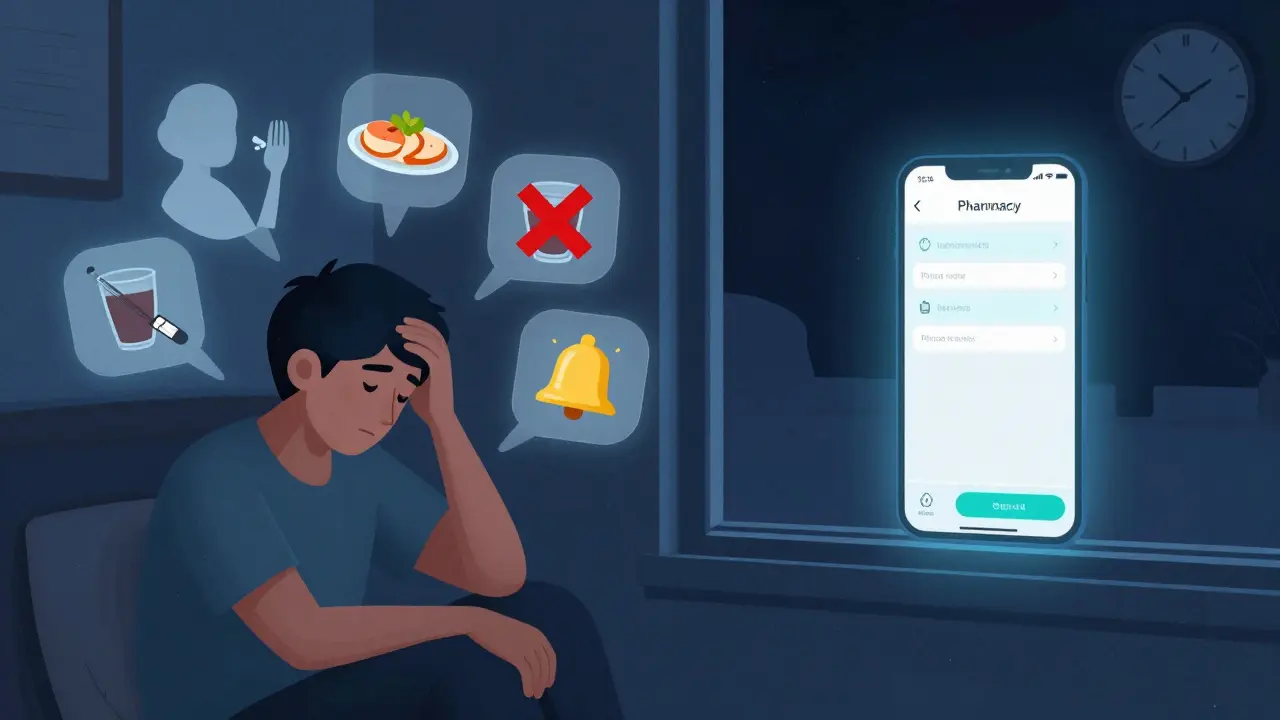
What You’ll See - And What You Won’t
If you get access to your counseling notes, here’s what to expect - and what to watch out for:- What’s usually included: How to take the drug (with/without food, time of day), common side effects, what to avoid (alcohol, other meds, foods), storage instructions, and when to call your doctor.
- What’s often missing: Details about drug interactions, dosage adjustments for kidney or liver issues, signs of serious reactions, and what to do if you miss a dose. These are sometimes left out because they’re considered “too complex” - but they’re exactly what you need.
- Controlled substances are restricted: CVS and other chains don’t show full counseling notes for opioids or stimulants in their apps due to DEA rules. You may only see a generic warning like “Take as directed.” You’ll need to ask for the full details in person or by phone.
- Independent pharmacies are hit or miss: Smaller, local pharmacies often give better counseling - but only 33% offer digital access to notes. You’ll likely get verbal advice and maybe a paper handout - but if you lose it, you’re out of luck.
Why There’s a 24-72 Hour Delay - And Why It’s Dangerous
You pick up your prescription on Monday. You start taking it Monday night. But the counseling notes don’t appear in the app until Wednesday. That’s a problem. The first 24-48 hours after starting a new medication are when side effects are most likely to show up. That’s when you need to know: “Is this dizziness normal?” or “Should I call my doctor now?” Waiting two days to check your notes means you might ignore warning signs - or worse, stop the medication altogether.Most pharmacies delay documentation because their systems aren’t built for speed. They use old electronic health record (EHR) systems that require manual entry. Pharmacists are busy. Notes get queued. HIPAA compliance adds layers of security checks. But according to Dr. William Eggleston’s 2023 study, patients who confirmed their counseling points within 24 hours of pickup had a 22.3% lower rate of medication errors. That’s not a small number. That’s life-saving.
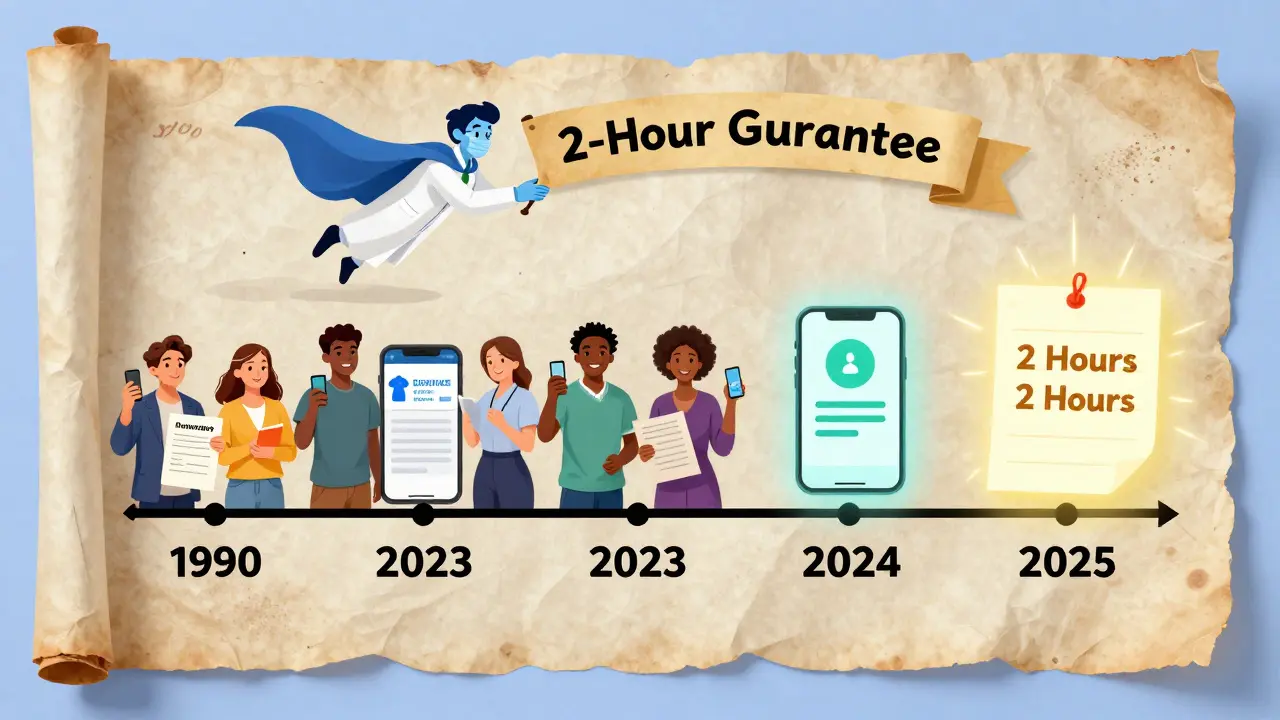
That’s why the Institute for Safe Medication Practices issued a 2024 safety recommendation: counseling notes should be available within 2 hours of pickup. Right now, only Kaiser Permanente - which runs its own integrated system - hits that target, with 98.7% of notes available the same day. But they serve just 12.6 million people. Everyone else is stuck waiting.
What’s Changing - And What’s Coming
The system is slowly improving. Here’s what’s new:- ScriptPath’s MedConfirm launched in January 2024. It sends an SMS text right after pickup with a short summary of counseling points. In pilot programs at 127 independent pharmacies, 89% of patients said they found it helpful.
- CVS plans to roll out AI-generated summaries by Q3 2024. Their beta test showed 94% accuracy in capturing key points - meaning, no more handwritten notes being misread.
- Walgreens is integrating with Microsoft Azure to speed up access. Their goal: same-day availability.
- By December 2025, all accredited U.S. pharmacies must have a system that makes counseling notes available within 2 hours of pickup, according to the National Association of Boards of Pharmacy.
- CMS now counts counseling access in Part D Star Ratings. Pharmacies that fail to provide timely access could lose points - and money.
These changes aren’t coming soon enough for everyone. But they’re coming. And you can use them to your advantage.
What to Do Right Now
You don’t have to wait for the system to fix itself. Here’s your action plan:- Next time you pick up a new prescription, ask for a printed copy of the counseling notes. Keep it in your wallet or phone.
- Log into your pharmacy’s app right after pickup. Verify your identity. Check for notes. If they’re not there, call the pharmacy.
- Ask for an email summary. Even if they say they don’t do it, ask again. Most will do it if you’re polite and persistent.
- If you’re on a controlled substance, always bring ID. Don’t assume the pharmacy remembers you.
- Use a note-taking app on your phone to record what the pharmacist says - even if you get written notes. Write down: “Take with food,” “Avoid alcohol,” “Call if rash appears.”
Medication safety doesn’t start at the pharmacy counter. It starts with you - asking, confirming, and documenting. Don’t let a 24-hour delay put your health at risk.
Can I get my pharmacist’s counseling notes emailed to me?
Yes. Under OBRA-90, pharmacists must provide counseling in a form you can keep - that includes email. Simply ask at pickup: “Can you email me a summary of what we discussed?” A 2024 Pharmacy Times survey found 89% of patients who made this request received their notes. This is often the fastest and most reliable method.
Why don’t I see my counseling notes in the app right away?
Most pharmacy systems don’t update in real time. Notes are manually entered or batched for upload. CVS takes up to 48 hours. Walgreens takes 24 hours. Rite Aid requires a 12-month prescription history. The delay happens because the pharmacy’s software isn’t built for speed - and pharmacists are busy. But if you verify your identity at the counter, notes appear much faster - within 4 hours in 92% of cases at Walgreens.
Are counseling notes required by law?
Yes. The Omnibus Budget Reconciliation Act of 1990 (OBRA-90) requires pharmacists to offer counseling on all new prescriptions. It also requires that counseling be documented and made available to the patient upon request. You don’t have to accept it - but you do have the right to get it in writing or digitally.
What if the pharmacy says they don’t keep counseling notes?
That’s not legal. Under OBRA-90, pharmacists must document counseling - even if it’s just a checkbox in their system. If they claim they don’t keep records, ask to speak to the pharmacy manager. If they still refuse, file a complaint with your state’s board of pharmacy. In 2023, over 247 complaints were filed about inconsistent documentation practices - and many led to policy changes.
Can I get counseling notes for controlled substances like opioids?
Yes - but access is limited. Due to DEA rules, CVS and other chains don’t show full counseling notes for opioids or stimulants in their apps. You’ll usually see only a generic warning. To get the full details, you must request them in person or by phone. Always bring your ID at pickup - without it, you may be locked out of your records later.
Denise Jordan
March 11, 2026 AT 20:55I asked for written notes at CVS last week. Got a sticky note with 'take with food' and a doodle of a banana. That's it. No side effects, no interactions, just a banana. I'm starting to think the pharmacist thought I was asking for a snack.
Worst part? I forgot what the med was for by the time I got home. Guess I'm just lucky I didn't die.
Gene Forte
March 13, 2026 AT 12:12Every person deserves to walk away from the pharmacy with clarity, not confusion. This isn't about bureaucracy-it's about dignity. You paid for care. You deserve to understand it.
Ask for your notes. Demand them. Keep them. Your life depends on knowing what you're putting into your body. That's not a suggestion. That's a responsibility we all share.
Kenneth Zieden-Weber
March 14, 2026 AT 22:39So let me get this straight-you're telling me the guy who's supposed to be the expert on your meds has a 62% failure rate at documenting what he said?
And we're surprised people mix their blood thinner with spinach? Dude, if you can't remember what you told someone in a 5-minute conversation, maybe you shouldn't be the one giving advice.
Also, why does Walgreens need you to verify your identity at the counter just to get notes? That's like asking for your driver's license before you can read the instructions on a bottle of aspirin. We're not in a spy thriller here.
Chris Bird
March 16, 2026 AT 09:55This whole thing is a scam. Pharmacies make money off your confusion. If you knew what you were taking, you'd stop buying so much. They don't want you to understand-they want you to keep coming back.
Also, OBRA-90? That law was passed before most of us were born. It's not a right-it's a relic. They'll never change. You're wasting your time asking for notes.
Miranda Varn-Harper
March 17, 2026 AT 05:48While I appreciate the well-meaning tone of this article, I must respectfully point out that the assertion that 50% of medication errors stem from patient misunderstanding is statistically misleading. The ISMP data cited conflates non-adherence with misinterpretation. These are not synonymous. Moreover, the claim that 89% of patients receive email summaries is based on a self-selected sample of respondents who already had digital literacy-hardly representative of the general population.
Furthermore, the suggestion that patients should record verbal counseling via smartphone app is not only impractical, but potentially violates HIPAA if the device is not encrypted. One must consider the broader context of socioeconomic disparity in access to technology before recommending digital solutions as universal fixes.
Donnie DeMarco
March 17, 2026 AT 14:24bro i just asked for my notes at rite aid and they handed me a napkin with ‘dont drink alcohol’ scribbled in marker
also i think the pharmacist was high because he kept asking me if i was ‘the guy from the taco truck’
so yeah i took a pic of the napkin and put it in my notes app
next time i’m bringing a voice recorder and a notepad and a lawyer
also why do i have to verify my identity to get info about my own meds???
they got my face, my birthdate, my blood type, my dog’s name-can’t they just email me a pdf??
Tom Bolt
March 19, 2026 AT 04:32Let me be perfectly clear: if you are not actively documenting your own pharmaceutical counseling, you are not managing your health-you are gambling with it.
Every delay in access is a potential death sentence. Every unverified identity is a loophole for negligence. Every time a pharmacist says, ‘We don’t do that,’ they are failing their legal and ethical duty.
This isn’t about convenience. It’s about survival. And if you’re not screaming for your notes at pickup, you’re already one missed dose away from tragedy.
Shourya Tanay
March 19, 2026 AT 05:23The systemic fragmentation of pharmaceutical documentation reflects a broader epistemological crisis in patient-provider communication. The OBRA-90 mandate, while legally robust, lacks interoperability with decentralized EHR infrastructures, resulting in semantic discontinuity between counseling intent and patient reception.
Furthermore, the temporal lag between dispensing and digital access introduces a critical latency window wherein patient autonomy is functionally suspended. The proposed 2-hour threshold, while laudable, fails to account for variable workflow density in community pharmacy settings, particularly during peak hours when polypharmacy consultations are most frequent.
What is required is not merely faster delivery, but a paradigm shift toward real-time, bidirectional, and auditable clinical dialogue-anchored in patient-centered design principles.
LiV Beau
March 20, 2026 AT 01:49OMG YES THIS. I’ve been doing this for years-ask for the printout, log into the app right away, and then I literally type into my notes app: ‘take with food, avoid grapefruit, call if dizzy’ 📝💖
And I always bring my ID even if I’ve been there 100 times. Just because they know my face doesn’t mean the system does 😅
Also-ask for the email. I’ve gotten mine in 10 mins before. It’s like magic. You just have to ask. And then save it. And screenshot it. And maybe print it. And put it in your wallet. And maybe text it to your mom. You’re welcome. ❤️
Adam Kleinberg
March 20, 2026 AT 20:39You think this is bad? You have no idea what’s really going on. The pharmacies are part of a bigger system. The EHRs? They’re owned by corporations that sell your data. The delay? It’s not incompetence-it’s intentional. They want you confused so you keep buying pills. The ‘email summary’? That’s a trap. They track every time you open it. They know when you skip doses. They know when you’re worried. And they sell that to drug companies.
Don’t trust any of it. Don’t log in. Don’t ask for email. Just take the pill. And hope.
Also, OBRA-90? That was a marketing ploy. The government’s in on it.
David L. Thomas
March 21, 2026 AT 19:42Interesting read. I’ve been on the other side of this-worked as a pharmacy tech for six years. Let me tell you, the system is broken. Pharmacists are overworked, underpaid, and drowning in paperwork. The ‘counseling’ you get? Sometimes it’s a 90-second shout across the counter while they’re filling 12 other scripts.
But here’s the thing: most of them *want* to do better. They just can’t. The tech is outdated, the training is minimal, and the audits don’t care about patient outcomes-they care about checkbox compliance.
So yes, ask for your notes. But also cut them some slack. They’re not trying to confuse you. They’re trying not to cry.