
How to Read Medication Labels: Health Literacy Strategies for Safe Dosing
 Apr, 28 2026
Medication Label Simplifier (UMS Tool)
Avoid the "confusion zone." Use this tool to translate vague pharmacy instructions into a clear, patient-centered schedule based on the Universal Medication Schedule (UMS).
Your UMS Schedule Breakdown:
Imagine picking up a prescription and seeing the instruction: "Take 1 tablet by mouth twice daily." It sounds simple, right? But for millions of people, this phrasing is a trap. Does "twice daily" mean every 12 hours exactly, or just once in the morning and once at night? Does "by mouth" mean with food, or on an empty stomach? These small ambiguities lead to a massive problem: nearly 50% of adults struggle to interpret at least one medication label correctly. When a simple misunderstanding turns into a dosing error, the result isn't just a missed pill-it can be a dangerous trip to the emergency room.
Improving your health literacy strategies is the process of improving how patients understand and act on health information, specifically focusing on the ability to interpret medical instructions and dosing requirements. It isn't about how many books you've read; it's about whether the information on your pill bottle actually makes sense in the real world. By shifting the focus from complex medical jargon to clear, patient-centered language, we can close the gap between a doctor's intention and a patient's action.
| Feature | Traditional Labeling | Literacy-Informed Labeling |
|---|---|---|
| Phrasing | "Take twice daily" | "Take 1 in the morning and 1 in the evening" |
| Reading Level | Often 10th grade or higher | 5th grade or lower |
| Timing | Vague (e.g., "every 4-6 hours") | Standardized (e.g., Morning, Noon, Evening, Bedtime) |
| Visuals | Text-heavy | Includes pictograms and icons |
The Danger of Vague Instructions
The root of most medication errors isn't a lack of effort from the patient, but a mismatch in communication. Many standard labels are written at a high school level, yet the average adult's health literacy sits closer to a 6th or 8th-grade level. This gap creates a "confusion zone" where patients guess what their doctor meant. For instance, a common mistake involves the phrase "take every 4-6 hours." Some patients interpret this as "take 4 to 6 tablets at once," leading to a potential overdose. Others confuse "mg" (milligrams) with "ml" (milliliters), which is especially dangerous with liquid medications where a decimal point error can result in a ten-fold dosing mistake.
In pediatric care, the stakes are even higher. Research shows that up to 50% of caregivers make errors when dosing children's medications. A common point of failure is the dosing chart; parents with lower health literacy often find complex grids confusing. A parent might see "5 mL twice daily" and mistakenly provide 2.5 mL twice a day, thinking the 5 mL was the total daily amount. This is why moving away from charts and toward explicit, single-dose instructions is a critical safety step.
Implementing the Universal Medication Schedule (UMS)
One of the most effective ways to stop the guessing game is through the Universal Medication Schedule (also known as UMS). This is a standardized system that organizes medication timing into four predictable daily intervals: morning, noon, evening, and bedtime. Instead of telling a patient to take a pill "three times a day," which is open to interpretation, the UMS provides a concrete schedule.
When health systems switch to UMS, the results are immediate. In some elderly populations taking multiple medications, dosing confusion has dropped by nearly 47%. By anchoring the medication to a time of day rather than a clock hour, it removes the need for patients to do complex math. It transforms a stressful calculation into a simple routine: "I take this one when I wake up, one at lunch, one at dinner, and one before bed."
Visual Aids and Patient-Centered Design
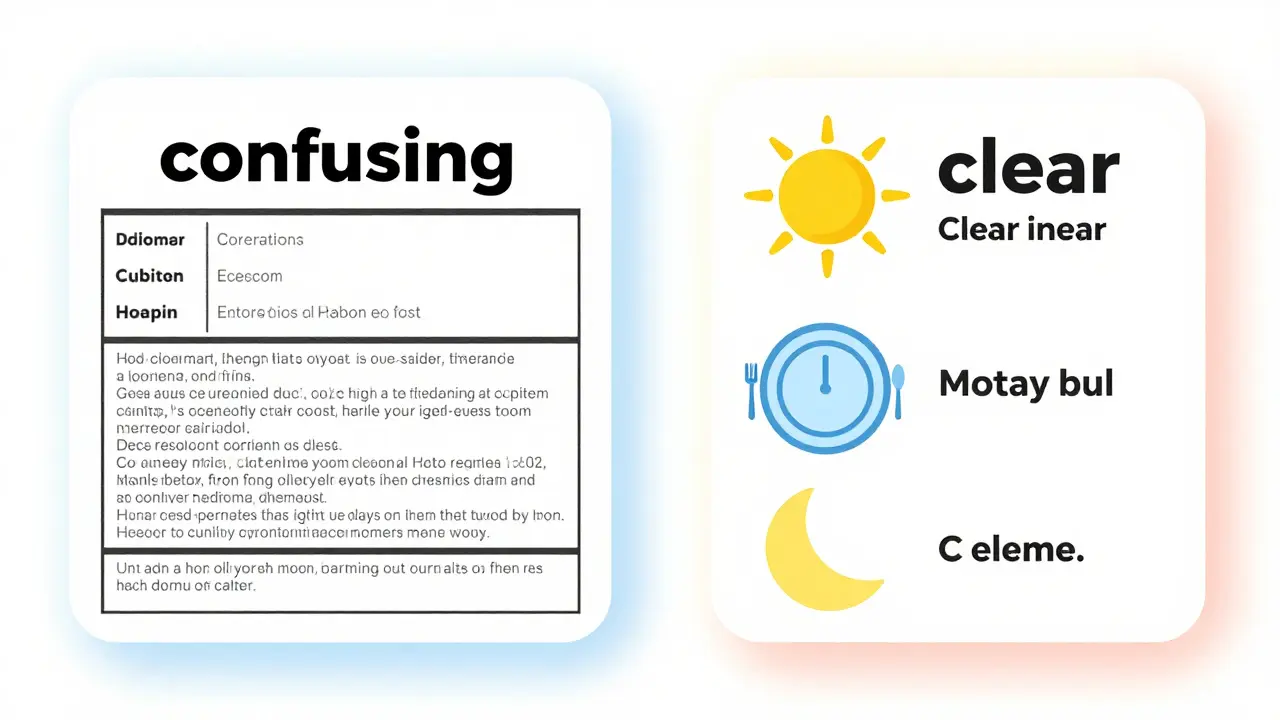
Text isn't always the best way to communicate a life-saving instruction. For people with limited literacy or those who speak English as a second language, pictograms are small, simple images used to represent an object or a concept, such as a sun for morning or a crescent moon for nighttime. Adding these visual cues can increase the correct interpretation of a label by about 28%.
Patient-centered labels go beyond just adding pictures; they rethink the entire layout. This includes using a single-column format to prevent the eye from skipping lines and using a 5th-grade reading level. When labels are designed this way, there is a significant reduction in patients exceeding the maximum daily dose. For example, while standard labels might see a 39% error rate in maximum dose exceedance, patient-centered designs can drop that number as low as 7%. This proves that when the layout is intuitive, the risk of a catastrophic error plummets.
Practical Tools for Verification: Teach-Back and Screening
How do you know if a patient actually understands their instructions? The gold standard is the teach-back method, which is a communication confirmation technique where the healthcare provider asks the patient to explain the instructions back in their own words. It only takes an extra minute or two, but it can reduce misunderstandings by 33%. If a patient says, "I'll take two pills every morning," but the label says "one pill twice daily," the error is caught instantly before the patient ever leaves the pharmacy.
For clinicians, screening tools help identify who needs extra help. The REALM-SF (Rapid Estimate of Adult Literacy in Medicine, Short Form) is a quick way to assess a patient's ability to read common medical words in just a few minutes. By identifying patients with low health literacy early, providers can tailor their communication, provide materials in a preferred language, and spend more time on the teach-back process.

Building a Medication Safety Plan
Whether you are a patient, a caregiver, or a healthcare provider, creating a safety plan around medication is essential. You shouldn't leave the pharmacy feeling "mostly sure" about how to take a drug. Instead, adopt a checklist approach to every new prescription:
- Verify the Dose: Ask, "Exactly how many milligrams/milliliters am I taking each time?"
- Clarify the Timing: Don't accept "twice daily." Ask, "Should I take this at 8 AM and 8 PM, or just morning and night?"
- Confirm the Method: Clarify "take with food." Does that mean a full meal, a snack, or just a glass of water?
- Check the Tools: If using a liquid medication, ensure you have a calibrated oral syringe rather than a household kitchen spoon, which can vary wildly in volume.
- Use a Log: Keep a simple diary of when doses are taken to prevent the common mistake of doubling a dose because you forgot if you already took it.
Why is a 5th-grade reading level recommended for medication labels?
It is recommended because nearly half of all adults struggle to understand health information written at an 8th-grade level or higher. By targeting a 5th-grade level, health providers ensure that the widest possible range of patients-regardless of their educational background-can safely interpret dosing instructions without needing constant assistance.
What is the difference between "twice daily" and "every 12 hours"?
"Twice daily" often implies convenience (e.g., once after breakfast and once after dinner), whereas "every 12 hours" implies a strict clinical need to maintain a steady level of medication in the bloodstream. Mistaking one for the other can lead to periods where the medication is less effective or, conversely, an accidental overdose if the timing is not tracked.
How does the teach-back method improve safety?
The teach-back method forces the patient to process the information and translate it into their own words. This reveals "hidden" misunderstandings that a simple "Do you understand?" question will not catch, as most patients will say "yes" even if they are confused to avoid embarrassment.
Are pictograms really as effective as text?
For patients with limited health literacy, pictograms can be more effective than text alone, increasing correct interpretation by up to 28%. However, they work best as a supplement to simple text, not a replacement, as different cultures may interpret the same symbol differently.
What should I do if my pharmacy labels are confusing?
You have the right to clear instructions. Ask your pharmacist to rewrite the instructions using the Universal Medication Schedule (morning, noon, evening, bedtime) and request a demonstration of the dosing tool (like a syringe) to ensure you are measuring the correct amount.
Next Steps for Better Safety
If you are managing medications for a loved one, start by auditing their current bottles. Look for vague terms like "PRN" (as needed) or "twice daily" and ask the pharmacist to clarify the exact window of time for those doses. If you are a healthcare provider, implementing a low-resource communication bundle-combining a 5th-grade level handout, a pictograph, and a 2-minute teach-back session-can reduce dosing errors by over 30%.
The goal is to move toward a system where the label is a tool for safety, not a riddle to be solved. By focusing on concrete timing, visual cues, and active verification, we can make sure that the right medicine gets to the right person in the right amount, every single time.