
How to Read OTC Drug Facts Labels Correctly and Confidently
 Dec, 5 2025
Every year, millions of people in the U.S. grab an OTC medicine without reading the label. They see ‘Tylenol’ on the box, think it’s just for headaches, and pop a few pills. But what if that same pill also contains something else-like dextromethorphan or phenylephrine? What if they’re already taking another medicine with the same active ingredient? That’s how accidental overdoses happen. And they’re more common than you think.
The OTC Drug Facts Label is your best defense against these mistakes. It’s not just a sticker on the box-it’s a legally required, standardized guide designed by the FDA to help you use medicines safely. Since 2017, every OTC product sold in the U.S. must use this format. And yet, nearly half of consumers still don’t understand it fully. You don’t need to be a pharmacist to read it right. You just need to know where to look-and what to look for.
What’s Actually in the Medicine? Start with Active Ingredients
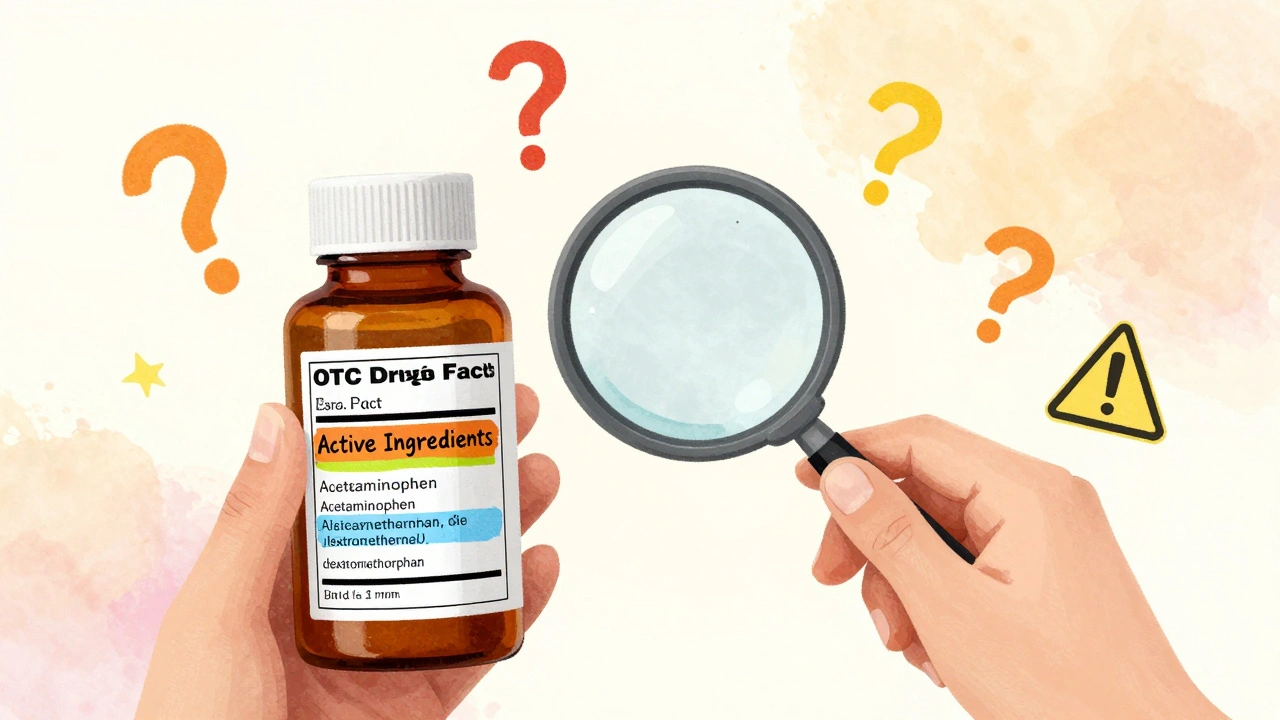
The very first thing on the label is the most important: Active Ingredients. This is the list of the actual medicines in the product-not the brand name, not the marketing slogan, but the chemical names that do the work. For example, you might see:
- Acetaminophen 325 mg
- Dextromethorphan HBr 10 mg
- Phenylephrine HCl 5 mg
Each one has a purpose listed right after: ‘pain reliever/fever reducer’, ‘cough suppressant’, ‘nasal decongestant’. This tells you exactly what each ingredient does. If you’re taking two different cold medicines, and both have acetaminophen, you’re doubling your dose. And that’s dangerous. The maximum safe daily dose of acetaminophen is 4,000 mg for most adults. One extra-strength Tylenol tablet has 500 mg. That means you can take up to eight in a day. But if you also take a cold medicine with 325 mg of acetaminophen per dose, and you take four of those, you’re already at 1,300 mg-before you even touch the Tylenol. It adds up fast.
Always check this section first. If you’re unsure what a chemical name means, look it up. Acetaminophen is also called paracetamol in other countries. Ibuprofen is the same as Advil or Motrin. Knowing these names helps you avoid taking duplicates.
Why Are You Taking This? Check the Uses Section
Next, look at the Uses section. This tells you what symptoms the medicine is approved to treat. It’s not marketing fluff-it’s what the FDA has verified through clinical testing. If the label says it treats ‘headache, fever, and body aches’, then that’s all it’s meant for. Don’t use it for something else, like allergies or stomach pain, unless it’s listed.
Some labels list dozens of symptoms. That doesn’t mean it’s better. It often means it’s a multi-symptom product, which combines several active ingredients. These can be useful if you have multiple symptoms-but risky if you only need one. For example, if you only have a cough, why take something that also has a decongestant and pain reliever? You’re exposing yourself to extra drugs you don’t need.
What Could Go Wrong? Read the Warnings
This is where most people skip. And that’s the biggest mistake.
The Warnings section is packed with life-saving information. It tells you when NOT to use the medicine. Look for:
- ‘Do not use if you have liver disease’ - this is almost always about acetaminophen
- ‘Ask a doctor before use if you’re taking blood thinners’ - ibuprofen can interfere with warfarin
- ‘May cause drowsiness’ - that’s usually diphenhydramine, found in nighttime cold medicines
- ‘Risk of stomach bleeding’ - common with NSAIDs like aspirin or naproxen
One study found that 89% of pharmacists say the Warnings section is the most critical part of the label. Why? Because it stops people from doing something dangerous before they do it. If you have high blood pressure, you need to avoid decongestants like phenylephrine. If you’re pregnant, some ingredients are off-limits. If you’re over 65, your body processes medicines slower-you might need a lower dose. The label won’t say ‘you’re old’-but it will say what to avoid based on your health.
How Much and How Often? Directions Are Not Suggestions
The Directions section tells you exactly how much to take, how often, and for how long. It’s not a suggestion. It’s a rule.
Pay attention to:
- ‘Adults and children 12 years and older: 2 caplets every 4 to 6 hours’
- ‘Do not take more than 12 caplets in 24 hours’
- ‘Do not use for more than 10 days’
Many people think ‘every 4 to 6 hours’ means they can take it whenever they feel like it. But that’s not how it works. If you take it every 4 hours, that’s six doses a day. If you take it every 6 hours, that’s four. Don’t go over the maximum. And never use it longer than the label says. Chronic use of pain relievers can damage your liver, kidneys, or stomach lining.
Also watch for units. ‘5 mL’ is one teaspoon. ‘10 mL’ is two teaspoons. Don’t guess. Use the measuring cup that comes with the bottle. Kitchen spoons vary too much to be reliable. And never use a child’s dose for an adult-or vice versa. Children’s Tylenol is 160 mg per 5 mL. Adult Tylenol is 325 mg or 500 mg per tablet. Mixing them up can lead to overdose.
What’s Not in It? Inactive Ingredients Matter Too
Many people think ‘inactive’ means ‘harmless’. That’s not true. These are the fillers, dyes, and preservatives that help the medicine stay stable or taste better. But if you have allergies, they can be dangerous.
Look for things like:
- FD&C Red No. 40 - a dye that can trigger reactions in sensitive people
- Gluten - some tablets use wheat starch as a binder
- Alcohol - some liquid cough syrups contain up to 10% alcohol
- Sodium - a single tablet might contain 2 mg, but if you’re on a low-sodium diet, that adds up
If you have celiac disease, a peanut allergy, or are on a strict diet, check this list every time. Brands change formulas. What was safe last month might not be safe this month.
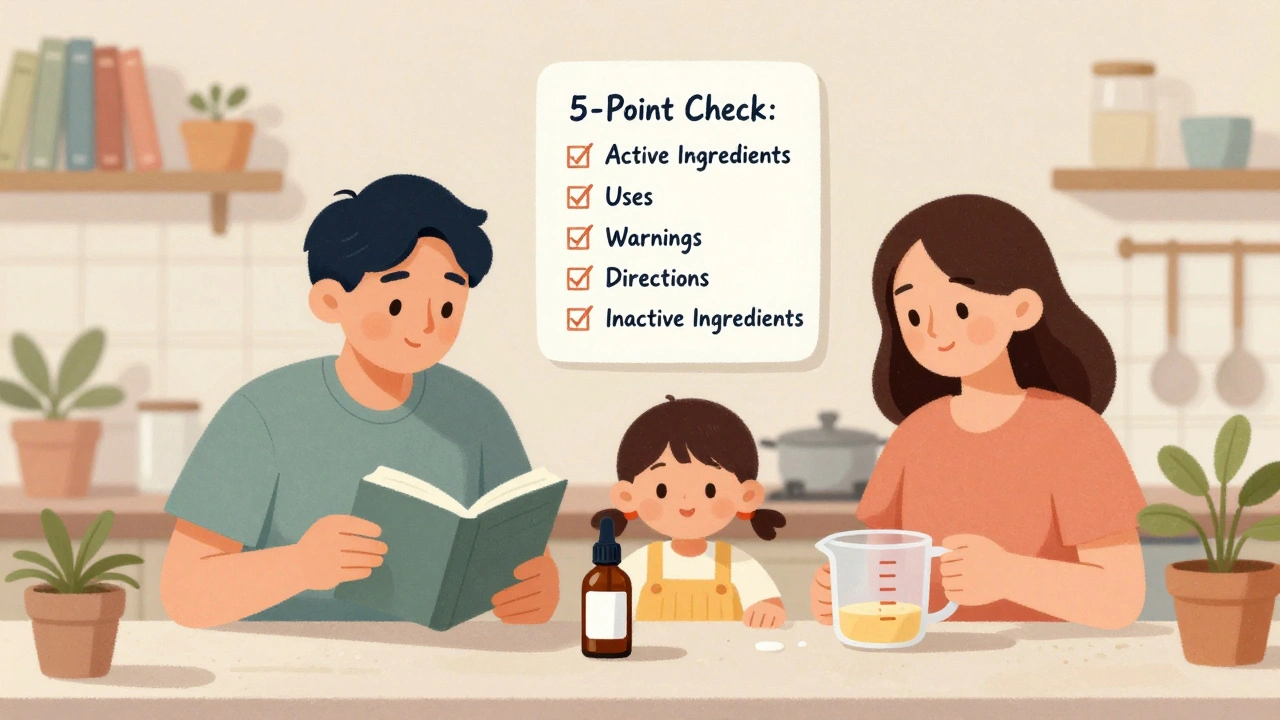
How to Use This Like a Pro: The 5-Point Check
Pharmacists at CVS Health and Walgreens recommend a simple five-step check that takes less than a minute:
- Identify the active ingredients - What’s actually in it? Write them down if you need to.
- Verify the uses - Does this match what you’re trying to treat?
- Read all warnings - Do any apply to you? Liver issues? High blood pressure? Pregnancy?
- Check directions - How much? How often? For how long? Are you giving the right dose for age or weight?
- Review inactive ingredients - Any allergens? Hidden sodium? Alcohol?
People who follow this method reduce their chance of a medication error by 68%, according to the BeMedWise Program. That’s not a small number. That’s life-changing.
What’s Changing Soon? The New Label Rules
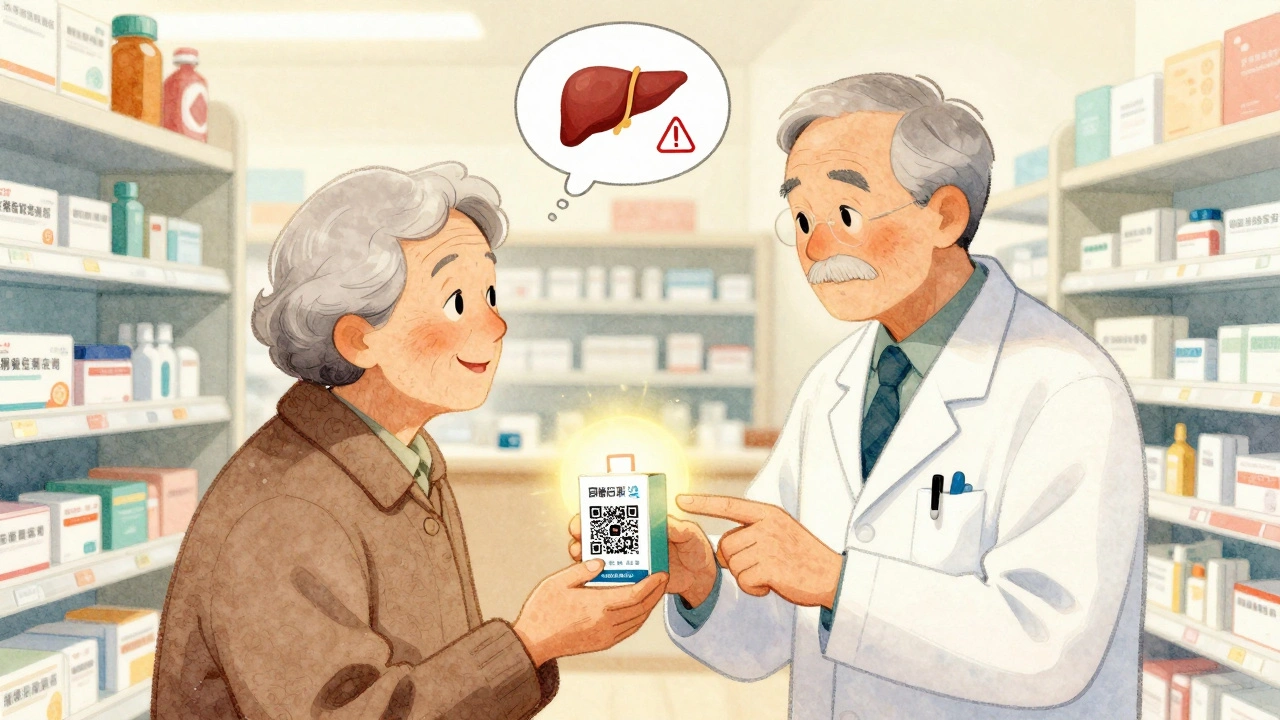
The FDA isn’t done. In 2024, new rules were passed requiring OTC labels to get even clearer by the end of 2025. Here’s what’s coming:
- Larger font size for active ingredients
- Color-coded sections (red for warnings, green for directions)
- Icons for common risks (like a liver icon for acetaminophen)
- QR codes that link to video explanations
These changes are based on data showing that visual cues help people understand faster. A 2023 FDA study found that when warnings had icons, 72% of older adults noticed them-compared to only 41% with text-only labels.
Don’t wait for the new labels to start reading carefully. The system works now. You just need to use it.
What If You’re Still Confused?
Ask a pharmacist. Seriously. They’re trained for this. And it’s free. Walgreens reported a 40% increase in OTC consultations after launching their ‘Label Literacy’ campaign in 2023. Pharmacists don’t judge. They’ve seen it all. They’ve helped people who accidentally took four cold medicines at once. They’ve helped grandparents who couldn’t read the tiny print. They’ve helped parents who didn’t know children’s medicine isn’t just ‘half the adult dose’.
And if you’re tech-savvy, download the free FDA Drug Label Decoder app. It lets you scan a barcode and instantly pulls up the label in plain language. Over 1.2 million people have used it since it launched in 2023.
Final Thought: You’re in Charge
OTC medicines are powerful. They’re not candy. They’re not harmless. They can save your life-or hurt you badly. The Drug Facts Label exists so you don’t have to guess. So you don’t have to rely on luck. So you can take control.
Next time you pick up a bottle, pause. Read the label like your health depends on it-because it does.
Can I take two OTC medicines if they have different brand names?
Only if they don’t share the same active ingredient. Many different brands contain acetaminophen, ibuprofen, or diphenhydramine. Just because the box says ‘Cold & Flu Relief’ and another says ‘Nighttime Pain Relief’ doesn’t mean they’re safe to combine. Always check the Active Ingredients section. If both list acetaminophen, don’t take them together. You could overdose without realizing it.
What does ‘extra strength’ mean on an OTC label?
‘Extra strength’ means the product contains a higher amount of the active ingredient than the regular version. For example, regular Tylenol has 325 mg of acetaminophen per tablet. Extra Strength Tylenol has 500 mg. That’s a 54% increase. Don’t assume extra strength means you can take fewer pills-always follow the directions on the label. Taking the same number of extra strength pills as regular ones can easily push you over the daily limit.
Why do some OTC medicines say ‘PM’ on the label?
‘PM’ means the product includes a sleep aid-almost always diphenhydramine (38 mg per dose). This is an antihistamine that causes drowsiness. It’s added to cold and pain medicines for nighttime use. But if you take a PM product during the day, you’ll feel sleepy. And if you’re already taking another medicine with diphenhydramine, you risk taking too much. Always check the Active Ingredients to avoid doubling up.
Is it safe to give children adult OTC medicine by cutting the dose in half?
No. Children’s medicines are specially formulated for their weight and metabolism. Adult medicines often contain ingredients or concentrations that aren’t safe for kids-even in smaller amounts. For example, adult ibuprofen tablets may include binders or coatings not tested for young children. Always use a product labeled for children and follow the dosing chart by weight or age. If you’re unsure, ask a pharmacist or pediatrician.
How do I know if I’m taking too much acetaminophen?
Acetaminophen is in more than 600 OTC and prescription products. The safe daily limit is 4,000 mg for most adults. But if you have liver disease, drink alcohol regularly, or are underweight, your limit may be lower. Signs of overdose include nausea, vomiting, loss of appetite, and pain in the upper right side of your abdomen. These symptoms can be delayed by hours or even a day. If you suspect you’ve taken too much, call Poison Control at 1-800-222-1222 immediately-even if you feel fine. Liver damage can happen without warning.
Sangram Lavte
December 6, 2025 AT 17:44Reading the label is the bare minimum. I used to ignore it until my cousin ended up in the ER after mixing NyQuil and Advil Cold & Flu. Both had acetaminophen. He thought ‘different brands = safe.’ Turns out, the FDA doesn’t care what the box looks like-only what’s in the pill. Always check the active ingredients. No exceptions.
Kurt Russell
December 7, 2025 AT 11:50THIS. This is the most important post I’ve seen all year. I work in a pharmacy and I’ve seen people take 12 different OTC meds at once because ‘they all help with different things.’ Bro. They all have the same active ingredients. You’re not being smart-you’re being a walking overdose waiting to happen. Stop guessing. Read the damn label. Your liver will thank you. And yes, the new color-coded labels are coming-and they’re long overdue.
Stacy here
December 9, 2025 AT 06:37They’re hiding the truth. The FDA doesn’t want you to know how many of these drugs are just repackaged junk. Look at the inactive ingredients-FD&C dyes, corn syrup, gluten fillers. Who approved this? Big Pharma’s got the FDA in their pocket. They don’t care if you get liver damage as long as you keep buying. The QR codes? Just a distraction. The real danger is the hidden sodium in ‘sugar-free’ cough syrups. I’ve seen diabetics crash because they didn’t check. This isn’t safety-it’s corporate theater.
Nicholas Heer
December 10, 2025 AT 01:26Y’all are missing the REAL issue. The FDA doesn’t regulate these labels to protect you-they regulate them so they can sue you if you mess up. ‘Warning: May cause drowsiness’? That’s not a warning, that’s a liability shield. They know people will ignore it. They know you’ll take it with alcohol. They know you’ll give it to your kid. And when you overdose? They say ‘you didn’t read the label.’ So they don’t pay. That’s the game. Don’t trust the label. Trust your gut. And if you’re still confused? Don’t take it. Go to the ER. They’ll check your blood anyway.
Oliver Damon
December 11, 2025 AT 08:29There’s a deeper layer here that nobody’s talking about: we’ve outsourced our health literacy to corporations. We treat OTC meds like snacks because we’ve been conditioned to believe that ‘if it’s on the shelf, it’s safe.’ But safety isn’t a feature-it’s a responsibility. The label isn’t a suggestion; it’s a contract between you and your biology. The 5-point check works because it forces you to pause. To think. To remember that your body isn’t a machine you can hack with random pills. And yes, the new icons and color-coding? They’re good. But they’re still just tools. The real upgrade is in your habits. Start reading. Not because you have to-but because you deserve to be in control.