
How to Request Easy-Open Caps and Accessible Labels for Medication Safety
 Mar, 29 2026
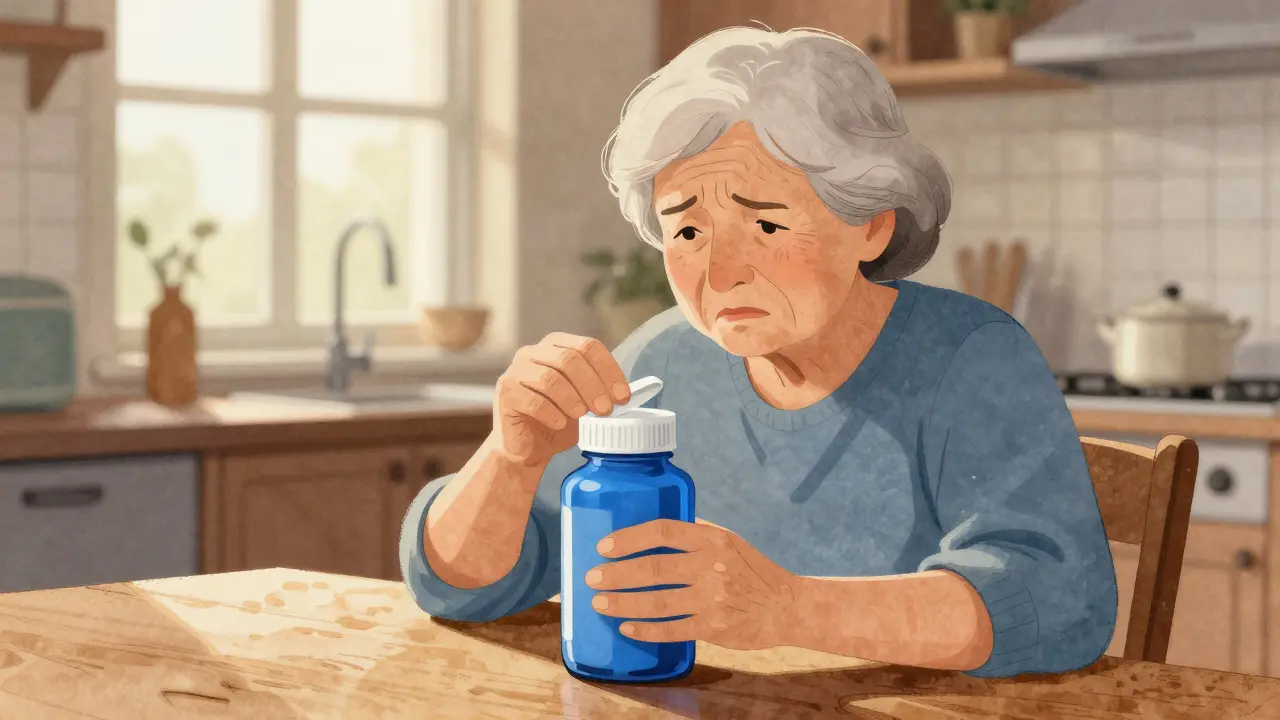
Did you know that nearly half of all adults over age 65 struggle to open their medicine bottles? That number is roughly 49%, according to a 2022 report from the FDA Consumer Safety Office. These standard caps are designed to keep children safe, often requiring significant strength and coordination. But for someone with arthritis, limited hand strength, or visual impairment, these safety features can actually become barriers to health. You shouldn't have to choose between keeping children safe and getting your medication. Easy-Open Caps are specifically designed closures that meet safety standards while requiring much less force to operate.
The Conflict Between Child Safety and Senior Accessibility
The United States mandated child-resistant packaging under the Poison Prevention Packaging Act of 1970 to protect children under five from accidental poisoning. To meet these rules, manufacturers design bottles that require specific movements, like pushing down while turning simultaneously. This creates a mechanical barrier that is hard for children to navigate. Unfortunately, the same strength and dexterity needed to open these bottles is often exactly what older adults lose due to aging or conditions like rheumatoid arthritis.
Current regulations follow ISO 8317 testing protocols established in 2015 and updated in 2020. These tests measure performance: 85% of children aged 42-51 months should not be able to open the bottle within 10 minutes, while 70-80% of adults aged 50-70 must be able to open it within 5 minutes. While this sounds reasonable, real-world usage tells a different story. Many seniors fall outside that "adults 50-70" demographic range or have mobility issues that make the 5-minute goal impossible. This gap has led to increased medication non-adherence, where patients simply don't take their medicine because opening the container is too painful or frustrating.
Types of Accessible Closures Available Today
If you walk into a pharmacy, the standard "child-resistant" cap isn't your only option anymore. Innovation in pharmaceutical packaging has created several alternatives that balance safety with ease of use. Understanding the specific mechanisms helps you request exactly what you need.
| Type of Cap | Opening Mechanism | Force Required | Child Resistance Rating | Best For |
|---|---|---|---|---|
| PUSH-AND-TURN (Standard) | Press down + Rotate | 4.5-8.5 lbf | 98% | Homes with active children under 5 |
| SQUEEZE-AND-TURN | Squeeze sides + Rotate | 6-10 lbf | 95% | Users with grip but low dexterity |
| SNAPSLIDE RX | Single-handed slide action | < 2.5 lbf | 94% | Arthritis sufferers, limited hand strength |
| EZ-OPEN FLIP CAP | Lift latch + Flip | Variable | Not Child-Resistant | Homes without children |
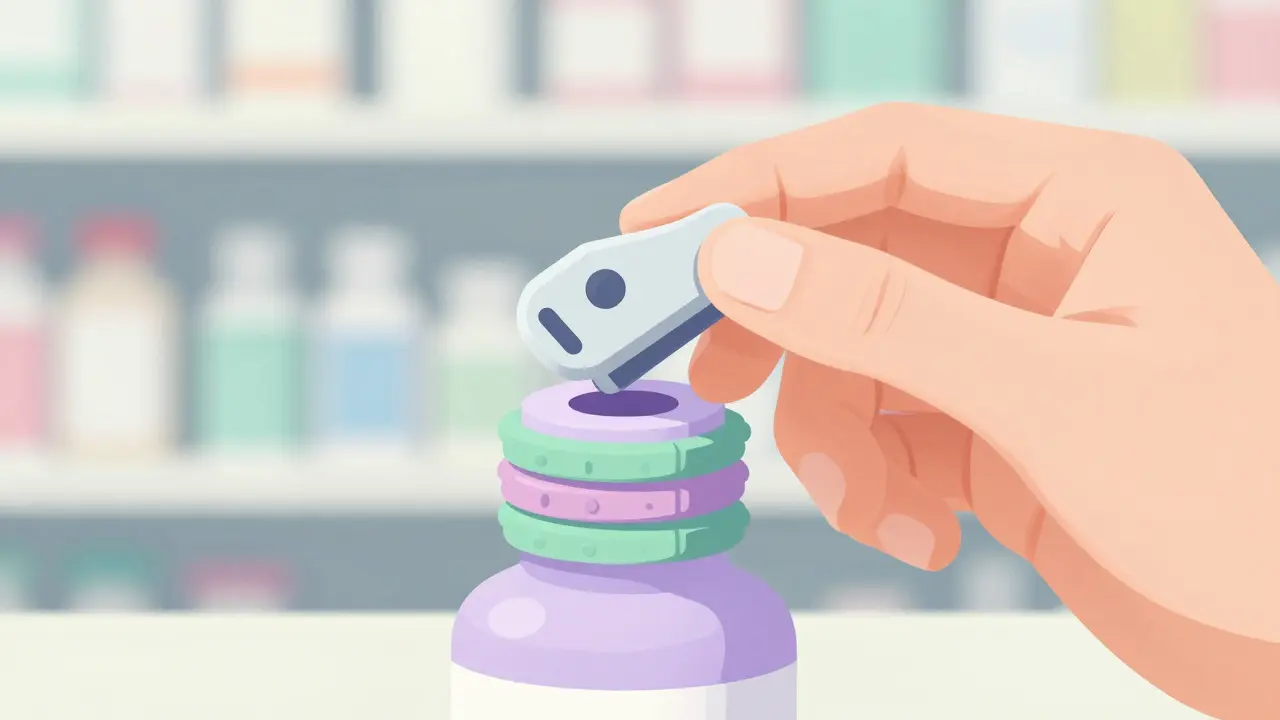
The SnapSlide Rx closure is particularly notable; it won the 2024 IoPP AmeriStar Award for balancing safety and accessibility. It uses a patented sliding mechanism that requires less than 2.5 pounds of force, compared to the 4.5 pounds often needed for standard push-down caps. Another common alternative is the flip-top cap with a larger serrated surface. However, be aware that some EZ-Open designs lack child resistance entirely. If you live with grandchildren who visit frequently, you may want to discuss the safety trade-offs with your pharmacist.
Understanding Accessible Label Formats
Accessibility isn't just about the lid; it's also about the information printed on the bottle. Vision loss affects millions of seniors, making standard 10-point font difficult or impossible to read. The Access Board finalized guidelines for prescription drug container labeling in 2019, establishing mandatory formats for accessibility.
- Large Print Labels: These use a minimum of 16-point font. They are high contrast and easier to read at arm's length.
- Braille Labels: Adhering to Grade 2 Braille standards with dot heights of 0.5mm. These provide tactile information about the drug name and dosage.
- Audible Labels: Some systems allow scanning a QR code or pressing a button on the bottle to hear the label information. The audio file must contain complete details within 90 seconds per guidelines.
- Tactile Markers: Color-coded bands help distinguish between morning and evening doses or different medications without reading fine print.
In 2023, the American Foundation for the Blind surveyed over 1,200 visually impaired users. Their findings were stark: 68% reported at least one medication error caused by inaccessible labeling. Switching to braille or large-print formats drastically reduces this risk. A separate study noted that when patients used accessible labels, adherence rates improved by over 30%. The text on the label matters as much as the mechanism of the cap.
Step-by-Step Guide to Requesting Accessible Packaging
Many pharmacies do not offer these solutions proactively because they require special stock. You often have to initiate the request correctly to get the right product. Here is the practical workflow for securing these accommodations.
- Time Your Request Correctly: Do not ask at the pickup counter. By then, the bottle is already sealed. You must request accessible packaging at the moment of prescription creation, ideally when the doctor's office faxes or electronically sends the order to the pharmacy. If you wait until you receive the medication, the delay could stretch up to 72 hours while the pharmacy restocks or repackages.
- Know Your Rights: Under the Access Board's 2019 guidelines, pharmacies are legally required to provide accessible options upon request. Contrary to popular belief, you generally do not need to provide medical documentation proving arthritis or vision loss. However, having a physician's note explaining the functional limitation can speed up approval in cases where staff are unfamiliar with the law.
- Be Specific About Needs: Don't just ask for "easy opening." Specify the type. Say, "I need a senior-friendly cap that meets child-resistance standards," or "Please provide large-print labeling due to vision impairment." Using specific terminology signals to the technician that you understand the available inventory.
- Verify Inventory Availability: Not every chain carries every type of closure. Major chains like CVS and Walgreens have increased adoption, but independent pharmacies may face stock constraints. If your local pharmacy cannot fulfill the request immediately, ask if they can transfer your prescription to a location with better stock.
Funding and Coverage for Specialized Packaging
A common concern is whether these specialized containers cost more than standard bottles. In reality, accessible packaging solutions typically carry a manufacturing premium of 15-20%. Historically, patients sometimes had to foot this bill. However, the financial landscape has shifted recently.
Medicare Part D's policy update in 2024 now covers the costs of these packages for beneficiaries with documented dexterity or vision limitations. This means if you are enrolled in Medicare Advantage or standalone Part D plans, you likely do not pay extra for the upgraded packaging. Commercial insurance plans vary, so it is worth asking your pharmacy benefits manager (PBM) if they cover the cost difference. The investment pays off in reduced waste; Kaiser Permanente data showed that patients using senior-friendly packaging saw a 32% drop in medication wastage because they didn't give up on opening the bottles.
Addressing Barriers and Troubleshooting
You might encounter resistance when requesting these changes. A January 2024 review on Yelp highlighted a scenario where a pharmacy claimed "no inventory" three times before finally providing large-print labels after the customer cited HIPAA and ADA rights. When this happens, you need escalation tactics.
First, clarify that you aren't asking for a gift, but a compliance accommodation. Pharmacists know about the regulations but might prioritize speed over accuracy during busy rushes. Speaking directly to the store manager rather than a counter technician can sometimes bypass routine objections. Second, use external support resources. The National Council on Aging maintains a Medication Access Hotline that assists in resolving disputes regarding packaging availability. As of Q1 2024, they reported a 94% success rate in helping patients secure proper equipment.
Third, remember that availability varies by location. The National Community Pharmacists Association noted in early 2024 that only 37% of independent pharmacies consistently stock accessible closures, while enterprise chains like CVS implemented system-wide options in late 2023. Switching pharmacies might be the only permanent solution if your current location lacks supply.
Does requesting an easy-open cap compromise child safety?
No. Most modern senior-friendly closures, including SnapSlide and other ISO-compliant versions, maintain a child-resistance rating above 90%. The mechanism is easier for adults to manipulate but still requires complex motions that young children typically cannot perform independently.
How long does it take to switch my bottle type?
Pharmacies usually require between 24 to 72 hours to prepare accessible packaging. This allows time for technicians to manually repackage medication or retrieve stock from the warehouse. Plan your refill requests ahead of time to avoid running out of medication.
Can I get this service if I am not disabled?
Yes. While regulations target patients with disabilities, pharmacies generally honor requests for easier caps for anyone who has difficulty opening them, regardless of formal diagnosis. However, some private insurance policies might require a documented medical reason to waive copay differences.
Are there apps that help identify accessible pharmacies?
The American Foundation for the Blind provides an online tool that identifies pharmacies within a specific radius offering accessible options. Additionally, many major pharmacy chains have locator pages where you can filter by accessibility services.
What is the difference between Braille and Large Print labels?
Large print labels use significantly larger fonts (minimum 16-point) for those with low vision but remaining sight. Braille labels feature raised dots following Grade 2 standards for those who rely on tactile reading. You can request both on the same container if needed for comprehensive accessibility.
Carolyn Kask
March 31, 2026 AT 11:52America is supposed to lead the world on this stuff but local pharmacies struggle so much! 😤 We know the laws! Just follow them properly!!!
Jonathan Sanders
April 1, 2026 AT 05:27Nothing says "we care" like a plastic bottle designed to break your fingers.
Seriously, why is health care this much effort?
Katie Riston
April 2, 2026 AT 23:57It is fascinating how medical safety becomes so bureaucratic. People lose their grip strength naturally with age. Society often forgets this simple biological fact. Designers prioritize children while ignoring the elderly. This imbalance creates unnecessary suffering for seniors. A pill bottle should not require gym strength. We build infrastructure for convenience yet ignore medicine. Accessibility features are treated like optional upgrades. True equity means removing barriers completely. When packaging hurts hands, adherence drops significantly. Non-compliance leads to worse health outcomes later. Preventing poison does not justify inflicting pain daily. Innovation in caps exists but adoption is slow. Insurance coverage helps bridge the financial gap finally. We deserve dignity in our basic healthcare access rights. Technology should serve humanity first of all.
emma ruth rodriguez
April 4, 2026 AT 20:41The regulations are clear! Compliance is mandatory!!! The FDA Consumer Safety Office data supports these claims fully! Everyone must read the ISO 8317 protocols!
Safety standards cannot be ignored!!
Beccy Smart
April 6, 2026 AT 13:32Rules are just suggestions for the greedy 💸🚫
Rick Jackson
April 8, 2026 AT 01:45Systems fail when profit overrides people.
Empathy drives better design choices.
sanatan kaushik
April 8, 2026 AT 12:02You should demand more rights from these shops now. Do not wait for permission to fix your own problems!
Debbie Fradin
April 9, 2026 AT 22:39Hope springs eternal even when the bottle cap fights back lol. At least the insurance covers the cost now mostly.
Keep fighting for what you need!