
How to Safely Dispose of Unused Opioids to Prevent Misuse and Overdose
 Feb, 17 2026
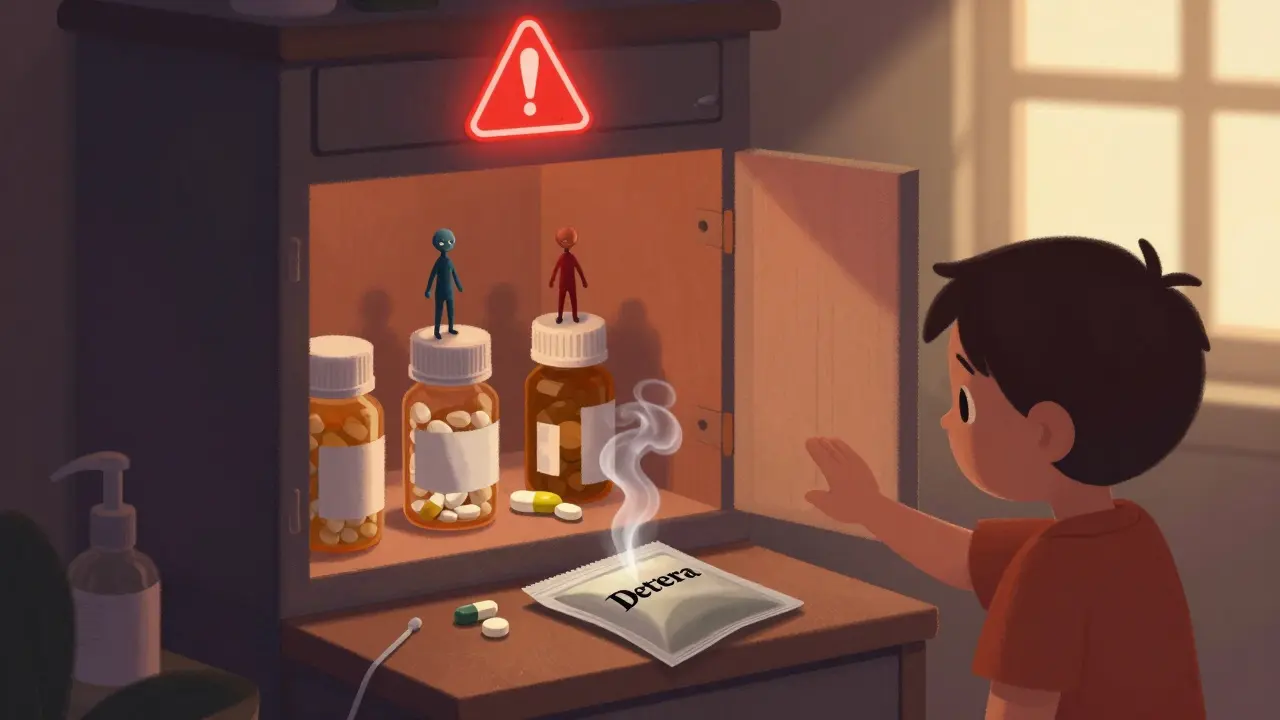
Every year, thousands of opioid overdoses happen because someone found leftover pills in a medicine cabinet - a friend, a teenager, a relative. It’s not a rare accident. It’s predictable. The CDC says nearly 70% of misused prescription opioids come from family or friends’ homes. If you’ve been prescribed opioids for pain after surgery or an injury, and you have pills left over, you’re holding onto a risk. Not because you’re careless, but because most people don’t know how to get rid of them safely. Here’s how to do it right - and why it matters.
Why Proper Disposal Matters
Unused opioids don’t just sit there quietly. They’re a magnet for misuse. A 2021 study found that 20% of opioid prescriptions go completely unused. That’s millions of pills sitting in bathrooms and drawers across the country. These aren’t just pills. They’re potential triggers for addiction, overdose, or even death - especially in homes with kids, teens, or visitors who don’t know the risks.
The CDC calls safe disposal a tier 1 intervention in overdose prevention. That means it’s one of the most effective steps you can take. Studies show that when people dispose of unused opioids properly, they cut the chance of someone else using them by up to 82%. And it’s not just about preventing misuse - it’s about saving lives. Experts estimate that if every unused opioid were disposed of correctly, we could prevent 8,000 to 12,000 deaths per year by 2030.
Four Safe Ways to Dispose of Unused Opioids
There are four proven methods to safely get rid of leftover opioids. Not all are equally easy or available, but one of them will work for you.
1. Use a Drug Take-Back Program
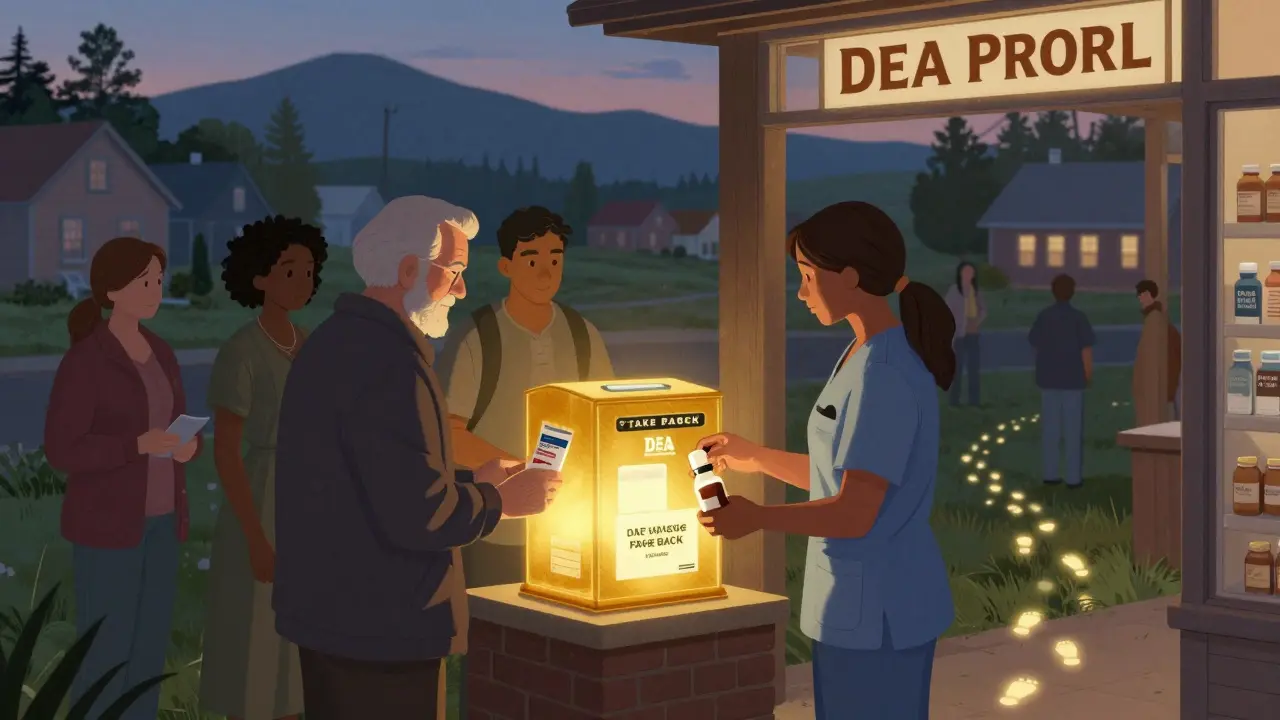
This is the gold standard. Take-back programs collect unused medications and destroy them in high-temperature incinerators that completely break down the drugs. No trace remains. These programs are run by pharmacies, hospitals, and police stations - all registered with the DEA.
As of 2023, there are over 16,900 official collection sites across the U.S. You can find your nearest one in under a minute using the DEA’s online Take Back Locator. Just enter your ZIP code. Many Walgreens and Walmart locations have secure drop boxes inside the pharmacy - no appointment needed. They’re open during store hours, and you don’t have to give your name or show ID.
These programs are 98% effective at preventing diversion. They’re free, fast, and anonymous. If you live near a city or town with a pharmacy or police station, this is your best option.
2. Use a Deactivation Pouch (Like Deterra or SUDS)
If you can’t get to a take-back site, deactivation pouches are your next best choice. These are small, biodegradable bags you can buy at most pharmacies. Brands like Deterra and SUDS use activated carbon and chemical agents to neutralize opioids within 30 minutes.
Here’s how they work: Put your pills in the pouch, add warm water, seal it, and shake. The pouch absorbs and breaks down the drugs. No flushing. No mess. No risk of someone finding them later. Lab tests show they deactivate 99.9% of opioids.
They cost between $2.50 and $5.00 each. You’ll find them at 85% of major pharmacy chains - CVS, Walgreens, Rite Aid, and many independent pharmacies. Some hospitals and clinics even give them out for free when they prescribe opioids. Just ask.
3. Household Disposal (When Nothing Else Is Available)
If you’re in a rural area with no take-back site within 50 miles, and you don’t have a deactivation pouch, the FDA says you can dispose of opioids at home - but only if you do it right.
Here’s the correct method:
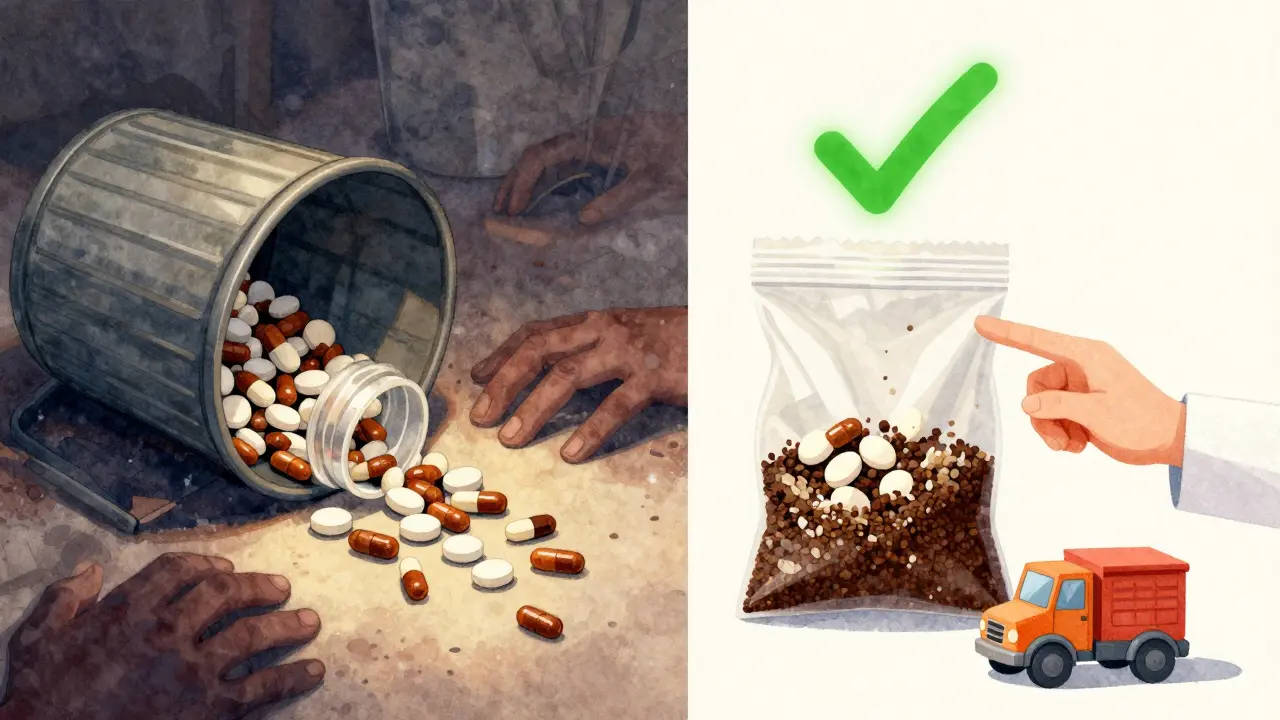
- Remove pills from their original container.
- Mix them with an unappetizing substance - used coffee grounds, cat litter, or dirt. This makes them disgusting to anyone who might dig through the trash.
- Put the mixture in a sealable plastic bag or empty jar with a tight lid.
- Cover your name and prescription info on the empty bottle with a permanent marker or tape.
- Throw the sealed bag in the trash.
This method reduces diversion risk by 82%, according to a 2020 study in Lake County, Indiana. But it only works if you follow all the steps. Many people skip the sealing or forget to mark out their name - which leaves their information vulnerable. Don’t do that. This isn’t a suggestion. It’s a safety protocol.
4. Flushing (Only for Specific Medications)
Flushing is controversial. It’s not ideal for the environment - trace drugs have been found in waterways. But for certain high-risk opioids, the FDA says flushing is the safest option if no other method is available.
Only flush these 15 specific opioids:
- Fentanyl patches
- Oxycodone (OxyContin, Percocet)
- Morphine sulfate
- Hydrocodone (Vicodin)
- Hydromorphone (Dilaudid)
- Tapentadol (Nucynta)
- Meperidine (Demerol)
- Methadone
- Levorphanol
- Tramadol (Ultram)
- Codeine
- Propoxyphene (Darvon)
- Alfentanil
- Buprenorphine (Subutex)
- Remifentanil
These are the ones most likely to cause overdose if accidentally ingested - especially by children. If you have one of these and can’t get to a take-back site or pouch, flush it down the toilet. It’s the quickest way to remove a deadly risk from your home.
What NOT to Do
Don’t make these common mistakes:
- Don’t just throw pills in the trash. Someone could find them.
- Don’t flush every opioid. Only the 15 on the FDA list. Flushing others harms the environment.
- Don’t mix pills with water in their original bottle. That doesn’t deactivate them - it just makes a sludge that’s still dangerous.
- Don’t wait. The longer you keep them, the higher the risk.
What Doctors and Pharmacies Should Be Doing
Here’s the uncomfortable truth: most people don’t know how to dispose of opioids because their doctors never told them. A 2022 report found that only 38% of prescribers routinely give disposal instructions.
But it’s changing. The American Society of Regional Anesthesia now requires all opioid prescriptions to include disposal info. Some hospitals - like Mayo Clinic - give out deactivation pouches at discharge and see 89% compliance. That’s not luck. It’s policy.
If your doctor didn’t mention disposal, ask. Say: “What should I do with the rest of these pills?” Most will be glad you asked.
Real-World Results
Communities that combine all four methods see real results. A University of Florida study found that when people had access to take-back sites, pouches, and clear instructions, opioid diversion dropped by 37%. In Wyoming, after they rolled out visual guides and free pouches, 61% of people without nearby sites still disposed of their pills correctly.
And it’s not just about numbers. One Reddit user wrote: “I found my dad’s old OxyContin bottle after he passed. I used a Deterra pouch. I felt like I just saved someone’s life.” That’s the power of this simple act.
What’s Changing in 2026
More options are coming. The DEA added 1,200 new collection sites in 2023 - many in tribal communities and rural areas. The FDA is testing QR-code-enabled pouches that track usage without naming users. By 2025, hospitals may be scored on how well they help patients dispose of opioids - just like patient satisfaction.
And the funding? It’s growing. States are using opioid settlement money to pay for pouches, kiosks, and education. In California, $5 million went to install drop boxes. In Wyoming, $1.2 million funded free disposal kits.
Your Next Step
Check your medicine cabinet right now. If you have any leftover opioids - even one pill - act today.
- Go to deadrugtakeback.com and find your nearest drop box.
- Check your local pharmacy. Ask if they have deactivation pouches.
- If you have a fentanyl patch, oxycodone, or morphine - and no other option - flush it.
- If you’re unsure, call your pharmacist. They’ve seen this before. They’ll help.
You didn’t need to be a doctor or a policymaker to make this change. You just needed to know. Now you do. And that’s how prevention starts - with one person, one bottle, one decision.
Sam Pearlman
February 17, 2026 AT 23:17Carrie Schluckbier
February 19, 2026 AT 20:53Jonathan Ruth
February 21, 2026 AT 10:52guy greenfeld
February 23, 2026 AT 05:25Adam Short
February 24, 2026 AT 08:55Steph Carr
February 24, 2026 AT 23:23Brenda K. Wolfgram Moore
February 25, 2026 AT 10:08Linda Franchock
February 26, 2026 AT 22:25Agnes Miller
February 27, 2026 AT 09:14Geoff Forbes
February 28, 2026 AT 18:21Philip Blankenship
March 1, 2026 AT 16:17Oliver Calvert
March 1, 2026 AT 18:00Kancharla Pavan
March 3, 2026 AT 10:15PRITAM BIJAPUR
March 3, 2026 AT 19:03Liam Earney
March 5, 2026 AT 12:41