
How to Store Light-Sensitive Medications and Eye Drops Correctly
 Dec, 15 2025
Many people don’t realize that their eye drops or medications could be losing effectiveness - even before the expiration date - just because they’re sitting on the bathroom counter. Light isn’t just something that helps you see; it’s actively breaking down the chemicals in some of the most important medicines you take. If you’re using eye drops for glaucoma, antibiotics, or hormone-based treatments, and you’re storing them in a clear bottle near a window or under bright lights, you might be risking your health without even knowing it.
Why Light Destroys Medications
Light doesn’t just fade your favorite shirt - it changes the chemistry of your medicine. Certain drugs, especially eye drops and injectables, contain compounds that react to UV and blue light. When exposed, these compounds break down. This isn’t just theoretical. Studies show that some eye drops lose up to 40% of their potency after just seven days in a clear container. Tretinoin cream turns yellow. Insulin clumps. Antibiotics become less effective. In some cases, degraded medications can even create harmful byproducts. The pharmaceutical industry has known this since the 1920s. Back then, pharmacists noticed that nitroglycerin and tetracycline lost strength fast if left in sunlight. Today, we have hard data: over 470 injectable drugs require light protection. The U.S. Pharmacopeia (USP) updated its standards in 2022 to make sure these drugs are packaged in containers that block light below 470 nanometers - the wavelength range most damaging to medications.What Counts as Light-Sensitive?
Not all medicines need special care. But many do. Look for these signs:- “Protect from light” or “Store in original container” on the label
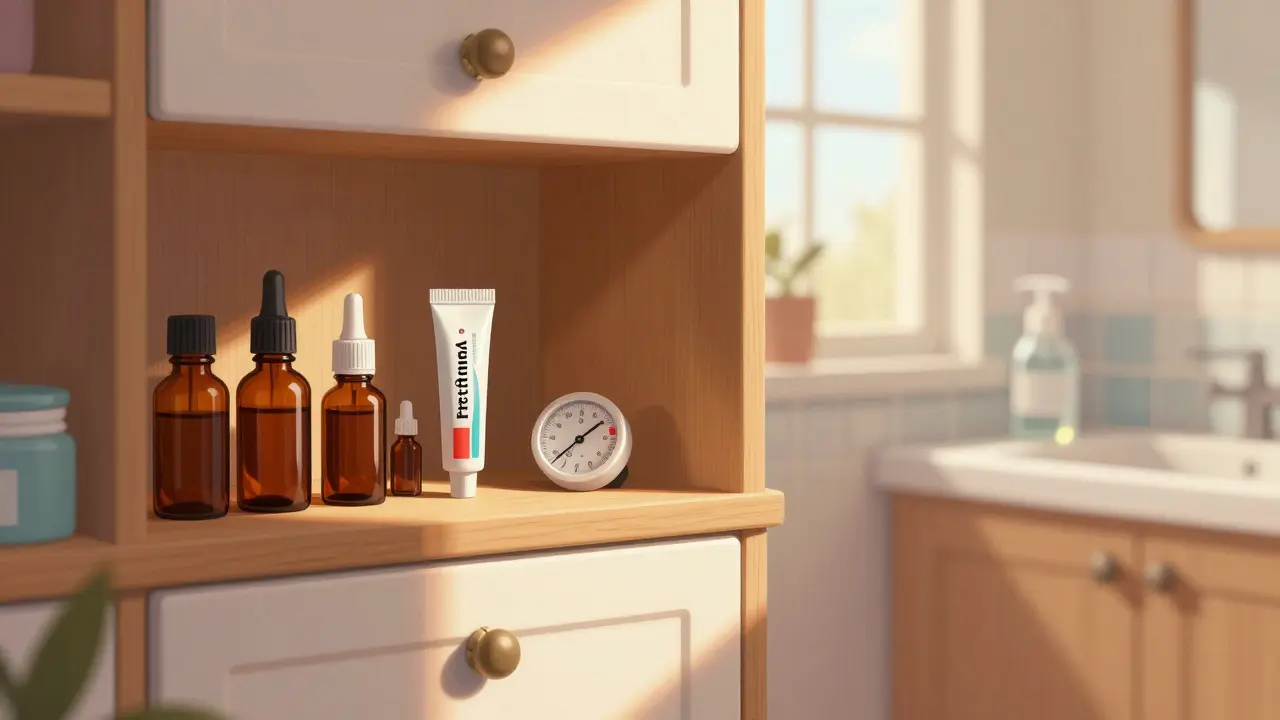
- Amber, brown, or opaque bottles (not clear plastic or glass)
- Medications like latanoprost, bimatoprost, tretinoin, doxycycline, nitroglycerin, chemotherapy agents, and certain vitamin D or potassium iodide formulations
- Eye drops, especially those for glaucoma, infections, or inflammation
How to Store Eye Drops Properly
Eye drops are especially vulnerable. They’re liquid, exposed to air, and often used daily for months. Once opened, they’re no longer sterile, and light makes them degrade faster.- Keep them in their original amber bottle. Never transfer them to a clear container, even if it’s easier to see the liquid level.
- Store them between 40°F and 77°F (4°C to 25°C). Most don’t need refrigeration unless the label says so. Some, like latanoprost, should be refrigerated before opening and kept at room temperature after opening.
- Avoid leaving them in your car, on a sunny windowsill, or in a hot bathroom.
- Check for changes: if the liquid turns cloudy, changes color, or develops particles, throw it away.

Storage Solutions That Actually Work
You don’t need fancy gadgets. But you do need the right container.- Amber glass bottles: Block 98% of harmful light. These are the gold standard. Most prescription eye drops come in these for a reason.
- Opaque plastic containers: Block about 85% of light. Cheaper and lighter, but slightly less effective. Still better than clear plastic.
- UV-blocking storage boxes: These cost $20-$60 and are great for travel or if you have multiple light-sensitive meds. Look for ones with internal UV filters, not just dark exteriors.
- Aluminum foil: Wrapping a bottle in foil gives 100% protection - but it’s messy. You have to unwrap it every time. A 2021 study found 32% of people stopped using this method because it was too inconvenient.
What to Avoid
Here are the top mistakes people make:- Storing meds in the bathroom - heat and steam ruin them.
- Leaving eye drops in the car - temperatures inside can hit 140°F on a summer day.
- Transferring medications to pill organizers or clear bottles - even if they look clean, they offer zero light protection.
- Keeping them near a window - even indirect sunlight can cause damage over time.
- Ignoring expiration dates after opening - most eye drops expire 4-6 weeks after opening, regardless of the bottle’s printed date.
Signs Your Medication Has Gone Bad
Trust your eyes - and your nose.- Color change: White cream turning yellow, clear liquid turning brown or cloudy.
- Texture change: Creams that separate, gels that become grainy, liquids that thicken or thin unnaturally.
- Unusual smell: Aspirin smells like vinegar when degraded. Some antibiotics smell metallic or sour.
- Visible particles: Especially in eye drops - never use if you see floating bits.

Traveling With Light-Sensitive Medications
Airports, road trips, vacations - all are risky for meds.- Carry them in your carry-on, not checked luggage. Temperatures in cargo holds can drop below freezing or rise above 100°F.
- Use a small insulated bag with UV protection. Many cost under $30 and fit in a purse or backpack.
- Keep them in your pocket or a shaded bag - never in a sunlit suitcase.
- For insulin or biologics, use a cooling pack designed for meds. Don’t freeze them.
When to Call Your Pharmacist
If you’re unsure about your medication’s storage needs, call your pharmacist. They have access to databases that list exact requirements for over 12,000 drugs. The American Society of Health-System Pharmacists offers a free online tool that checks storage conditions by drug name. Also call if:- Your medication looks or smells different.
- You’ve left it in a hot car or sunny room for more than a few hours.
- You’re traveling to a very hot or cold climate.
- You’re unsure whether to refrigerate it.
Final Tip: Make It Simple
You don’t need to overthink this. Here’s a one-step rule:Keep your light-sensitive meds where you keep your toothpaste - but not in the bathroom.
A kitchen cabinet, away from the stove and sink, is ideal. Cool, dry, dark. Add a small hygrometer (they cost under $10) to check humidity. If you have kids or pets, use a cabinet with a child-resistant lock. It’s not about being perfect. It’s about being consistent. One mistake won’t ruin your treatment. But repeated exposure? That’s how people lose vision, get infections, or find their meds just don’t work anymore.Light protection isn’t optional. It’s part of your treatment plan - just like taking the dose on time.
Can I store eye drops in the refrigerator?
Some eye drops should be refrigerated before opening, like latanoprost. Once opened, most can be kept at room temperature (40-77°F) for up to 6 weeks. Always check the label. Refrigerating drops that don’t need it can cause them to thicken or form crystals, making them harder to use.
What if my medication came in a clear bottle?
If the label says “protect from light,” transfer it to an amber or opaque container immediately. Many pharmacies offer free amber vials. Don’t wait until the medicine looks changed - degradation can happen before you see it.
How long do eye drops last after opening?
Most last 4 to 6 weeks after opening, even if the bottle says “use by” a later date. Light, air, and bacteria reduce effectiveness faster than the printed expiration. When in doubt, throw it out.
Are UV-blocking storage boxes worth it?
Yes, if you take multiple light-sensitive medications or travel often. They offer consistent protection without needing to wrap each bottle. Look for ones with internal UV filters, not just dark plastic. Many users report fewer medication issues after switching.
Can light exposure make my medication dangerous?
In rare cases, yes. Degraded chemotherapy drugs, antibiotics, and hormone treatments can form toxic byproducts. Even if they don’t become poisonous, they lose potency - which means your condition isn’t being treated properly. That’s dangerous on its own.
Storing your medications correctly isn’t complicated - but it’s critical. A few minutes of attention today can save you from weeks of ineffective treatment, wasted money, or worse. Keep them dark, cool, and dry. Your health depends on it.
jeremy carroll
December 16, 2025 AT 00:44bro i just threw out my glaucoma drops last week cuz they looked weird and i thought i was being dramatic. turns out i was right?? this post saved my vision lmao
Rulich Pretorius
December 17, 2025 AT 23:39Light degradation of pharmaceuticals isn’t new-it’s been documented since the early 20th century. What’s alarming is how little public education exists around it. Pharmacists know this, but patients are left to guess. The real issue isn’t storage-it’s systemic neglect in patient counseling. We treat meds like groceries, not precision tools. Fix that, and you fix half the non-adherence problems in chronic disease management.
Edward Stevens
December 18, 2025 AT 07:01so let me get this straight-i’ve been keeping my tretinoin next to my toothbrush like it’s a damn body wash and now my face looks like a lizard’s? thanks for the wake-up call, doc. i’m wrapping everything in foil tonight. even my vitamins. i’m not taking any chances.
Thomas Anderson
December 20, 2025 AT 02:04just bought one of those UV boxes for $25. worth every penny. my insulin and eye drops are now in a little black box under my bed. no more guessing. no more scary color changes. simple as that.
Jonny Moran
December 21, 2025 AT 08:21if you’re reading this and you’re on glaucoma meds-please, for your future self, stop leaving them on the bathroom counter. i’ve seen people go blind because they thought ‘it’s just eye drops.’ it’s not. it’s your vision. treat it like it matters.
Sinéad Griffin
December 22, 2025 AT 08:16USA > all other countries when it comes to med safety. why? because we have standards. if you’re still using clear bottles, you’re basically playing russian roulette with your eyes 😤🇺🇸💊
Alexis Wright
December 22, 2025 AT 15:54Let’s be real-this isn’t about light. It’s about the pharmaceutical industry’s deliberate obfuscation. Why aren’t ALL medications sold in UV-blocking containers? Because it costs more. Because they profit off your ignorance. You think your $80 bottle of latanoprost is safe? It’s only safe if you’re willing to do the work they don’t want you to do. Welcome to capitalism, where your vision is a line item on a balance sheet.
Sarthak Jain
December 23, 2025 AT 18:04i live in india and we dont have access to amber bottles everywhere. i wrap my drops in aluminum foil and put them in a dark drawer. its messy but it works. also, i check the color every day. if it looks off, i throw it. better safe than blind, right?
Daniel Thompson
December 24, 2025 AT 11:30I noticed you didn’t mention the FDA’s 2023 guidance on photodegradation reporting. While your data is accurate, it lacks regulatory context. The 1,800 adverse events cited are underreported by an estimated 67% due to patient non-disclosure. Also, the USP standard you referenced is voluntary for OTC products. I recommend cross-referencing with the Drug Information Portal for full compliance.
Daniel Wevik
December 26, 2025 AT 05:22Storage protocols are not optional-they’re pharmacokinetic imperatives. The degradation kinetics of tetracycline under 470nm exposure follow first-order decay models, and the resulting epimerization products are not merely inactive-they’re cytotoxic. This isn’t anecdotal. It’s biochemistry. Treat your meds like lab reagents, not household items.
Tim Bartik
December 27, 2025 AT 08:53you think this is wild? my cousin stored his chemo in a glovebox in his damn convertible and ended up in the ER. they had to pump his stomach because the degraded stuff turned into acid. we’re talking life or death here, people. stop being lazy. wrap it, lock it, hide it.
Rich Robertson
December 28, 2025 AT 14:31in my family, we’ve been doing this for generations. My grandma kept all her meds in a tin box under the bed. No fridge, no window, no nonsense. She lived to 98. Maybe it’s not the meds-it’s the mindset. Respect your treatment. Treat it like your life depends on it-because it does.
Natalie Koeber
December 29, 2025 AT 18:06you know who really benefits from this? Big Pharma. They want you to think it’s your fault if your drops go bad. But what if they’re using clear bottles on purpose so you run out faster and buy more? What if the ‘6-week expiration’ is a scam? I’ve got receipts from 2019 that show the same bottle still worked after 11 months. They’re lying to sell more. Don’t trust the label. Trust your gut.