
How to Use Lockboxes for High-Risk Medications at Home
 Nov, 13 2025
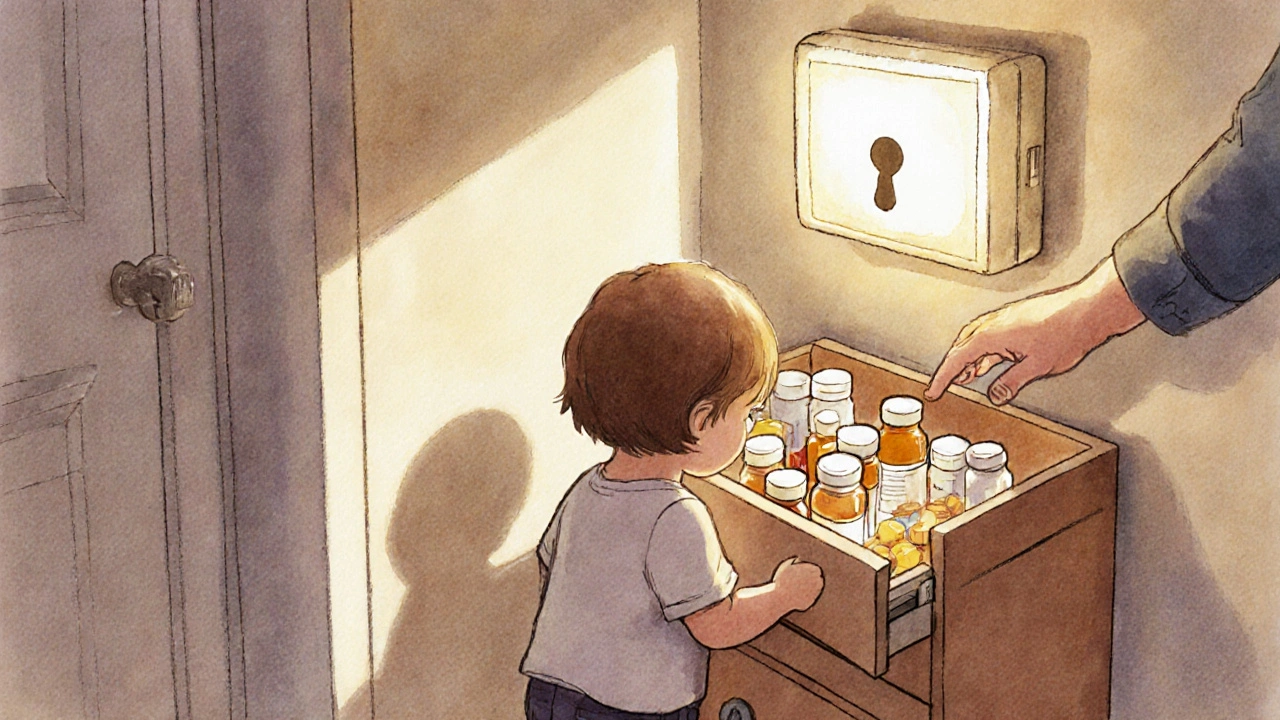
Every year, around 60,000 children in the U.S. end up in the emergency room because they got into medications left within reach. Most of these cases aren’t accidents caused by curiosity alone-they’re preventable. A simple lockbox can stop most of them. If you keep opioids like oxycodone, benzodiazepines like Xanax, or stimulants like Adderall at home, you’re not just storing medicine-you’re storing risk. And the safest way to manage that risk isn’t hiding pills in a drawer or relying on child-resistant caps. It’s a lockbox.
Why Lockboxes Are the Only Real Solution
Child-resistant caps sound good on paper. But here’s the truth: half of kids aged 4 to 5 can open them in under a minute. Hidden spots? A 2023 study found 72% of children find hidden medications within 30 minutes. They check under pillows, behind books, inside sock drawers-even inside the fridge if they think it’s candy. Lockboxes are different. They’re physical barriers. No matter how clever or curious a child (or teen) is, they can’t get in unless they have the key, code, or fingerprint.The CDC, the American Academy of Pediatrics, and SAMHSA all agree: if you have high-risk medications in your home, a lockbox isn’t optional. It’s essential. In homes where lockboxes were introduced, safe storage rates jumped by 92%. That’s not a small win. That’s life-saving.
Which Medications Need a Lockbox?
Not every pill needs to be locked up. But these do:- Opioids: Hydrocodone (Vicodin, Norco), oxycodone (Percocet, OxyContin), fentanyl patches
- Benzodiazepines: Alprazolam (Xanax), diazepam (Valium), clonazepam (Klonopin)
- Stimulants: Dextroamphetamine-amphetamine (Adderall), methylphenidate (Ritalin)
- Other high-risk drugs: Sleep aids like zolpidem (Ambien), certain painkillers with high abuse potential
If your doctor prescribed one of these, treat it like a loaded gun. Even if you think your kids are too young to understand, or your teenager is responsible, accidents happen fast. A 2021 study showed that 87% of families saw a dramatic improvement in safety after installing a lockbox-even if they’d been "careful" before.
Choosing the Right Lockbox
Not all lockboxes are made the same. Here’s what to look for:- Size: For one person’s short-term meds, a 6x4x3 inch box works. For a family with multiple prescriptions, go bigger-12x8x6 inches holds 2-3 months’ worth.
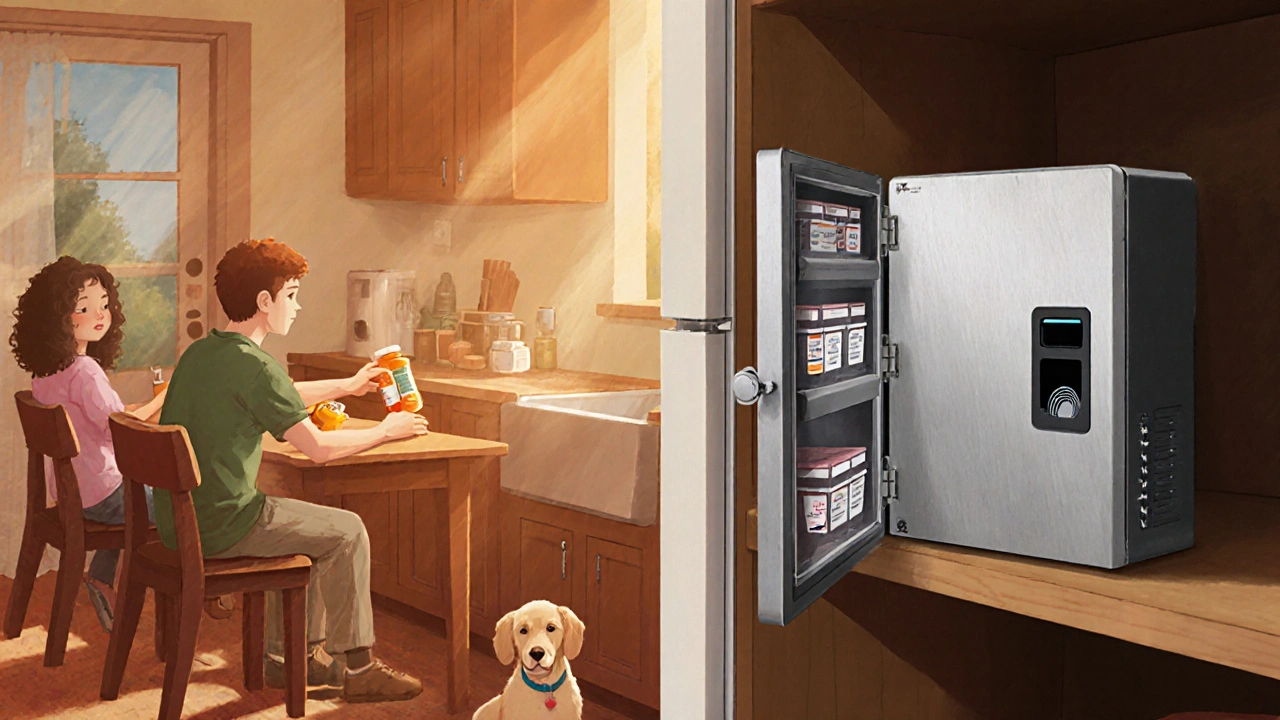
- Lock type: Key locks are cheap but risk losing the key. Combination locks (3-4 digits) are common but can be forgotten. Biometric (fingerprint) models cost more but are ideal for elderly users or households with multiple authorized people.
- Material: Look for reinforced steel or heavy-duty ABS plastic. Fire resistance up to 1,700°F for 30 minutes is a plus.
- Portability: If you travel with meds, get a travel-sized version (4x3x2 inches). Some even come with TSA-approved locks.
- Climate control: If you store insulin or other temperature-sensitive meds, you need a lockbox with cooling. Most standard ones don’t have this-check the specs.
GoodRx reports that 68% of top-rated lockboxes use steel or fire-resistant plastic. Brands like Master Lock, Safe Keeper, and MediVault Pro are widely trusted. Avoid flimsy plastic boxes labeled "medication organizer"-those aren’t lockboxes.
Where to Put It
Location matters more than you think. The CDC says 62% of lockbox failures happen because they’re placed in the wrong spot.Good spots:
- High up on a bedroom closet shelf
- Inside a locked dresser drawer
- Wall-mounted in a hallway or home office
Avoid these:
- Bathrooms (too humid-can damage pills and locks)
- Under the sink (easy for kids to reach)
- On the nightstand (too convenient, too tempting)
- On the kitchen counter (too public)
Mounting it to the wall with screws makes it harder for kids to move or tip over. If you have an elderly family member who needs daily access, keep it within arm’s reach but still locked-like on a nightstand with a biometric lock.
How to Set It Up Right
Follow this 5-step process:- Identify every high-risk medication in your home. Check cabinets, purses, drawers-even old prescriptions in the garage.
- Choose your lockbox based on size, lock type, and who needs access.
- Install it securely in your chosen location. Don’t just set it on a shelf.
- Limit access to one or two trusted adults. Don’t give the code or key to teenagers unless absolutely necessary.
- Check monthly that all high-risk meds are inside and nothing’s been removed without authorization.
Most people get comfortable with the system in 2-3 days. The hardest part? Remembering to put the meds back after taking them. Make it a habit: after you take your pill, lock it up again. Set a phone reminder if you need to.
What About Elderly Users?
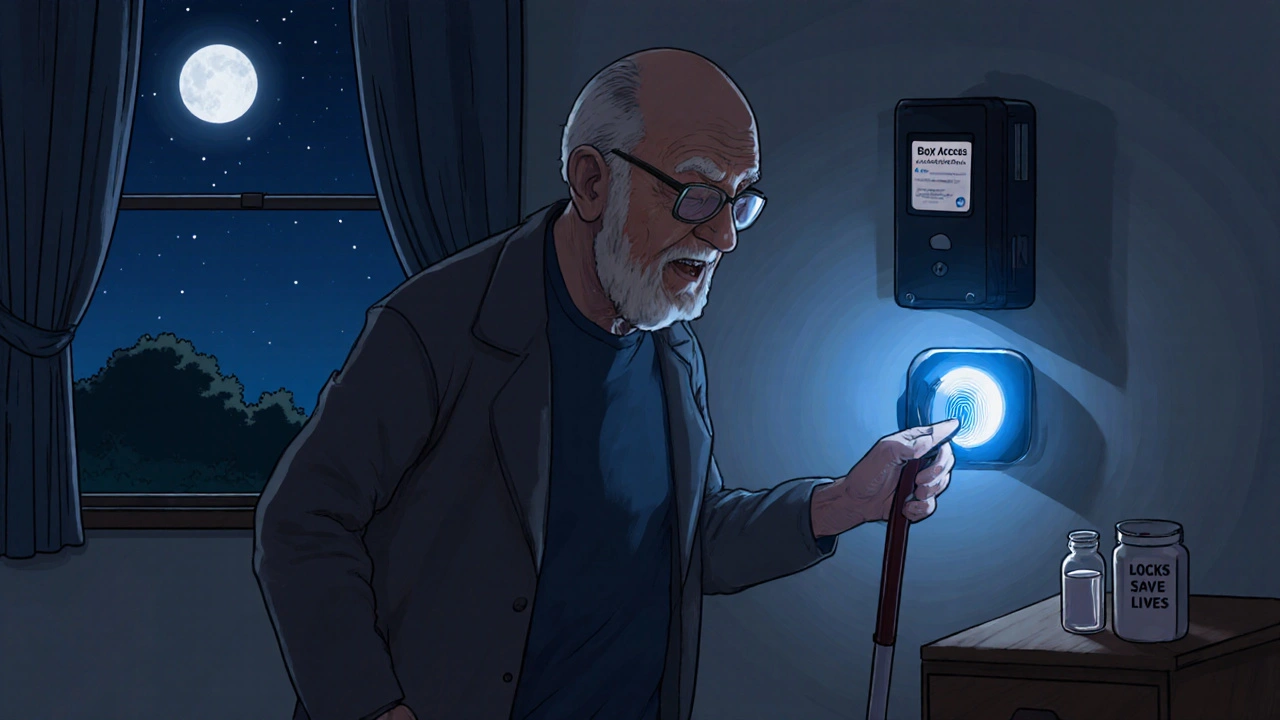
If you or someone you care for is over 75, combination locks and keys can be a problem. Arthritis, poor eyesight, or memory issues make it easy to forget codes or lose keys.Biometric lockboxes are the answer. They open with a fingerprint. No remembering numbers. No fumbling with keys. They cost $30-$50 more than basic models, but for many families, it’s worth it. One Reddit user, u/CaregiverAnne, switched from a combo lock to a fingerprint box for her 80-year-old father. "It was the best $35 I ever spent," she wrote. "He can open it without help now. No more yelling at me to come unlock it."
What If Someone Needs the Meds in an Emergency?
This is a real concern. What if your spouse has a panic attack and needs Xanax at 2 a.m.? Or your parent falls and needs pain relief?Plan ahead:
- Give a trusted neighbor or family member a spare key or code-just one person.
- Use a biometric lock so multiple people can access it with their own fingerprints.
- Keep a small, labeled emergency dose (like one tablet) in a separate, clearly marked container in a different locked location if needed.
- Never leave a key under the mat or taped to the box. That defeats the whole purpose.
Smart lockboxes like the MediVault Pro now send alerts to your phone if someone opens the box. That’s useful if you’re worried about misuse-but it’s not a substitute for good habits.
What About Unused or Expired Meds?
Lockboxes are for active prescriptions. Once a medication is expired or no longer needed, dispose of it safely.Don’t flush it. Don’t throw it in the trash. Use a drug take-back program. Many pharmacies, police stations, and hospitals offer free disposal bins. In the UK, you can return unused meds to any pharmacy-no questions asked. If no take-back is nearby, mix pills with coffee grounds or cat litter, seal them in a container, and throw them in the trash. Remove all labels first.
Never leave expired meds in the lockbox. It creates confusion and increases risk.
Real Stories, Real Results
On Reddit’s r/Parenting, a mom named u/MedSafetyMom shared how her 3-year-old nearly got into a fentanyl patch. "I didn’t think it was a big deal-I kept it in a drawer. I was wrong. After the lockbox went up, I slept better for the first time in months. No incidents in eight months. Zero."A 2023 Consumer Reports survey of 1,200 households found 78% of lockbox users felt more at ease. Only 22% said it was inconvenient-and most of those were people who didn’t make it a habit.
Public health programs like "Locks Save Lives" have distributed over 14,000 free lockboxes in 2022 alone. Satisfaction? 94%.
Final Thought: It’s Not About Distrusting Your Family
This isn’t about assuming your kids will steal your meds. It’s about assuming they might accidentally find them. It’s about knowing that curiosity, play, and confusion can lead to tragedy in seconds. Lockboxes aren’t paranoid-they’re practical. They don’t cost much. They’re easy to use. And they work.If you have high-risk meds at home, you owe it to everyone in your house to lock them up. Not tomorrow. Not next week. Today.
Can I just use a locked cabinet instead of a lockbox?
Yes, a locked cabinet or drawer works if it’s secure and out of reach. But lockboxes are designed specifically for meds-they’re smaller, portable, and often more reliable than furniture locks. If your cabinet is easy for kids to open or access (like a kitchen cabinet), it’s not safe enough.
Are lockboxes covered by insurance?
Most insurance plans don’t cover lockboxes. But some state health programs give them away for free-especially if you have an opioid prescription. Check with your pharmacy, local health department, or visit LocksSaveLives.org to see if you qualify.
What if I have pets? Are lockboxes safe for them too?
Yes. Pets can be just as dangerous around medications as children. Dogs, in particular, are attracted to pills and can get sick or die from ingesting even one tablet. A lockbox protects them too. Make sure the box is sturdy enough that a large dog can’t knock it over.
Do I need a lockbox if I only take one pill a week?
If it’s a high-risk medication-even if you take it rarely-you still need a lockbox. Accidental ingestion doesn’t care how often you use it. One fentanyl patch can kill a child. One Xanax can cause serious harm to a pet or toddler. Risk isn’t about frequency. It’s about potency.
Can I use a lockbox for over-the-counter drugs?
You don’t have to, but it’s smart if you keep large quantities of painkillers like acetaminophen or cough syrups with dextromethorphan. Teens sometimes misuse these. If you have teens in the house, locking up OTC meds reduces risk. It’s not required-but it’s safer.
Jonathan Dobey
November 14, 2025 AT 23:19Let’s be real-this isn’t about lockboxes. It’s about the state’s slow creep into domestic autonomy. They want you to believe your home is a liability, not a sanctuary. A lockbox? That’s just the velvet glove. Next, they’ll mandate biometric logs for every pill you swallow. The CDC doesn’t care about your safety-they care about control. You think your kid won’t find it? What about the NSA’s new ‘Medication Compliance Algorithm’? They’re already mapping your pill habits. This is Step 1 of the Pharmaco-Panopticon. Wake up. The feds don’t want you healthy-they want you compliant.
And don’t get me started on ‘free lockboxes.’ Free things always come with strings. Attached to your soul. Or your Social Security number.
Remember: if you lock your meds, you’re not protecting your family-you’re surrendering your sovereignty. The real danger isn’t the pills. It’s the people selling you the box.
;-)
ASHISH TURAN
November 15, 2025 AT 22:54I live in India, and I’ve seen too many families keep medicines in open drawers-antibiotics, painkillers, even psychiatric drugs. Children find them. Pets get sick. Elderly forget if they already took their dose. Lockboxes are simple, cheap, and effective. No drama. No ideology. Just practicality.
My uncle had a fentanyl patch in his bedside drawer. My cousin, age 5, found it. Lucky he only licked it. We bought a $25 lockbox the next day. No more nightmares. No more panic. Just peace.
It’s not about distrust. It’s about design. We design seatbelts not because we think drivers are reckless-but because humans are human.
Ryan Airey
November 17, 2025 AT 19:35Let’s cut the fluff. The entire article is a performative safety ritual. You’re not preventing accidents-you’re creating compliance theater. 92% improvement? That’s a cherry-picked stat from a study funded by lockbox manufacturers. Where’s the longitudinal data? Where’s the control group? Who tracked whether parents just became lazy and stopped monitoring because they ‘had’ the box?
And don’t even get me started on biometric locks. You’re now training your toddler to recognize fingerprints as the new ‘magic key.’ Next thing you know, your kid’s trying to unlock the fridge with their thumb.
This isn’t safety. It’s corporate solutionism dressed in public health pajamas. Buy the box. Feel good. Then forget about it until the opioid crisis hits again-and we’ll sell you the next shiny gadget.
Real solution? Stop prescribing these drugs like candy. But that’s too hard, isn’t it?
Hollis Hollywood
November 18, 2025 AT 04:37I read this whole thing and just… felt a deep sense of relief. Not because I’ve been careless-I’ve always locked my meds-but because I’ve felt so alone in this. Like I’m the only parent who thinks, ‘What if my kid just gets curious?’
My daughter turned four last month. She’s brilliant. She climbs. She opens drawers. She’s seen me take my Xanax after bad days and asked, ‘Is that the happy pill?’ And I didn’t know how to answer without scaring her.
So I got the biometric lockbox. It’s on the top shelf of my closet. I don’t have to explain anything. I don’t have to lie. I just take what I need, and it’s gone. And when she asks again, I say, ‘It’s for grown-up feelings. Not for you.’ And she accepts it.
I used to think locking things up was paranoid. Now I think not doing it is the real risk. Not because I don’t trust my kid-but because I trust how curious kids are. And curiosity doesn’t know the difference between a candy and a capsule.
Thank you for writing this. I needed to hear it.
Aidan McCord-Amasis
November 18, 2025 AT 23:40Lockbox. Done. 🚪💊
Next.
Adam Dille
November 19, 2025 AT 13:16I love how this post doesn’t shame people. It just says: ‘Here’s what works. Here’s why. Here’s how.’ No guilt. No judgment. Just facts wrapped in care.
I used to think, ‘My kid’s too young to care.’ Then my 6-year-old found my old Adderall bottle in my gym bag. He thought it was gummy bears. Took two. Didn’t get sick, but the ER visit? Traumatic.
Now I have the MediVault Pro. Biometric. Mounting screws. I even labeled it ‘Adult Only’ in big letters. My wife and I are the only ones who can open it. My teen knows it’s off-limits-not because we yelled, but because we showed him how it works. He said, ‘That’s kinda cool.’
It’s not about distrust. It’s about responsibility. And honestly? It’s way easier than hiding pills in the toilet tank.
Also, pets are totally a thing. My dog ate a whole bottle of gabapentin once. $1,200 vet bill. Never again.
Chris Bryan
November 19, 2025 AT 19:20Let’s not pretend this is about safety. This is another liberal nanny-state tactic to infantilize American families. You don’t need a lockbox-you need discipline. Teach your kids not to touch things that aren’t theirs. Teach them respect. Teach them consequences.
But no, we’d rather turn our homes into prisons and our children into suspects. Lockboxes? That’s the first step to mandatory drug registries. Next thing you know, the government will track every pill you take. And if you forget to log it? You lose your parental rights.
My grandfather kept his pills in a cigar box. He lived to 94. No lockbox. No panic. Just common sense.
Wake up, sheeple. This isn’t protection. It’s control.
Andrew Eppich
November 21, 2025 AT 12:51While the intent behind this article is commendable, the tone and framing risk alienating the very demographic it seeks to help. The comparison of medications to ‘loaded guns’ is hyperbolic and counterproductive. It evokes fear rather than responsibility.
A more effective approach would be to frame safe storage as an act of familial care-not as a response to existential threat. The data is solid, but the rhetoric is alarmist. We should be encouraging thoughtful behavior, not inducing panic.
Also, the assumption that all parents are negligent until they purchase a product is problematic. Many households already practice safe storage through routine and awareness. The solution should uplift, not shame.
Jessica Chambers
November 22, 2025 AT 16:10Wow. So I just spent 20 minutes reading this like it was a novel. And now I feel like I’ve been handed a pamphlet from a very anxious librarian.
But… I guess I needed it.
I kept my husband’s oxycodone in a drawer. Because ‘he takes it at night, so it’s fine.’
Then my 7-year-old asked why the ‘white dots’ in the drawer looked like Skittles.
…I bought the lockbox today.
And I’m not even mad. Just… grateful.
Thanks for not being preachy. Just… factual. And that’s enough.
:-|
Shyamal Spadoni
November 23, 2025 AT 19:45Ok so listen. I read this and i was like wow this is legit but then i thought wait a sec. What if the lockbox itself is the problem? I mean think about it. If you have a biometric lockbox, you’re storing your fingerprint data with some random company in China that probably sells it to the NSA or whoever. And then what? Next thing you know, your kid’s face is in a facial recognition database because they touched the box? And the government starts tracking your opioid use because they know when you opened the box? And then your insurance hikes your rates because you’re a ‘high-risk medication user’? And what if the battery dies? You’re locked out of your meds during a panic attack? And what if your kid learns to jimmy the lock? I’ve seen YouTube videos. It’s easy. And what if the box catches fire? Does it melt and release the drugs? Or does it burn and poison the air? I mean, come on. We’re just swapping one risk for ten new ones. And the whole thing is just a marketing scheme by Master Lock to sell overpriced plastic boxes. I think we should just educate kids and trust them. Like in my village in Bihar, we never locked anything and no one died. So maybe the real problem is not the meds. It’s the fear. And the fear is manufactured. By corporations. And the government. And the media. And the doctors. And the lockbox companies. And now I’m paranoid. And I haven’t even taken my gabapentin yet. 😅