
How to Use Medicare Extra Help to Pay Less for Generic Prescriptions
 Dec, 1 2025
For millions of Medicare beneficiaries, paying for daily medications is one of the biggest financial stresses. If you’re taking generic drugs for high blood pressure, diabetes, cholesterol, or other chronic conditions, Medicare Extra Help can cut your out-of-pocket costs to as little as $1.60 per prescription. This isn’t a discount coupon or a promo code-it’s a federal program designed to remove financial barriers to essential medicines. And yet, nearly 4 in 10 people who qualify don’t even apply.
What Medicare Extra Help Actually Covers
Medicare Extra Help, also called the Part D Low-Income Subsidy (LIS), pays for nearly all of your prescription drug costs under Medicare Part D. It doesn’t just lower your copays-it wipes out your monthly premium, your annual deductible, and caps your copay for generics at $4.90 in 2025. If you’re also on Medicaid and earn below 100% of the Federal Poverty Level, your generic copay drops even further-to just $1.60.
Without Extra Help, you’d pay up to $595 just to get started on your prescriptions in 2025. After that, you’d pay 25% of the drug’s cost until you hit the coverage gap. A $50 generic pill? That’s $12.50 out of your pocket. With Extra Help? You pay $4.90-no matter how expensive the drug is. For someone filling 12 prescriptions a month, that’s over $600 saved annually just on copays alone.
And here’s the kicker: Extra Help eliminates the donut hole entirely. You never hit that coverage gap. Your costs stay predictable all year long.
Who Qualifies for Extra Help in 2025
To qualify, your income and resources must fall below strict federal limits. In 2025, these are:
- Income limit: $23,475 per year for one person, $31,725 for a married couple living together
- Resource limit: $17,600 for one person, $35,130 for a couple
Income includes Social Security, pensions, wages, and veterans’ benefits. It does NOT include housing assistance, food stamps, or medical care payments.
Resources are things you own that can be turned into cash: bank accounts, stocks, bonds, mutual funds, IRAs, and second homes or land. Your primary home, one car, household goods, and personal belongings don’t count. You also get a $1,500 allowance for burial expenses that doesn’t count against your resource limit.
Many people think they’re too rich to qualify-but they’re wrong. If you’re living on fixed income and still struggling to pay for meds, you might be eligible. Even if you’re just $200 over the income limit, you should still apply. Some exceptions exist for people in nursing homes or those receiving state assistance.
How Extra Help Compares to Regular Part D
Let’s say you take three generic drugs a month: one for blood pressure ($30 retail), one for cholesterol ($45 retail), and one for diabetes ($55 retail). Without Extra Help:
- You pay $595 deductible first (if you haven’t met it)
- Then 25% coinsurance: $7.50 + $11.25 + $13.75 = $32.50 per month
- That’s $390 a year just in copays, not counting the deductible or monthly premium
With Extra Help:
- No deductible
- No monthly premium
- Each generic costs $4.90
- Total monthly copay: $14.70
- Total annual copay: $176.40
You save over $200 a year just on copays-and that’s without counting the waived $595 deductible and $30-$100 monthly premiums you’d normally pay. For people on multiple medications, the savings can top $1,000 a year.
How to Apply for Extra Help
You don’t need to be a financial expert to apply. The Social Security Administration (SSA) handles applications. Here’s how:
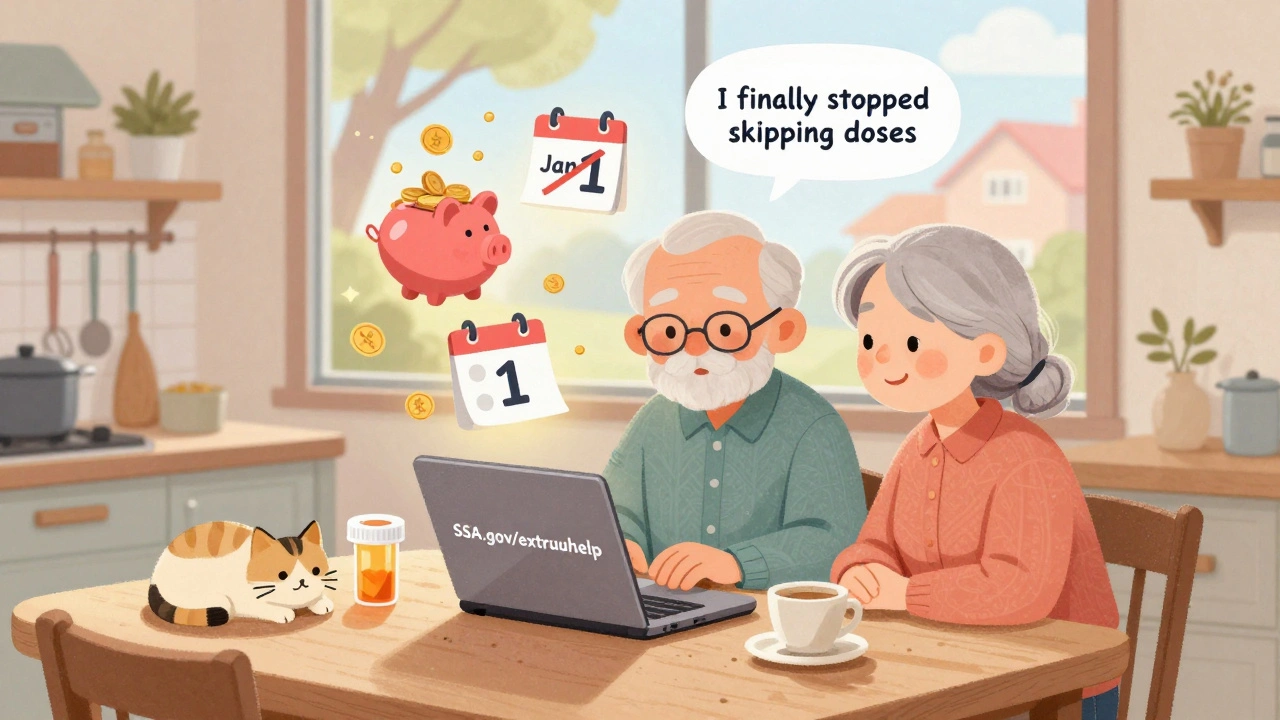
- Apply online at SSA.gov/extrahelp. The form takes about 15 minutes.
- Call 1-800-772-1213 to speak with a representative.
- Visit your local Social Security office. No appointment needed.
If you already get Supplemental Security Income (SSI), Medicaid, or a Medicare Savings Program, you’re automatically enrolled. You’ll get a letter confirming your Extra Help status.
If you’re unsure, call your State Health Insurance Assistance Program (SHIP). They offer free, personalized help filling out the application. In 2024, 73% of applicants needed this kind of support.
What Happens After You Apply
It usually takes 3 to 6 weeks to get a decision. If approved, your savings start immediately-even if you applied mid-year. You’ll get a notice in the mail, and your pharmacy will automatically know you’re enrolled.
Once you’re in, you can switch your Part D plan once a month. That’s a special perk only Extra Help recipients get. If your current plan doesn’t cover a drug you need, you can change plans without waiting for open enrollment.
You’ll also get a new Medicare & You handbook every year. It lists which drugs are covered under your plan and how much you’ll pay.
Annual Review and Keeping Your Benefits
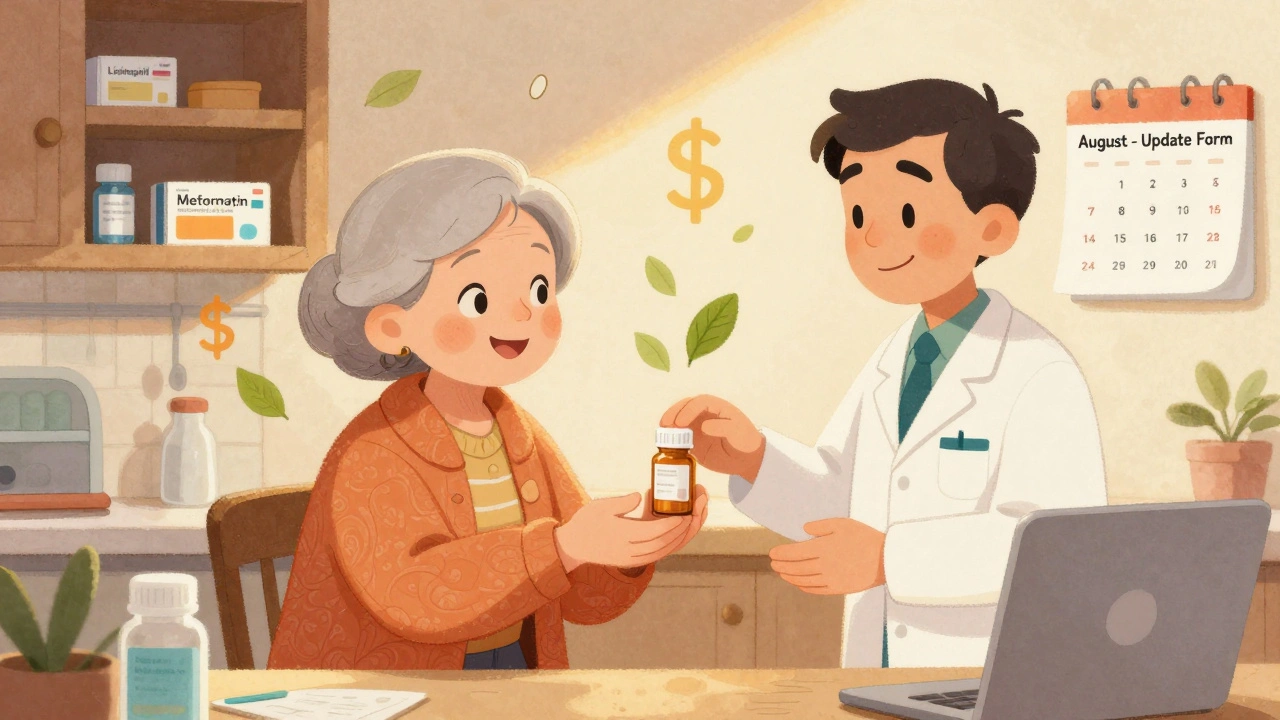
Extra Help isn’t permanent. Every August, you’ll get a form in the mail asking you to update your income and resources. You must return it within 30 days.
If you don’t, your benefits stop on January 1 of the next year. That’s not a mistake-it’s the rule. One user on Reddit shared how their Social Security benefit increased by $500 a year, and they lost Extra Help overnight. Their monthly generic drug bill jumped from $150 to $1,200. That’s not a small change-it’s life-altering.
Set a calendar reminder for August. If you’re not sure how to fill out the form, call SHIP again. They’ll walk you through it.
Real Stories: The Good and the Hard
People who get Extra Help say the same thing: "I finally stopped skipping doses." A retired nurse on Reddit said she watched patients skip insulin because it cost $30 a month. Once they got Extra Help, their blood sugar stabilized. Her words: "It’s not charity. It’s basic care."
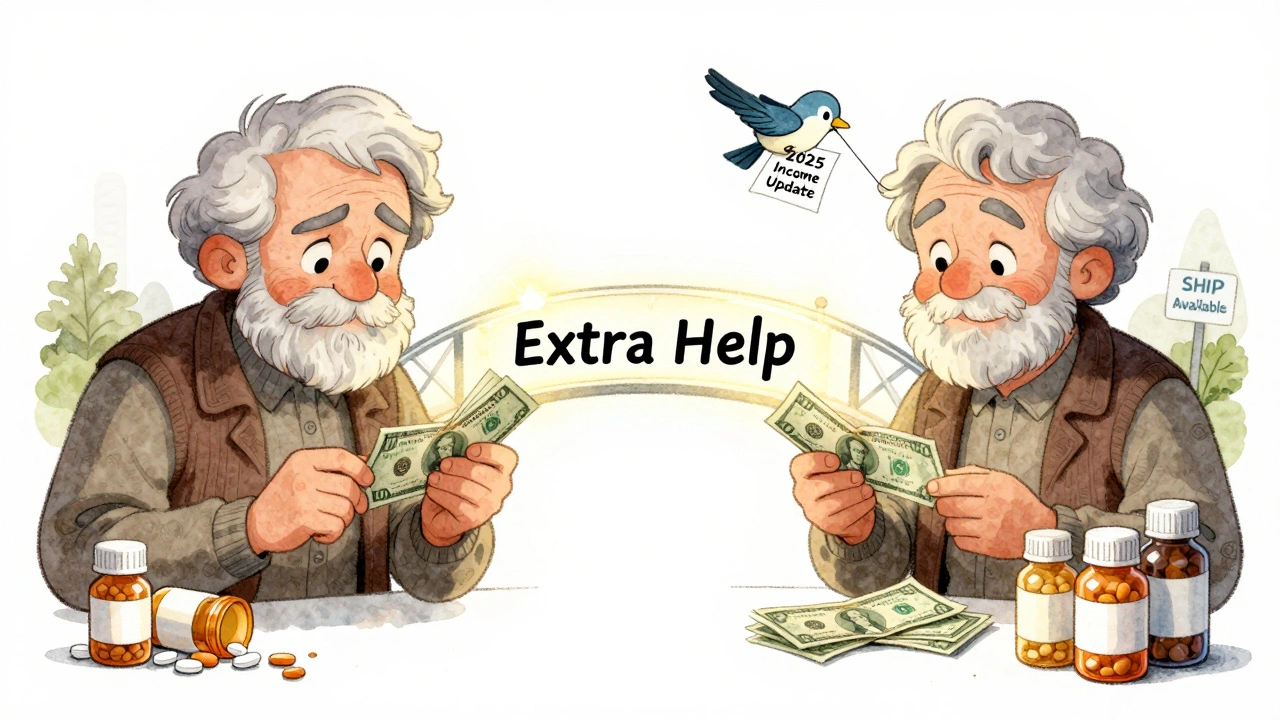
But there’s a dark side. The income limits are rigid. If you’re at $23,476, you get nothing. If you’re at $23,474, you get everything. That’s called a "cliff effect," and it’s been criticized by experts at AARP and the Kaiser Family Foundation. Many seniors fall through the cracks because they got a small raise, a one-time tax refund, or sold a small asset.
Some states offer supplemental programs to help bridge the gap. Check with your local Area Agency on Aging. They might have funds for people just above the limit.
What’s Changing in 2025 and Beyond
This year, the $35 monthly cap on insulin kicks in for all Medicare Part D users-including those without Extra Help. That’s good news, but Extra Help recipients were already paying less than that for insulin.
The Biden administration has proposed raising the income limit to 175% of the Federal Poverty Level. That would mean an individual earning up to $28,500 could qualify. If passed, it could help over a million more seniors.
For now, the program remains one of the most powerful tools in Medicare for keeping people healthy. It’s not perfect. The application is confusing. The rules are strict. But for those who make it through, the payoff is clear: consistent access to medicine, fewer hospital visits, and less stress.
What to Do Next
If you or someone you know takes generic drugs and struggles to pay for them:
- Go to SSA.gov/extrahelp and start the application
- Call 1-800-772-1213 and ask for "Extra Help"
- Find your local SHIP through Medicare.gov/ship
- Don’t wait until January-apply now. Benefits start the day you’re approved
You don’t need to be poor to qualify. You just need to be struggling. And if you’re taking generic meds every month, you’re already in the target group.
Medicare Extra Help isn’t a handout. It’s a lifeline. And it’s there for you if you know how to reach for it.
Do I have to reapply for Extra Help every year?
No, you don’t reapply from scratch. Every August, you’ll get a form from Social Security asking you to update your income and resources. You must return it within 30 days. If you don’t, your Extra Help stops on January 1. It’s not automatic renewal-you have to act.
Can I use Extra Help with any Part D plan?
Yes. Extra Help works with any Medicare Part D plan, including those from private companies like Humana, UnitedHealthcare, or Aetna. The program pays the difference between what the plan charges and what you’re allowed to pay. You can switch plans once a month while enrolled in Extra Help.
What if I make too much money this year but need help next year?
You can reapply anytime. If your income drops-because of job loss, reduced hours, or a death in the family-you can submit a new application. Social Security will review your case based on your current situation. Don’t assume you’re locked out just because you were over the limit once.
Are brand-name drugs covered under Extra Help?
Yes. Extra Help covers both generic and brand-name drugs. For brand-name drugs, your copay is capped at $12.15 in 2025. But generics are always cheaper, so your plan will usually encourage you to use them first. If a brand is medically necessary, you can request a formulary exception.
Does Extra Help cover over-the-counter medicines?
No. Extra Help only covers drugs that are on your Medicare Part D plan’s formulary. Over-the-counter medications like ibuprofen, allergy pills, or sleep aids are not included unless they’re prescribed and on your plan’s list. Always check with your plan before buying OTC drugs expecting coverage.
John Biesecker
December 2, 2025 AT 12:48Genesis Rubi
December 3, 2025 AT 21:49Doug Hawk
December 4, 2025 AT 14:53John Morrow
December 5, 2025 AT 01:16Kristen Yates
December 5, 2025 AT 07:22Anthony Breakspear
December 6, 2025 AT 23:37Zoe Bray
December 7, 2025 AT 20:03Girish Padia
December 9, 2025 AT 01:07Sandi Allen
December 9, 2025 AT 22:21Eddy Kimani
December 10, 2025 AT 19:53Chelsea Moore
December 12, 2025 AT 06:49Saurabh Tiwari
December 12, 2025 AT 22:33Michael Campbell
December 13, 2025 AT 08:42Victoria Graci
December 13, 2025 AT 21:05Saravanan Sathyanandha
December 14, 2025 AT 21:31