
Long-Term Solutions for Building Resilience Into the Drug Supply
 Jan, 7 2026
Drug shortages aren’t just inconveniences-they’re life-or-death emergencies. When a critical injectable antibiotic runs out, or a heart medication disappears from pharmacy shelves, patients don’t get a delay. They get worse outcomes. In 2022 alone, the U.S. saw 245 drug shortages, with over half involving sterile injectables used in hospitals during surgeries, cancer treatments, and emergency care. These aren’t random glitches. They’re the result of a system built for efficiency, not endurance.
Why the Drug Supply Is So Fragile
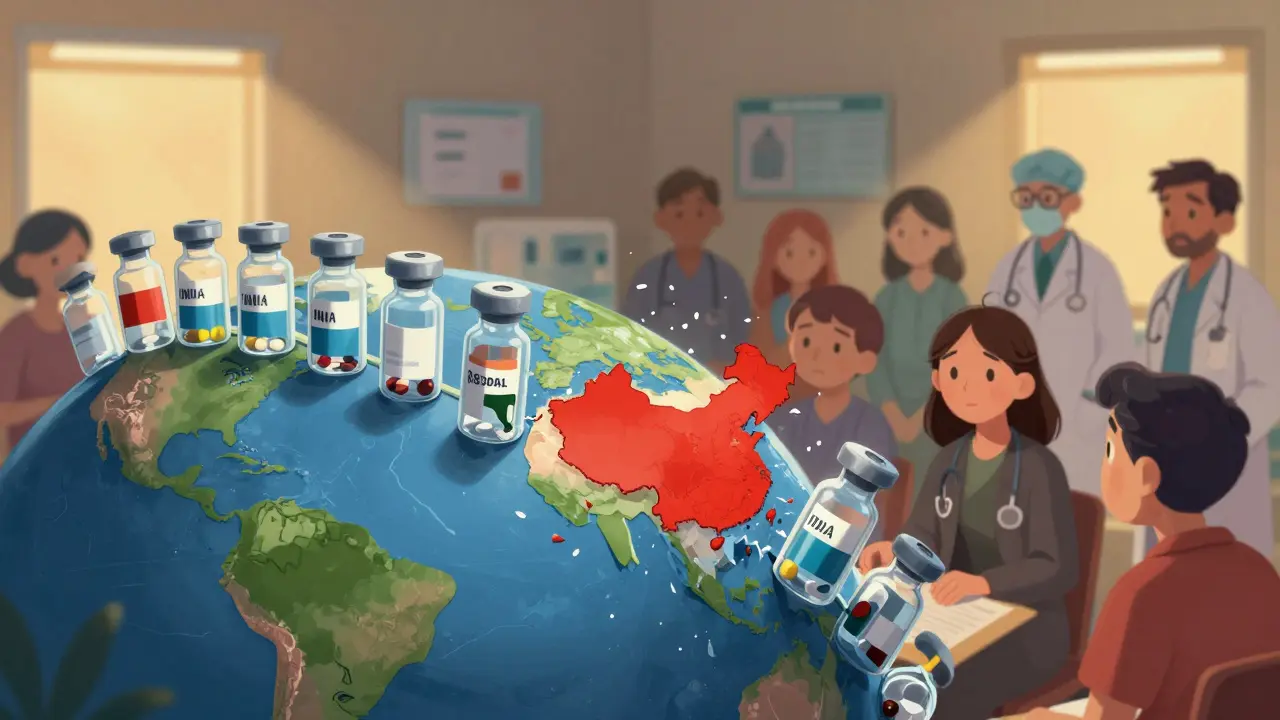
For decades, pharmaceutical companies optimized their supply chains for low cost and speed. Just-in-time manufacturing became the norm. Why make extra when you can order just what you need, when you need it? The problem is that this model breaks under pressure. When a factory in China shuts down for a week, or a shipping port gets blocked, or a cyberattack knocks out a distributor’s system, the ripple effect hits patients fast.Here’s the hard truth: 72% of active pharmaceutical ingredients (APIs)-the core chemical components of drugs-are made outside the U.S. Nearly 30% of those come from just two countries: China and India. That’s not diversification. That’s concentration. And when a single supplier controls 80% of a critical API, you’re not building a supply chain-you’re building a single point of failure.
Even worse, most companies don’t even know where their raw materials come from. Only 12% have visibility past their third-tier supplier. That means if a mine in Mongolia stops exporting a key chemical, the company making your blood pressure pill might not find out until it’s too late.
What Resilience Actually Means
Resilience isn’t about panic buying or hoarding. It’s about designing systems that can bend without breaking. The National Academies of Sciences laid out a clear framework: resilience requires three things-anticipation, planning, and risk management. Not one, not two. All three.Anticipation means knowing what could go wrong before it happens. That’s not guesswork. It’s data. Companies using AI to model disruptions can now predict supply chain breakdowns with 83% accuracy over a 30-day window. That’s enough time to shift orders, reroute shipments, or activate backup suppliers.
Planning means having options built in. That includes:
- Dual-sourcing critical APIs-having at least two manufacturers, preferably in different regions
- Keeping 6 to 12 months of buffer stock for life-saving drugs
- Having pre-approved alternative formulations ready to swap in if the primary drug runs out
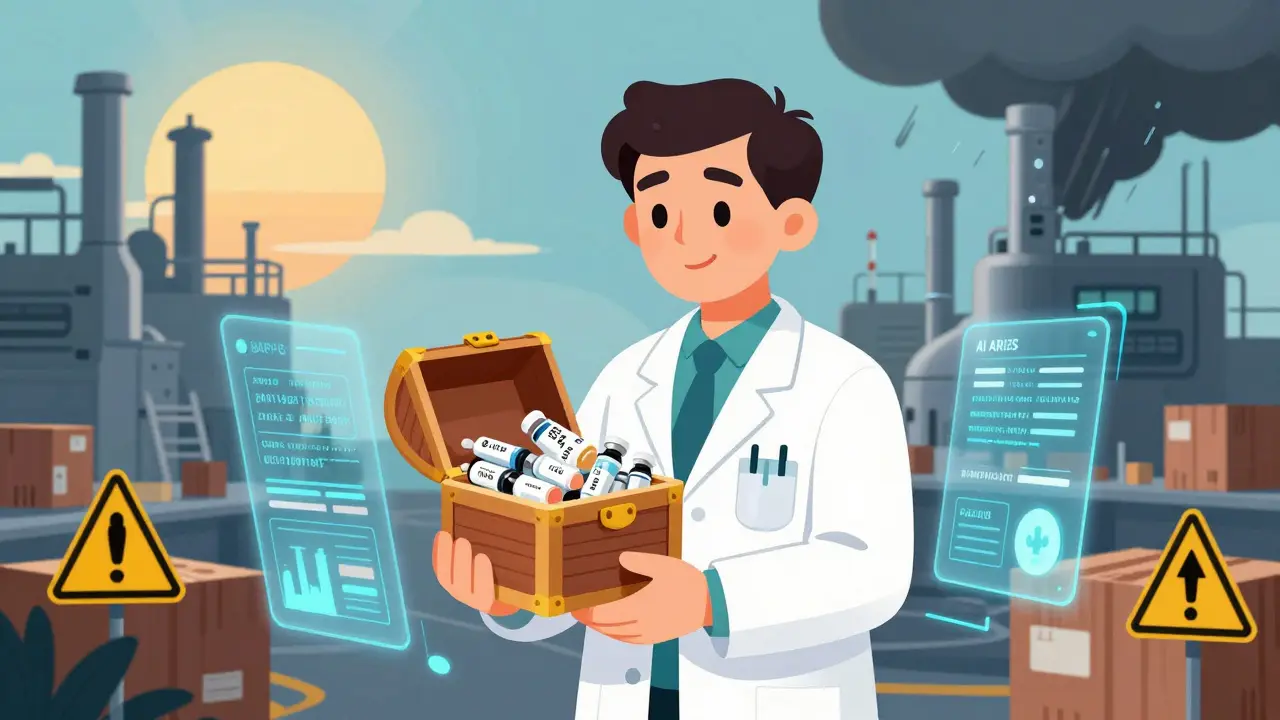
And risk management? That means treating cybersecurity like a supply chain issue. Between 2020 and 2023, cyberattacks on healthcare supply chains jumped by 214%. A ransomware attack on a logistics provider can freeze the entire flow of insulin or chemotherapy drugs. The Healthcare Distribution Alliance found that companies using the NIST Cybersecurity Framework cut their response time by nearly half.
The Cost of Doing Nothing
Some argue that building resilience is too expensive. But the cost of shortages is higher. In 2022, drug shortages cost the U.S. healthcare system an estimated $216 million in extra expenses-more staff time, emergency imports, substitute drugs that cost more, longer hospital stays. That’s not a line item. That’s patient harm.Let’s compare options:
| Strategy | Annual Cost | Shortage Reduction |
|---|---|---|
| Full reshoring of API production | $4-6 billion | 80-85% |
| Buffer stockpiling only | $3.5-4.2 billion | 45% |
| Hybrid model: targeted domestic + global diversification | $1.2-1.8 billion | 85% |
| Supply chain mapping tech | $100-300 million | 32% fewer disruptions |
The hybrid model-keeping domestic capacity for the most critical drugs while diversifying elsewhere-is the smartest balance. It costs less than half of full reshoring but delivers nearly the same protection. And supply chain visibility? It’s the lowest-cost, highest-return move. Companies that map their entire supply chain see disruptions drop by a third, even if they spend less than 1% of their budget on it.
Real-World Wins and Failures
Pfizer spent $220 million on AI-driven forecasting across 150 distribution centers. Result? A 38% drop in stockouts. Merck used federal incentives to bring API production for 12 key antibiotics back to the U.S. They now source 95% of those domestically. Costs went up 31%, but they didn’t lose a single dose during a global disruption.Meanwhile, some distributors tried drone delivery to rural pharmacies. It cut emergency delivery times from three days to four hours. But 42 states blocked it because regulations hadn’t caught up. That’s the problem: innovation moves faster than policy.
What’s holding most companies back? Three things:
- Data systems that don’t talk to each other (78% of firms)
- Staff who don’t know how to analyze supply chain risk (only 35% have trained teams)
- Procurement departments still choosing suppliers based on lowest price, not reliability (67% of manufacturers say this is the biggest barrier)
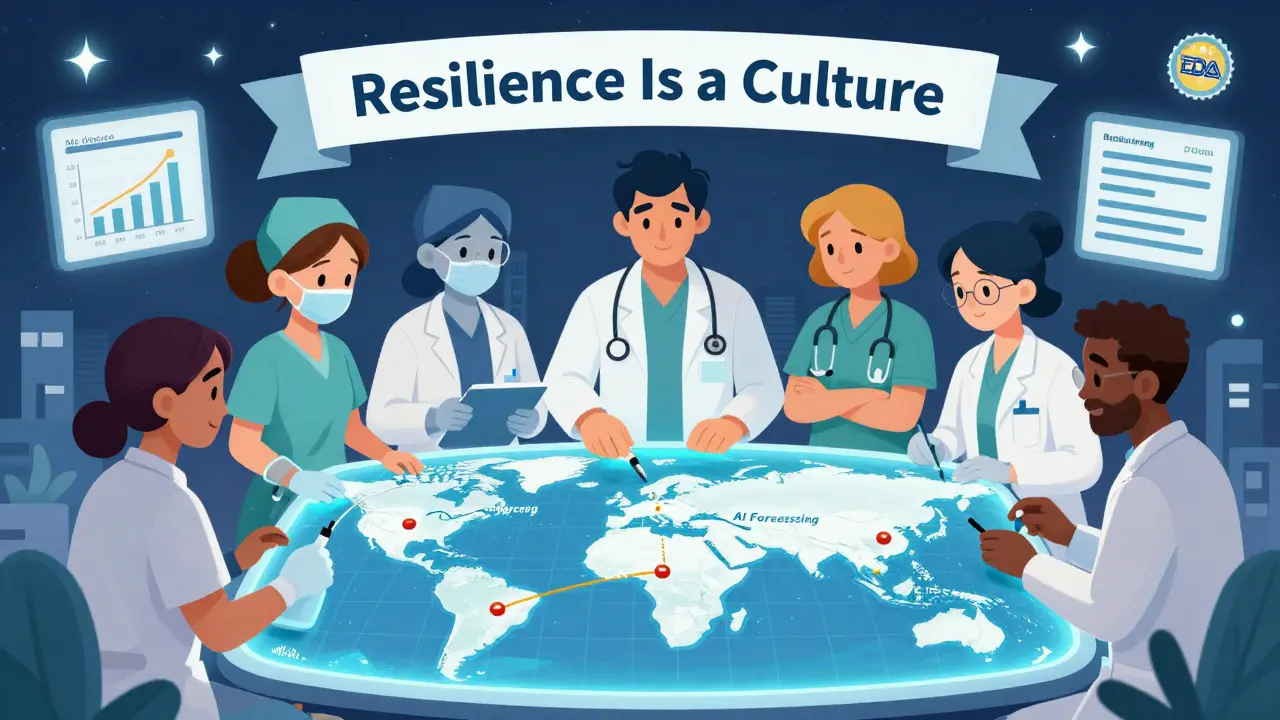
Resilience isn’t a project. It’s a culture. And it starts when the CFO stops asking, “How cheap can we make this?” and starts asking, “What happens if this breaks?”
What’s Changing Now (2025-2026)
The rules are shifting. The FDA’s new draft guidance, effective by Q3 2025, will require every manufacturer to do an annual vulnerability assessment. No more hiding behind silence. And the CMS 2024 proposed rule? It’s a game-changer. Starting in 2026, Medicare will tie reimbursement to supply chain transparency. If you can’t prove you know where your drugs come from, you won’t get paid for them. That’s $80 billion in incentives to fix the system.The HHS is also investing $520 million to build domestic capacity for 50 critical drugs, aiming for 40% API production in the U.S. by 2027. And internationally, 17 countries have joined the Pharmaceutical Security Institute’s Global Resilience Partnership to align regulations for 200 life-saving medicines.
AI adoption in pharma supply chains has more than doubled since 2021. From 22% to 58%. That’s not hype. That’s adoption. Companies that waited are now scrambling to catch up.
What Needs to Happen Next
We don’t need a miracle. We need consistency.- Regulators must enforce transparency-not just for APIs, but for every tier of the supply chain.
- Procurement contracts must include resilience metrics, not just price.
- Hospitals and insurers must reward manufacturers who invest in redundancy, not punish them for higher costs.
- Training programs need to be built for supply chain risk analysts. The industry will need 125,000 more of them by 2027.
The truth is, we’ve known how to fix this for years. The National Academies laid it out in 2021. Experts have been warning us since the pandemic. The tools exist. The data is there. What’s missing is the collective will to make resilience a priority-not an afterthought.
Drug shortages aren’t inevitable. They’re a design flaw. And like any flaw, they can be fixed. But only if we stop treating them as emergencies and start treating them as preventable failures.
What causes most drug shortages?
Most shortages stem from manufacturing disruptions-especially in facilities that produce active pharmaceutical ingredients (APIs). Over 70% of these facilities are overseas, with heavy concentration in China and India. Single-source suppliers, quality control failures, and sudden demand spikes (like during a pandemic) are common triggers. Cyberattacks and logistics breakdowns are rising causes too.
Can stockpiling solve drug shortages?
Stockpiling helps, but only for specific drugs. Keeping 6-12 months of buffer stock for critical injectables can prevent 45% of shortages. But it’s expensive-costing $3.5-4.2 billion a year-and doesn’t address root causes like supplier concentration or lack of manufacturing redundancy. It’s a band-aid, not a cure.
Is reshoring API production the best solution?
Reshoring gives more control, but it’s not practical for all drugs. Bringing API production back to the U.S. increases costs by 25-40%. It’s most viable for the most critical medicines-like antibiotics, anesthetics, and cancer drugs. The smarter approach is targeted reshoring combined with global diversification, which offers 85% of the benefits at half the cost.
How does AI help prevent drug shortages?
AI models analyze global data-weather, political events, shipping delays, factory output-to predict disruptions up to 30 days in advance. Companies using AI report 32% fewer supply chain disruptions. It’s not magic; it’s pattern recognition. For example, AI can flag that a monsoon in India might delay a key chemical shipment, allowing a company to switch suppliers before stock runs out.
Why aren’t more companies doing this already?
Three big reasons: First, procurement teams are still paid to cut costs, not reduce risk. Second, most companies don’t have full visibility into their supply chains beyond their first supplier. Third, data systems across manufacturers, distributors, and regulators don’t talk to each other. Fixing this requires culture change, investment, and regulation.
What role does cybersecurity play in drug supply resilience?
Cybersecurity is now a core part of supply chain resilience. Between 2020 and 2023, cyberattacks on healthcare supply chains rose by 214%. A single ransomware attack on a logistics company can halt shipments of insulin, vaccines, or chemotherapy drugs. Companies using the NIST Cybersecurity Framework cut incident response time by 47%. Protecting data systems is protecting patient access.
Will new FDA rules make a difference?
Yes. Starting in 2025, manufacturers must submit annual vulnerability assessments to the FDA. This forces transparency. Previously, companies could ignore risks. Now, they must document them-and explain how they’re mitigating them. Combined with Medicare’s new transparency requirements in 2026, this creates real financial pressure to act.
How can hospitals prepare for shortages today?
Hospitals should build a tiered response plan: 1) Identify which drugs are most critical and hardest to replace; 2) Maintain a 30-day emergency stock of those; 3) Pre-approve alternative formulations; 4) Train staff on conservation protocols (like reducing doses when safe); 5) Join regional drug shortage alerts through state health departments or the FDA’s shortage list.
Prakash Sharma
January 7, 2026 AT 21:16India makes 40% of the world’s generic drugs and you’re acting like we’re the problem? We’ve been supplying life-saving meds to the US for decades while you outsource everything and then cry when it breaks. Stop blaming the supplier and fix your own broken system. We’re not your backup battery.
Manish Kumar
January 8, 2026 AT 20:05Think about it-this isn’t just about pills or patents, it’s about the metaphysics of dependence. We’ve built a globalized economy on the illusion of efficiency, but efficiency without resilience is just fragility dressed in spreadsheets. The moment we stop treating medicine as a commodity and start treating it as a covenant between human beings and the earth that sustains us-that’s when we’ll stop having shortages. Until then, we’re just rearranging deck chairs on the Titanic while the water rises.
Aubrey Mallory
January 10, 2026 AT 03:31As someone who works in oncology nursing, I’ve seen patients cry because their chemo was delayed. This isn’t abstract. It’s daily trauma. We need policy that treats supply chains like critical infrastructure-not a cost center. And yes, that means paying more. But not paying more is paying with lives.
christy lianto
January 11, 2026 AT 12:47Just saw a nurse in Texas use a 20-year-old vial because the new one hadn’t arrived. That’s not a shortage. That’s a failure of imagination. We have the tech. We have the data. We just need leaders who care more about people than quarterly earnings. Let’s stop waiting for a crisis to act.
Dave Old-Wolf
January 13, 2026 AT 05:57Wait so if we just map out all the suppliers and use AI, we can avoid most shortages? That sounds almost too easy. Why hasn’t everyone done this already?
swati Thounaojam
January 14, 2026 AT 11:25my mom got her heart med 3 weeks late. she almost died. this isnt theory. its real.
Donny Airlangga
January 15, 2026 AT 17:13That hybrid model makes so much sense. Why are we even debating reshoring everything? We don’t need to make every pill here-we just need to make the ones that can’t afford to fail. And yeah, AI is the quiet hero here. It’s not flashy, but it’s saving lives one prediction at a time.
Molly Silvernale
January 16, 2026 AT 12:54Resilience… resilience… resilience… like a mantra whispered in a cathedral of greed. We’ve turned medicine into a casino-and now we’re shocked when the house always wins. The FDA’s new rules? A start. But until we stop rewarding the cheapest bidder and start rewarding the most responsible… we’re just painting flowers on a sinking ship.
Kristina Felixita
January 18, 2026 AT 06:01soooo… like… we gotta stop being cheap?? and maybe… like… pay a lil more for meds so people dont die?? i mean… duh?? why is this even a debate?? i just want my grandma to get her blood pressure pill without a 3 week wait 😭
Joanna Brancewicz
January 19, 2026 AT 19:58Supply chain visibility gaps at tier 3+ are the silent killer. No one’s auditing beyond Tier 1. That’s the blind spot. Fix that first.
Evan Smith
January 21, 2026 AT 11:16So let me get this straight… we’re spending $200M on AI to predict shortages… but still letting procurement pick suppliers based on who’s cheapest? Bro. We’re literally playing Jenga with people’s lives. And someone’s always gonna pull the wrong block.