
Market Exclusivity Extensions: Mechanisms Beyond Patents
 Jul, 5 2026
When a blockbuster drug’s core patent expires, you might expect generic prices to crash immediately. That was the original promise of the Hatch-Waxman Act, passed in 1984. The goal was simple: balance innovation with access. But here is the reality check for 2026. In most cases, that "patent cliff" never really happens. Instead, pharmaceutical companies use a complex web of regulatory shields and secondary patents to keep generics at bay long after the main patent dies.
This isn't just about one extra year. It is about strategic stacking. Recent data shows that 91% of drugs receiving patent extensions maintain their monopoly well beyond those initial terms. Some molecules accumulate dozens of secondary patents, effectively locking out competition for decades. If you are navigating the pharma landscape-whether as an investor, a policy maker, or a patient advocate-you need to understand these mechanisms. They are not glitches; they are features of the current system.
The Core Mechanism: Patent Term Restoration
Let's start with the foundation. A standard patent lasts 20 years from the filing date. For a new drug, this timeline is brutal. You spend years in clinical trials before the FDA even looks at your product. By the time you get approval, half your patent life might be gone. To fix this, the US offers two specific tools through the USPTO.
- Patent Term Adjustment (PTA): This compensates for delays caused by the USPTO during the patent examination process. If the agency takes too long to review your application, they give you back that lost time.
- Patent Term Extension (PTE): This compensates for the regulatory review period with the FDA. It adds up to five years to your patent term.
There is a hard cap, though. The total post-approval patent life cannot exceed 14 years. Also, only the first approval of a new active ingredient qualifies, and you can only extend one patent per drug. This creates a tight window. Once that 14-year mark hits, the core patent protection ends. Or does it? That is where the real game begins.
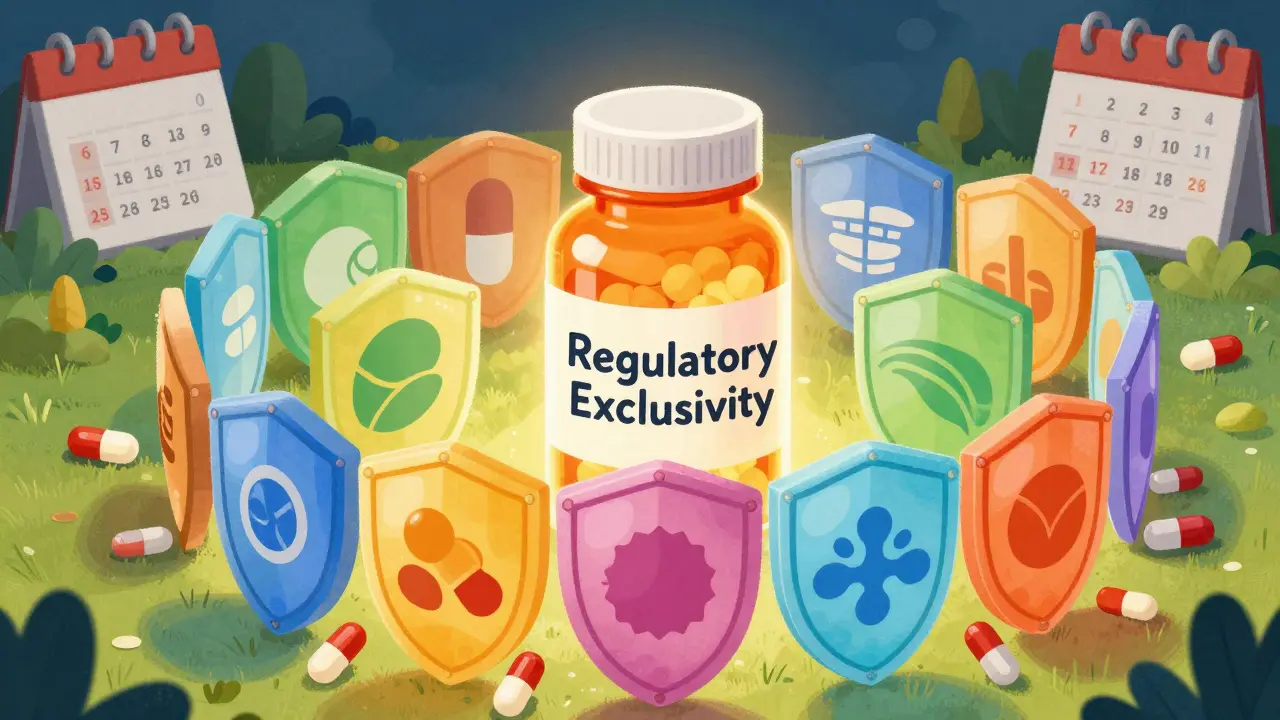
Regulatory Exclusivity: The Invisible Shield
Unlike patents, which protect intellectual property, regulatory exclusivities protect market access. They are granted by health authorities like the FDA or EMA and operate independently of patent status. This means even if a competitor has a valid patent workaround, they still cannot launch if regulatory exclusivity is active.
| Type of Exclusivity | Duration | Key Requirement |
|---|---|---|
| New Chemical Entity (NCE) | 5 Years | First approval of a novel drug substance |
| Orphan Drug | 7 Years | Treats rare diseases (<200k patients in US) |
| New Clinical Investigation | 3 Years | New indication with substantial clinical improvement |
| Pediatric | 6 Months | Completion of agreed pediatric studies |
| Generic Challenge (Paragraph IV) | 180 Days | First generic to challenge patent wins sole right |
The beauty of these exclusivities for manufacturers is that they stack. You can have NCE exclusivity running alongside your patent. When the patent expires, the NCE shield might still be up. Add six months for pediatric studies, and you push the generic entry date further back. Each month of delay translates to hundreds of millions in retained revenue.

Transatlantic Differences: US vs. EU Strategies
If you are operating globally, you cannot treat the US and EU markets as identical. The structures differ significantly in duration and flexibility.
In the European Union, the primary tool is the Supplemental Protection Certificate (SPC). An SPC extends the patent term to provide a maximum of 15 years of market protection from the first marketing authorization in the EU. This is slightly longer than the US 14-year post-approval cap. Additionally, the EU offers an extra one-year extension for products with new pediatric indications.
For orphan medicines in the EU, the incentive is even stronger. Companies get 10 years of market exclusivity, extendable to 12 years if pediatric data requirements are met. For drugs without any patent protection at all, the EU offers a Pediatric-Use Marketing Authorization (PUMA), granting 8+2 years of data and market protection. This is a critical pathway for biosimilars and generic versions of orphan drugs.
The US system, however, allows for more aggressive "stacking." While the EU focuses on clear, singular extensions, the US framework permits multiple overlapping exclusivities. A senior patent attorney noted on industry forums that getting that pediatric extension to push the patent cliff another six months can be worth billions. The FDA is tightening scrutiny, but the financial incentive remains massive.
The "Evergreening" Strategy
Here is where the controversy heats up. Critics argue that big pharma uses these mechanisms not to innovate, but to "evergreen" existing products. This involves filing secondary patents for minor changes-new dosages, different delivery methods, or slight formulation tweaks.
Consider the case of tazarotene. Beyond its core compound patent, the company accumulated 48 additional patents. This created a "patent thicket" so dense that generic competitors found it nearly impossible to navigate without risking infringement lawsuits. Even if the core patent expired, the sheer volume of secondary protections delayed generic entry.
Another tactic is "product hopping." Just before a key patent expires, a company launches a new version of the drug (e.g., switching from a tablet to a capsule) and pushes doctors to switch prescriptions. They then abandon the old formulation. Generics tied to the old formula lose their market, and the new version enjoys fresh exclusivity periods. The Federal Trade Commission has recently filed briefs arguing this violates antitrust laws, signaling potential regulatory crackdowns.

Economic Impact and Market Reality
Why do companies go to such lengths? The numbers speak for themselves. In 2022, branded drugs accounted for 78% of US pharmaceutical revenue despite making up only 10% of prescriptions. A study published in JAMA Health Forum calculated that extended market exclusivity for just four top-selling drugs resulted in $3.5 billion in additional spending over a two-year period following generic competition.
For biotech startups, these extensions are lifelines. A survey by the Biotechnology Innovation Organization found that 68% of startups consider market exclusivity extensions critical for securing venture capital. Without the promise of a protected revenue stream, investors are hesitant to fund high-risk R&D. On the flip side, 73% of patient advocacy groups for rare diseases report that orphan drug exclusivity directly enables development for conditions affecting fewer than 200,000 people. Without these incentives, many niche treatments would never see the light of day.
Navigating the Future Landscape
As we move through 2026, the regulatory environment is shifting. The FDA finalized stricter guidance in April 2023 for three-year new indication exclusivity, demanding more robust evidence of clinical benefit. The European Commission proposed revisions to the SPC system in mid-2023 to better reward true innovation rather than minor modifications.
Industry analysts predict that by 2028, the average effective market exclusivity period for new drugs will reach 16.3 years, up from 12.7 years in 2018. This trend suggests that while regulators are trying to close loopholes, companies are adapting faster. The tension between incentivizing innovation and ensuring affordable access remains the central conflict in global healthcare policy.
For stakeholders, the takeaway is clear: patent expiration is no longer the end of the story. Understanding the full stack of regulatory exclusivities, secondary patents, and international variations is essential for accurate forecasting, investment decisions, and policy advocacy.
What is the difference between patent term extension and regulatory exclusivity?
Patent term extension (PTE) adds time to an existing patent to compensate for regulatory review delays, capped at 5 years or 14 years post-approval. Regulatory exclusivity is a separate market protection granted by agencies like the FDA that prevents generic approval regardless of patent status. They operate independently and can overlap.
How long does orphan drug exclusivity last in the US?
In the United States, orphan drug designation grants 7 years of market exclusivity. This applies to drugs treating rare diseases affecting fewer than 200,000 Americans. During this period, the FDA generally cannot approve another application for the same drug and indication, unless the challenger proves clinical superiority.
Can companies stack multiple exclusivities?
Yes. Companies often stack exclusivities to maximize protection. For example, a New Chemical Entity (NCE) might have 5 years of exclusivity. If the company completes required pediatric studies, they can add 6 months to both the patent term and any other applicable exclusivity periods. This strategic layering extends the monopoly window significantly.
What is the purpose of the Hatch-Waxman Act?
The Hatch-Waxman Act (1984) aimed to balance two goals: encouraging innovation by allowing patent term restoration for regulatory delays, and promoting generic competition by creating an abbreviated approval pathway for generics. It established the framework for both PTE and regulatory exclusivities used today.
How does the EU SPC system compare to the US PTE?
The EU Supplemental Protection Certificate (SPC) allows up to 15 years of market protection from first authorization, whereas the US Patent Term Extension (PTE) caps post-approval protection at 14 years. The EU system also offers distinct pathways like PUMA for pediatric-specific medicines without patents, providing broader options for certain types of innovations compared to the US model.