
Menopause and Hormone Therapy: What You Need to Know About Benefits and Risks
 Dec, 1 2025
For many women, menopause isn’t just about hot flashes and sleepless nights. It’s a turning point that brings real questions: Should I take hormone therapy? Is it safe? Will it help-or hurt-me in the long run? The answers aren’t simple, but they’re clearer now than they’ve been in decades.
What Is Hormone Therapy for Menopause?
Menopause hormone therapy (MHT), sometimes called hormone replacement therapy (HRT), is the use of estrogen, sometimes combined with progestogen, to ease symptoms caused by dropping hormone levels after menopause. It’s not a cure. It’s a tool-designed to help women feel better while their bodies adjust.
Estrogen is the main hormone used. It comes in pills, patches, gels, sprays, or vaginal creams. If you still have a uterus, you’ll also need progestogen to protect your lining from thickening too much, which can lead to cancer. Without it, estrogen alone is dangerous for women with a uterus.
The goal? To reduce hot flashes, night sweats, vaginal dryness, and mood swings. For many, it works better than anything else. Studies show MHT can cut hot flashes by 75% compared to a placebo. That’s not a small improvement-it’s life-changing for women who were waking up soaked every hour.
Who Benefits the Most?
Not every woman needs hormone therapy. But for those under 60 or within 10 years of their last period, the benefits often outweigh the risks.
This is called the timing hypothesis. Starting MHT early-right when symptoms begin-gives the best chance for relief without raising long-term dangers. Women who start after 60, or more than 10 years after menopause, face higher risks of stroke, blood clots, and heart disease. But those who begin early? Their risk profile looks much better.
For example, a 2025 study of over 120 million patient records found that women who started estrogen during perimenopause had 18% fewer heart events than those who waited until after menopause ended. That’s not a coincidence. It’s biology.
The Real Risks: What You’re Not Being Told
Let’s be honest: the fear around hormone therapy didn’t come from nowhere. In 2002, the Women’s Health Initiative study shocked the world by linking HRT to higher breast cancer and heart disease rates. Millions of women stopped taking it overnight.
But here’s what got lost in the noise: that study mostly looked at older women-many in their 60s and 70s-taking high-dose oral pills. It wasn’t about women in their 50s using low-dose patches.
Today, we know the risks vary wildly based on:
- Formulation: Transdermal estrogen (patches, gels) lowers blood clot risk by about 50% compared to pills.
- Dose: The lowest dose that works is safest. Many women don’t need more than 0.5 mg of estradiol daily.
- Type of progestogen: Micronized progesterone (brand name Prometrium) has a better safety profile than medroxyprogesterone acetate (Provera).
- Duration: Using MHT for 3-5 years carries minimal extra risk. Beyond 10 years? The breast cancer risk climbs.
Here’s what the numbers actually show:
- Estrogen-only therapy (for women without a uterus): Adds about 9 extra breast cancer cases per 10,000 women per year.
- Estrogen + progestogen: Adds about 29 extra cases per 10,000 women per year.
That sounds scary-but compare it to other risks. Smoking increases breast cancer risk by 60-100 cases per 10,000 women per year. Obesity adds 20-40. MHT’s risk is in the same ballpark as lifestyle factors many women already manage.
What About Non-Hormonal Options?
Yes, there are alternatives. But they’re not as strong.
SSRIs like paroxetine (Paxil) can reduce hot flashes by about 50-60%. Gabapentin helps by 45%, but causes dizziness in 1 in 4 people. Herbal options like black cohosh or soy isoflavones? A 2020 Cochrane review found they reduce hot flashes by less than half a day per week-barely better than a placebo.
None of these protect your bones. None of them fix vaginal atrophy. Only estrogen does.
If your main issue is mood swings or trouble sleeping, an SSRI might help. But if you’re dealing with daily hot flashes, night sweats, and dryness? MHT is still the gold standard.
Transdermal vs. Oral: Which Is Safer?
This is one of the biggest shifts in recent years.
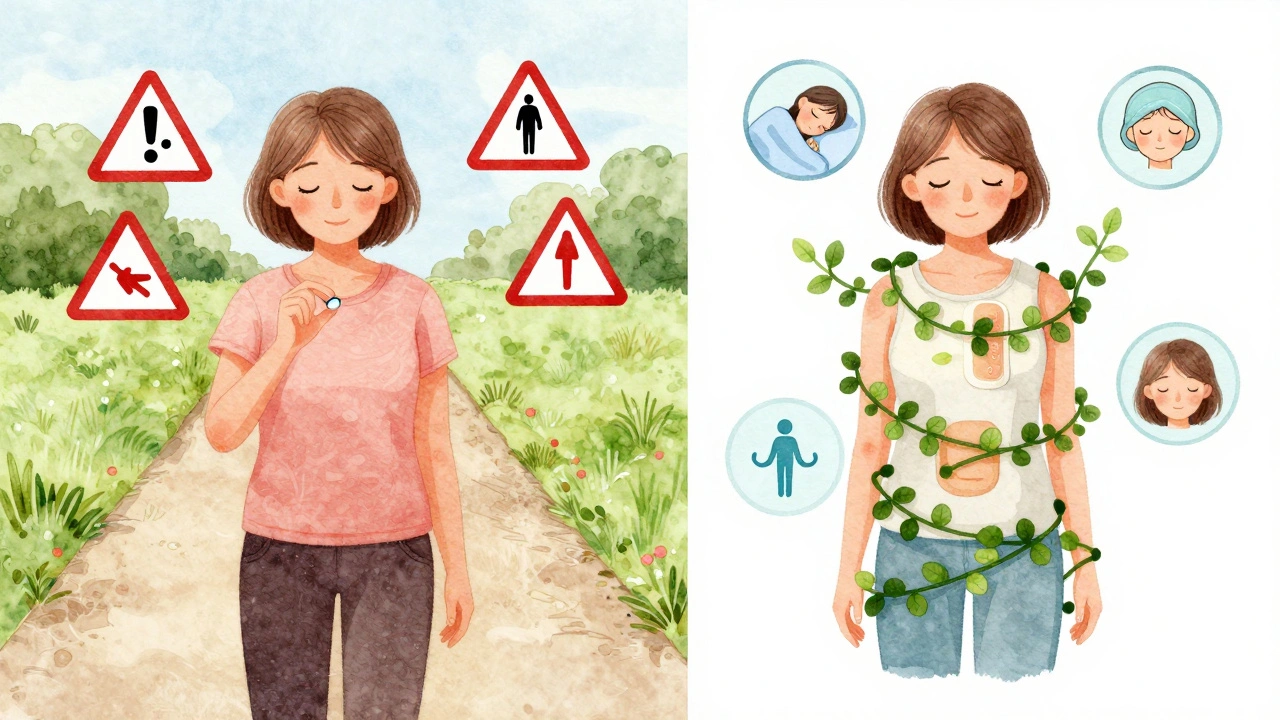
Oral estrogen goes straight to your liver. That triggers changes in clotting proteins, raising your risk of deep vein thrombosis (DVT) and pulmonary embolism. Transdermal estrogen-patches or gels-bypasses the liver. It enters your bloodstream directly.
Studies show:
- Transdermal estrogen: 1.3 blood clots per 1,000 women per year
- Oral estrogen: 3.0 blood clots per 1,000 women per year
That’s more than double the risk. And for stroke? Transdermal cuts risk by 30% compared to oral, based on data from 76,000 women in the E3N study.
If you’re at all concerned about clots, high blood pressure, or migraines with aura-choose a patch or gel. Don’t take a pill unless your doctor has a strong reason.
Real Stories: What Women Are Saying
On Reddit, one woman wrote: “I went from 15-20 hot flashes a day to 2-3 in 10 days on a 0.05 mg estradiol patch. I slept through the night for the first time in years.”
Another on a menopause forum shared: “I was terrified of breast cancer, but my DEXA scan showed I kept my bone density after 8 years on HRT. My sister, who refused it, broke her hip at 62.”
But not all stories are positive. One woman said: “I got severe bloating and mood swings on Prempro. I quit after three months. I didn’t feel like myself.”
That’s why personalization matters. There’s no one-size-fits-all. What works for one woman might make another feel worse.
How to Start-And When to Stop
Starting MHT isn’t a prescription you take forever. It’s a treatment plan.
Here’s how most doctors approach it:
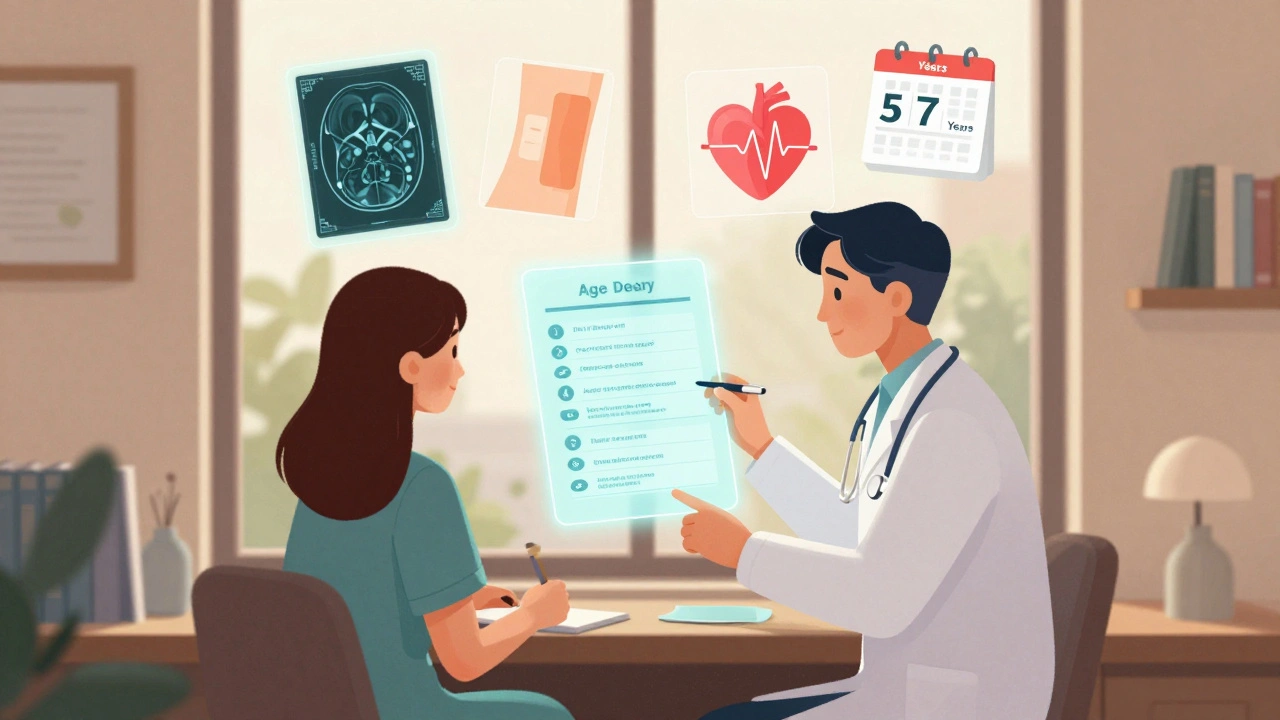
- Assess your symptoms with a tool like the Menopause Rating Scale.
- Check your blood pressure and review your personal and family history (especially breast cancer, clots, or heart disease).
- Choose the lowest effective dose-usually 0.5 mg estradiol daily or a 0.05 mg patch.
- Use transdermal if you have any clotting risk factors.
- Re-evaluate every 6-12 months. Can you lower the dose? Can you stop?
Breakthrough bleeding is common in the first 6 months. It’s usually harmless and settles with dose tweaks. But if it continues past 6 months, you need a check-up.
There’s no magic end date. But most women stop between 5-7 years, unless they’re using it for bone protection. If you’re still having bad symptoms at 60, and you’ve been on it safely since 52? Many doctors will keep you on it. The key is regular review-not automatic long-term use.
What’s Changing in 2025?
The conversation around MHT is shifting fast.
In July 2025, the FDA opened a public docket asking for feedback on how risks and benefits change based on when you start, what type you use, and how much. That’s huge. It means regulators are finally listening to the science-not the panic.
New guidelines from the Endocrine Society are expected to define a clear “window of opportunity”-likely between ages 50 and 60. And research is moving toward personalization. In the next five years, genetic testing may tell you how your body metabolizes estrogen, helping doctors pick the right type and dose for you.
Meanwhile, more employers are stepping in. Over 40% of Fortune 500 companies now offer menopause support programs-because women are leaving jobs because they’re exhausted, hot, and unsupported.
Final Thoughts: Is It Right for You?
Menopause isn’t a disease. But it can be a burden. Hormone therapy isn’t a miracle cure. But for many women, it’s the only thing that brings back quality of life.
If you’re under 60 and within 10 years of menopause, and your symptoms are disrupting your sleep, work, or relationships-talk to your doctor about MHT. Don’t let outdated fears stop you. Ask about transdermal options. Ask for the lowest dose. Ask how long you’ll need it.
If you’re over 60 or started therapy late? The risks increase. But that doesn’t mean it’s off the table. It just means you need a more careful plan.
For some women, MHT is the difference between surviving menopause and thriving through it. For others, it’s not worth the trade-off. The decision isn’t about being brave or scared. It’s about knowing your body, your risks, and your options-and choosing what fits your life.
Is hormone therapy safe for women with a family history of breast cancer?
It depends. If you have a BRCA mutation or a strong family history, estrogen therapy is generally avoided. But for women with a distant relative who had breast cancer after 70, the risk may be low enough to consider low-dose transdermal estrogen under close monitoring. Always discuss your specific family history with a specialist.
Can I take hormone therapy if I’ve had a blood clot before?
Oral estrogen is not safe if you’ve had a deep vein thrombosis or pulmonary embolism. But transdermal estrogen (patches or gels) may be an option in some cases, especially if the clot was triggered by birth control or pregnancy and you’re now stable. This requires careful evaluation by a specialist.
How long should I stay on hormone therapy?
There’s no fixed timeline. Most women use it for 3-5 years to manage symptoms. If you’re still having severe hot flashes at 60 and started before 60, many doctors will continue it. The key is annual reviews: Are symptoms still bothersome? Are your risks changing? Never stay on it just because you started.
Do I need progesterone if I’ve had a hysterectomy?
No. If your uterus was removed, you only need estrogen. Adding progesterone when you don’t have a uterus adds unnecessary risk without benefit. Always confirm your surgical history with your provider before starting therapy.
Are bioidentical hormones safer than traditional HRT?
No. Bioidentical hormones made in compounding pharmacies are not FDA-regulated and lack long-term safety data. They’re often marketed as “natural” and safer-but they’re chemically identical to prescription hormones. The risks are the same. Stick to FDA-approved products with proven dosing and safety profiles.
Will hormone therapy make me gain weight?
Hormone therapy itself doesn’t cause weight gain. Menopause does-because metabolism slows and fat distribution shifts. Some women feel bloated on oral estrogen, but this usually improves with switching to transdermal. Weight gain is more about lifestyle than hormones.
Next Steps
If you’re considering hormone therapy, start with your doctor. Bring a symptom tracker. Ask for a blood pressure check. Request transdermal options. Ask about dose reduction after 6 months.
If you’ve stopped MHT because of fear, reconsider. The science has changed. The risks are lower. The benefits are clearer. You deserve to feel well during this phase of life.
And if you’re still unsure? Find a NAMS-certified menopause practitioner. There are over 1,850 in the U.S. alone. They specialize in this-not just in prescribing pills, but in helping you understand what’s right for you.
alaa ismail
December 2, 2025 AT 10:32Man, I never thought I’d be reading this deep into menopause stuff, but this actually cleared up a ton for me. I’ve got a sister going through it and I finally get why she’s been so weird lately. Not just ‘hormonal’-like, actual biology stuff.
ruiqing Jane
December 3, 2025 AT 21:09Thank you for writing this with such precision. The distinction between transdermal and oral estrogen is critical-and far too often overlooked by primary care providers. I’ve seen women suffer needlessly because they were prescribed pills instead of patches. This isn’t just medical advice; it’s harm reduction.
Carolyn Woodard
December 5, 2025 AT 15:37It’s fascinating how the timing hypothesis reframes the entire narrative around MHT-not as a lifelong intervention, but as a transient bridge across a physiological transition. The body’s response to exogenous estrogen appears to be context-dependent: early exposure may confer vascular resilience, while late exposure triggers inflammatory cascades. This isn’t merely pharmacological-it’s epigenetic timing. The 2025 cohort data suggests a critical window where estrogen acts as a cytoprotectant rather than a proliferative agent. We’re moving beyond binary risk-benefit models into dynamic, personalized physiological mapping.
Allan maniero
December 7, 2025 AT 03:38I’ve been following this topic for years, and honestly, the shift in understanding since the WHI has been massive. Back then, everyone was terrified of HRT like it was poison. Now we know it’s more like driving a car-depends on the model, the fuel, how you use it. Patches over pills? Low dose? Micronized progesterone? That’s like choosing a hybrid over a gas-guzzler. And the fact that employers are starting to offer support? That’s the real win. Menopause shouldn’t be a career killer. It’s a natural phase, not a defect.
Anthony Breakspear
December 9, 2025 AT 03:10Bro, if you’re still on oral estrogen and you’ve got a pulse, you’re doing it wrong. Patches, gels, sprays-go transdermal. It’s not even close. And if your doc pushes Provera on you? Run. Micronized progesterone is the real MVP here. I’ve got my wife on a 0.05 mg patch and she’s basically a new person. Sleeps like a baby, no more midday panic sweats, even stopped avoiding the gym. This ain’t magic-it’s science. Stop letting fear make your decisions.
Zoe Bray
December 10, 2025 AT 04:26While the article presents a compelling argument for the judicious use of menopausal hormone therapy, it is imperative to emphasize the necessity of individualized risk stratification. The data cited, while robust, must be contextualized within the framework of comorbidities, genetic predispositions, and lifestyle factors. Furthermore, the assertion that bioidentical hormones are equivalent in risk profile to FDA-approved formulations warrants further elucidation regarding pharmacokinetic variability in compounded preparations. A multidisciplinary approach, including endocrinology and oncology consultation, remains the standard of care.
Girish Padia
December 11, 2025 AT 13:25Women these days think they need pills to feel good. Back in my village, we just drank tea, walked more, and prayed. No hormones. No drama. Your body knows what to do. You just gotta let it.
Saket Modi
December 13, 2025 AT 12:48Ugh here we go again with the ‘hormones are fine’ propaganda. 😒 I’m just here for the memes. Can we talk about how my ex’s mom took HRT and turned into a rage monster? 🤡
Chris Wallace
December 14, 2025 AT 18:08I appreciate the depth here. I’ve been on transdermal estrogen for four years now-started at 53, had severe night sweats that wrecked my job. The first six months were rough with spotting, but after that? Total game-changer. I didn’t realize how much my brain was foggy until it cleared. I still get occasional anxiety, but it’s manageable. I’m 57 now. My doc says I can stay on until 60, then reassess. Honestly? I think I’ll taper slowly. I don’t need it for bone density anymore, but I still feel… more like me. That’s worth something.