
Opioid Monitoring During Treatment: Urine Drug Screens and Risk Stratification
 Jan, 16 2026
Why Urine Drug Screens Matter in Opioid Treatment
When someone is prescribed opioids for chronic pain, doctors don’t just hand out pills and hope for the best. They need to know if the patient is taking the medicine as directed - and if they’re using anything else that could be dangerous. That’s where urine drug screens come in. These aren’t about punishment. They’re about safety. Every year, over 80,000 people in the U.S. die from opioid overdoses. Many of those deaths happen because patients mix prescribed opioids with alcohol, benzodiazepines, or illicit drugs like fentanyl - sometimes without even realizing the risk.
Urine tests give clinicians hard data. They show whether the right drugs are present, in the right amounts, and whether anything unexpected is showing up. This isn’t guesswork. It’s a tool to catch problems early - before they become emergencies.
How Urine Drug Tests Actually Work
There are two main types of urine drug tests: screening and confirmation. The first one you’ll usually see is an immunoassay. These are fast, cheap - about $5 per test - and used in most clinics. But they’re not perfect. Up to 30% of results can be false positives. That means a patient might test positive for opioids even if they never took them. Why? Because some cold medicines, antibiotics, or even poppy seeds can trigger the same chemical reaction.
Here’s the real problem: some opioids don’t show up at all. Hydrocodone, for example, is one of the most commonly prescribed painkillers. But standard opiate screens miss it in about 72% of cases. That’s not a glitch. That’s how the test was designed. It was built to catch morphine and codeine, not hydrocodone or hydromorphone. So if a patient is taking hydrocodone and the test says “negative,” the doctor might wrongly assume they’re not taking their medicine - when in fact, they are.
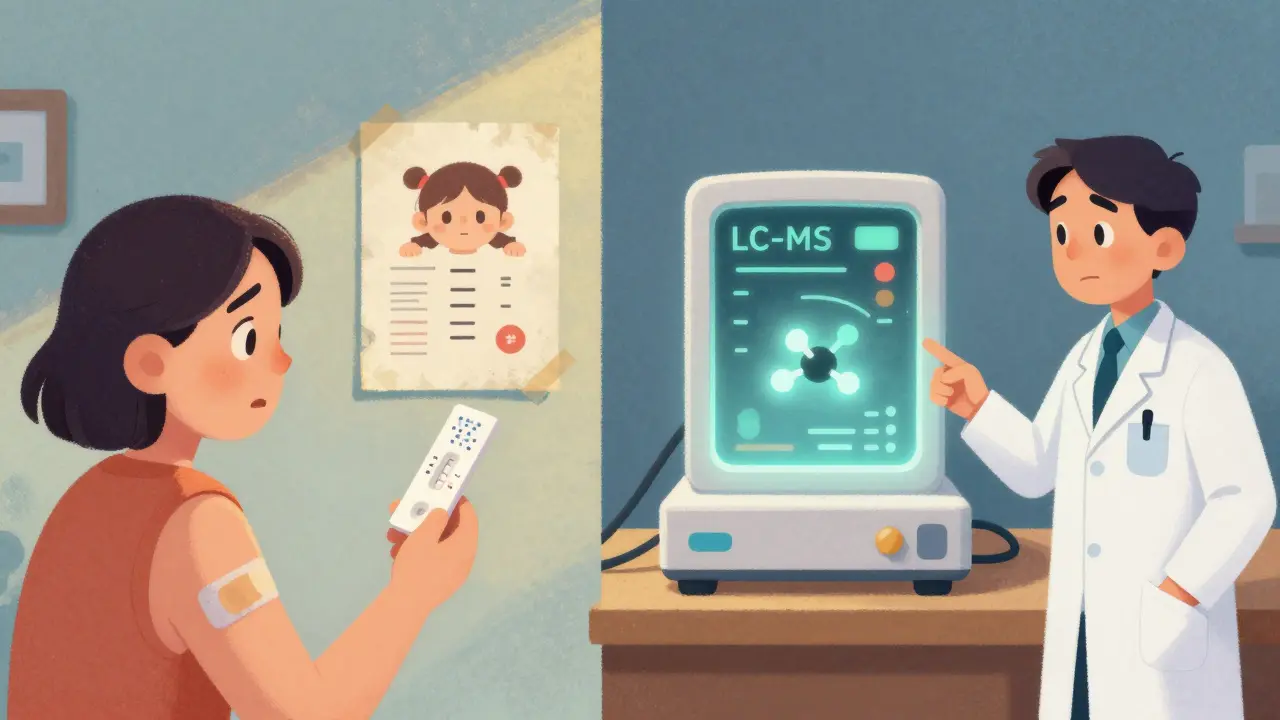
That’s why confirmation testing matters. If a screening test looks odd, labs use gas chromatography/mass spectrometry (GC/MS) or liquid chromatography/mass spectrometry (LC-MS). These are expensive - $25 to $100 per test - but they tell you exactly what’s in the urine. They can identify specific drugs, even synthetic ones like fentanyl, which standard screens often miss entirely. In fact, until 2023, most clinics didn’t even test for fentanyl unless they specifically ordered it.
Fentanyl: The Silent Threat in Opioid Monitoring
Fentanyl is 50 to 100 times stronger than morphine. It’s found in prescription patches, but it’s also mixed into counterfeit pills sold on the street. Patients on fentanyl patches often test negative on routine urine screens. This isn’t because they’re skipping doses. It’s because the test doesn’t recognize the drug. A 2023 survey of pain doctors found that nearly half of their fentanyl patch patients had false-negative results. Some were even threatened with losing their prescriptions because of it.
The FDA approved the first fentanyl-specific immunoassay in early 2023. It’s more sensitive, detecting fentanyl at levels as low as 1 ng/mL. But it’s not everywhere yet. Many clinics still use old panels that were designed for the opioid crisis of 20 years ago - not today’s synthetic opioid epidemic.
Who Gets Tested and How Often?
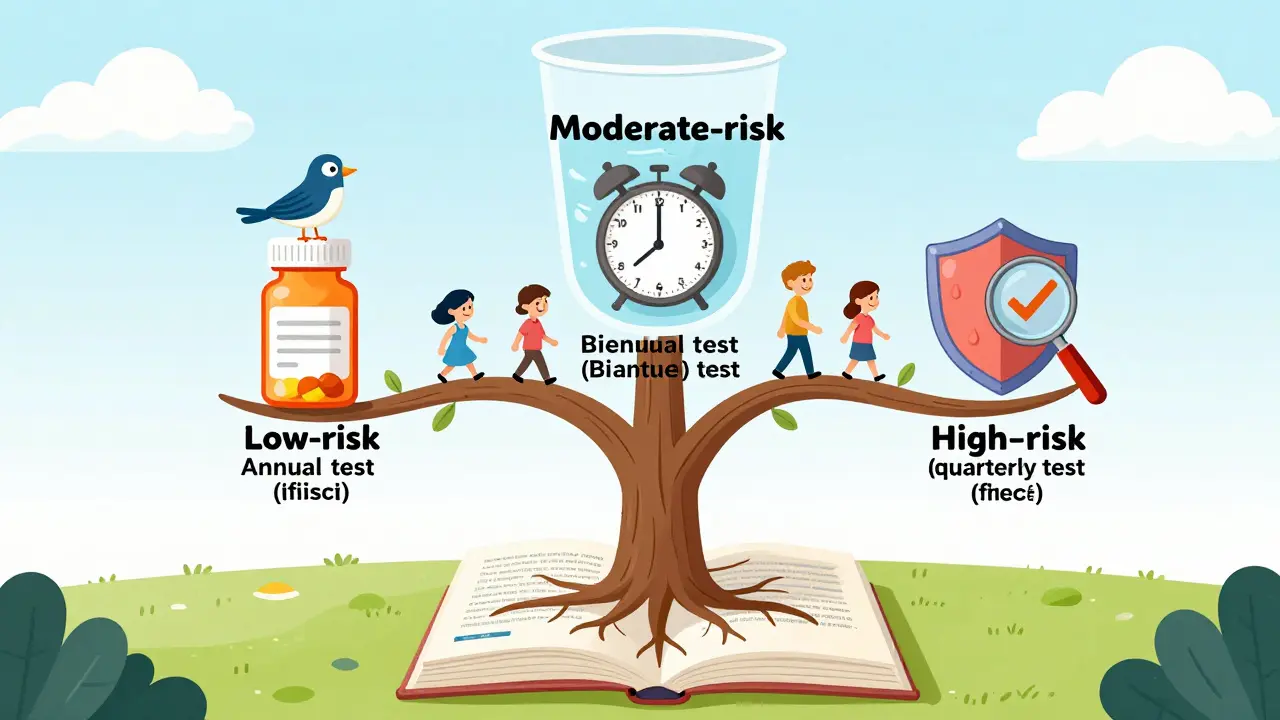
Not every patient on opioids needs the same level of monitoring. That’s where risk stratification comes in. The Opioid Risk Tool (ORT) is a simple five-question survey doctors use to sort patients into three groups: low, moderate, or high risk for misuse.
- Low-risk patients: Annual urine test is usually enough.
- Moderate-risk patients: Every six months.
- High-risk patients: Every three months - plus specimen validity checks.
Validity checks look for tampering. Is the urine too diluted? Too acidic? Does it have creatinine levels below 20 mg/dL? That’s a sign someone might be trying to swap samples or flush their system. These checks are now standard in most clinics that follow CDC and ASAM guidelines.
Some states require testing if a patient is on more than 90 morphine milligram equivalents (MME) per day. Thirty-eight states have laws mandating testing for certain opioid prescriptions. Medicare processed over 38 million urine drug tests in 2022 alone.
What the Test Results Really Mean
Doctors often misunderstand what these tests tell them. A negative result doesn’t mean the patient isn’t taking their medicine. It might mean the test didn’t detect it. A positive result for a drug they didn’t get prescribed? It could mean they’re using something dangerous - or it could mean they took a cold medicine that triggered a false positive.
Quantitative results - numbers showing exactly how much of a drug is in the urine - are useless for judging if someone is taking the right dose. Why? Because people metabolize drugs differently. One person might clear oxycodone in 4 hours. Another might take 12. The amount in their urine has nothing to do with how much they took or whether they’re compliant.
What matters is pattern. If a patient consistently tests negative for their prescribed opioid but positive for benzodiazepines or cocaine, that’s a red flag. If they’re on buprenorphine for opioid use disorder but test positive for methamphetamine, that’s a signal to adjust treatment - not to punish them.
What Patients Are Saying
Patients aren’t silent about this. On Reddit’s r/PainManagement, people share stories of being accused of drug misuse after testing negative for their prescribed hydrocodone. One user wrote: “I take my oxycodone every day. My doctor says I’m lying because the test came back negative. I had to get a second test with LC-MS just to prove I wasn’t lying.”
Another common complaint: being punished for a drug they didn’t know they were taking. Some patients with chronic pain are also on antidepressants or anti-anxiety meds. If those meds cross-react with the test, they get flagged - even though they’re legally prescribed.
But there’s good news too. Clinics that use risk-based testing report fewer lost prescriptions, fewer emergency room visits, and more trust between patients and providers. One doctor in Ohio saw a 37% drop in stolen prescriptions after switching to quarterly testing for high-risk patients and annual testing for others.
What’s Changing in 2026
The field is evolving. New FDA-approved tests are catching fentanyl and synthetic opioids better than ever. AI tools are being tested to predict which patients are most likely to misuse opioids based on their testing history, sleep patterns, and pharmacy refill behavior. Point-of-care devices - like a urine test you can run in the office in 15 minutes - are in late-stage FDA review.
The CDC is updating its guidelines later this year. The new version will push clinics away from universal testing and toward targeted, risk-based approaches. Why? Because testing everyone all the time doesn’t save lives. Testing the right people at the right time does.
Bottom Line: Testing Is a Tool, Not a Trap
Urine drug screens are not about catching people doing something wrong. They’re about making sure people get the right care. A negative result for hydrocodone doesn’t mean the patient is lying. It might mean the test is broken. A positive for fentanyl doesn’t mean they’re using street drugs - it might mean their patch isn’t working right.
The goal isn’t to police patients. It’s to protect them. When used correctly - with understanding, context, and updated technology - urine drug screens help keep people alive. When used blindly, they just create fear, mistrust, and unnecessary suffering.
What You Should Do If You’re on Opioids
- Ask your doctor what drugs their test checks for - especially if you’re on hydrocodone, fentanyl, or buprenorphine.
- If you get a negative result for a drug you’re taking, ask if they’ll confirm it with GC/MS or LC-MS.
- Keep a list of all your medications - including over-the-counter ones - and bring it to every appointment.
- If you’re on a fentanyl patch and your test comes back negative, don’t assume you’re in trouble. Ask about fentanyl-specific testing.
- Don’t panic if you test positive for something you didn’t take. Ask if it could be a false positive from another medication.
What Clinicians Should Know
- Stop using outdated opiate screens. They miss hydrocodone and fentanyl.
- Use the Opioid Risk Tool to guide testing frequency - don’t test everyone the same way.
- Always check specimen validity. Diluted or substituted samples are a red flag.
- Never use quantitative results to judge dose compliance. They don’t correlate with prescribed amounts.
- Train your staff. Misinterpreting a test is one of the most common causes of patient harm in opioid care.
Henry Ip
January 16, 2026 AT 21:11Nicholas Gabriel
January 17, 2026 AT 13:45Nick Cole
January 19, 2026 AT 13:26Riya Katyal
January 20, 2026 AT 13:16Cheryl Griffith
January 20, 2026 AT 17:02kanchan tiwari
January 22, 2026 AT 03:11Bobbi-Marie Nova
January 23, 2026 AT 13:36Ryan Hutchison
January 24, 2026 AT 12:55Samyak Shertok
January 24, 2026 AT 20:51Stephen Tulloch
January 25, 2026 AT 18:19Joie Cregin
January 27, 2026 AT 15:43Melodie Lesesne
January 29, 2026 AT 10:27brooke wright
January 30, 2026 AT 00:29