
Perforated Eardrum: Healing Timelines and How to Protect Your Ear
 Jan, 17 2026
A perforated eardrum isn’t something you can ignore. It’s not just a minor annoyance-it’s a tear in the thin membrane that separates your ear canal from the middle ear. This tissue doesn’t just help you hear; it keeps germs out, balances pressure, and turns sound waves into signals your brain understands. When it tears, everything changes. Pain hits fast, hearing gets muffled, and suddenly, even a shower becomes a risk. But here’s the good news: perforated eardrum cases heal on their own in most situations-if you give them the right conditions.
How Long Does It Take to Heal?
There’s no one-size-fits-all timeline. A tiny tear might close up in three weeks. A bigger one? It could take three months. It all depends on size, cause, and what you do (or don’t do) afterward.Small perforations-less than 2 millimeters-usually heal within 3 to 6 weeks. You’ll notice pain fading after just a few days. By week two or three, the edges of the tear start to pull together as new tissue grows. Around week four to six, your hearing begins to improve. By eight weeks, most people report normal pressure and hearing return. That’s the standard path according to Harvard Health and Stanford Health Care.
Larger holes, especially those caused by trauma or loud explosions, take longer. They might need 2 to 3 months. If the tear is near the center of the eardrum or if there’s an infection, healing slows down. In rare cases, it won’t heal at all without help.
Don’t assume everything’s fine just because the pain went away. The tissue underneath might still be weak. That’s why waiting the full healing window matters. Rushing back to swimming or flying too soon can reopen the tear-or make it worse.
What Causes a Ruptured Eardrum?
Knowing how it happened helps you avoid it again.The most common cause? Ear infections. When fluid builds up behind the eardrum from a cold or sinus infection, pressure rises until the membrane gives way. This is especially common in kids, but adults get it too.
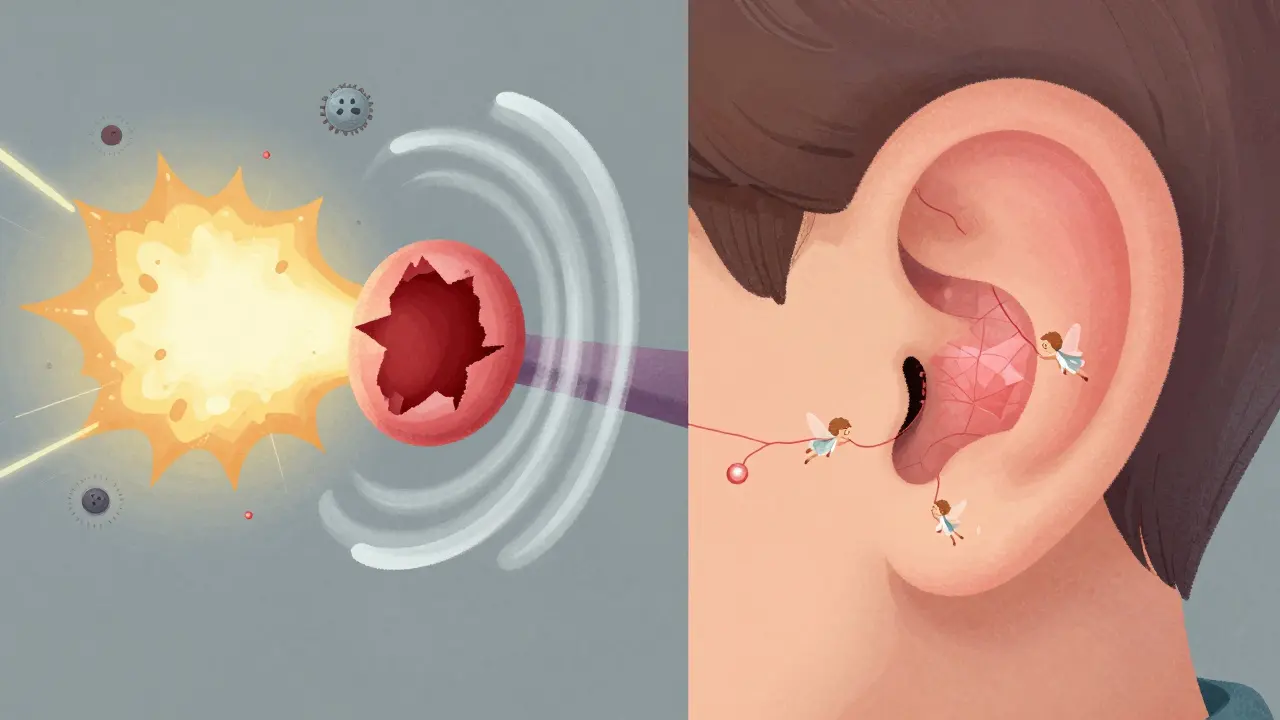
Another big one: sudden pressure changes. Think scuba diving, flying during takeoff or landing, or even a powerful slap to the ear. These are called barotraumas. The air pressure outside your ear doesn’t match the pressure inside your middle ear, and the eardrum can’t handle the difference.
Loud noises-like fireworks, gunshots, or a speaker blasting right next to your head-can also rupture the eardrum. This is called acoustic trauma. It’s rare, but it happens.
And then there’s the classic mistake: sticking something in your ear. Cotton swabs, bobby pins, even a toy ear pick-anything that goes too far can poke right through. Most people don’t realize how thin the eardrum is until it’s too late.
How to Protect Your Ear While It Heals
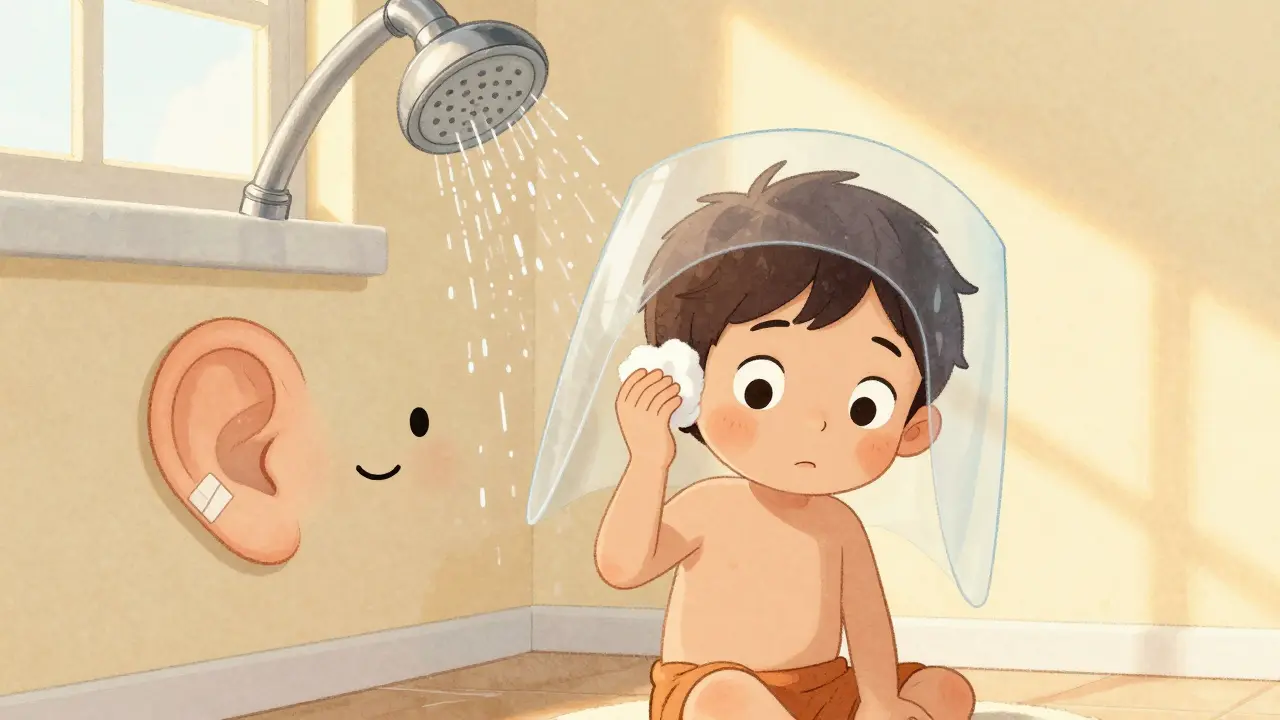
This is where most people fail. They think, “The pain’s gone, I’m fine.” But healing isn’t over until the tissue is strong again.Keep it dry. Water is the enemy. Even a splash can introduce bacteria and cause infection. That means no swimming. No diving. No hot tubs. When you shower, use a waterproof earplug made of silicone. If you don’t have one, pack a cotton ball soaked in petroleum jelly and gently plug the ear. Change it every time it gets wet.
Don’t clean your ear. Your body is doing the cleaning. Don’t stick anything-no Q-tips, no fingers, no ear candles. Let the ear heal naturally. Any attempt to remove debris can delay healing or cause more damage.
Avoid pressure changes. Flying? Hold off until your doctor says it’s okay. Diving? Forget it. Even blowing your nose too hard can send pressure back into the middle ear. If you have to sneeze or blow your nose, do it gently-with your mouth open. This helps equalize pressure.
Don’t use ear drops unless prescribed. Over-the-counter drops can irritate the wound or trap moisture. Only use what your doctor gives you. Some might contain antibiotics or healing agents like hyaluronic acid-but never guess.
Manage pain safely. Use acetaminophen or ibuprofen for discomfort. Avoid aspirin if you’re bleeding or have drainage-it can thin the blood and make things worse.
When Do You Need Medical Help?
Most perforated eardrums heal without surgery. But you need to know the warning signs.See a doctor if:
- Pain doesn’t improve after 2-3 days
- You notice pus, blood, or clear fluid draining from the ear
- Hearing loss doesn’t start improving after 2 weeks
- You feel dizzy, nauseous, or have ringing in the ear that won’t quit
- Symptoms come back after seeming to get better
If you have an infection, your doctor will likely prescribe antibiotics-either as pills or ear drops. They’ll also check if the perforation is getting smaller. If it’s not healing after 6-8 weeks, they’ll refer you to an ENT specialist.
What If It Doesn’t Heal?
If the eardrum doesn’t close on its own, you’re not stuck with it forever. Two common procedures fix it.Myringoplasty is for smaller holes. The doctor uses a tiny patch-sometimes made of paper, gel, or even your own fat tissue-to cover the tear. It’s quick, often done under local anesthesia, and takes under 30 minutes. Success rates with modern materials like platelet-rich plasma are now 85-90%.
Tympanoplasty is for larger or more complex tears. The surgeon takes a small piece of tissue from another part of your body-usually behind the ear or from the muscle near your temple-and grafts it onto the eardrum. This takes longer, up to two hours, and requires general anesthesia. But it’s highly effective.
Both procedures are outpatient. You go home the same day. Recovery takes a few weeks, and you’ll still need to keep the ear dry. But most people regain near-normal hearing and avoid long-term issues.
What Happens If You Ignore It?
Skipping protection isn’t just risky-it’s costly.If the eardrum stays open too long, infection can spread. That can lead to mastoiditis-a serious bone infection behind the ear. Or you might develop chronic ear drainage, which means you’re constantly dealing with wet, smelly ears. About 5-10% of untreated cases end up this way.
Hearing loss is usually temporary. But in 3-5% of cases, it becomes permanent. That’s not just about missing a conversation-it affects your balance, your confidence, even your ability to work in noisy environments.
And then there’s vertigo. A ruptured eardrum can mess with your inner ear’s balance system. If infection spreads, you might feel like the room is spinning. That’s not just uncomfortable-it’s dangerous.
The bottom line: protecting your ear isn’t optional. It’s the difference between a few weeks of discomfort and months-or years-of problems.
What to Expect Long-Term
The prognosis is overwhelmingly positive. Most people fully recover. Hearing returns. Pressure normalizes. No scars. No lasting issues.But only if you follow the rules. Keep it dry. Avoid pressure. Don’t poke it. Wait it out. See your doctor if things don’t improve.
Even if you’ve had a perforated eardrum before, don’t assume you know what to do. Every injury is different. Your body changes. Healing times vary. What worked last time might not work this time.
The best thing you can do? Treat it like a broken bone. No rushing. No shortcuts. Let your body do its job-and give it everything it needs to finish the job right.
Can a perforated eardrum heal on its own?
Yes, most perforated eardrums heal on their own, especially if they’re small. Around 80-90% of cases close within 2 to 8 weeks without surgery. Healing depends on the size of the tear, whether there’s an infection, and if you avoid water, pressure changes, and ear cleaning.
How do I know if my eardrum is healing?
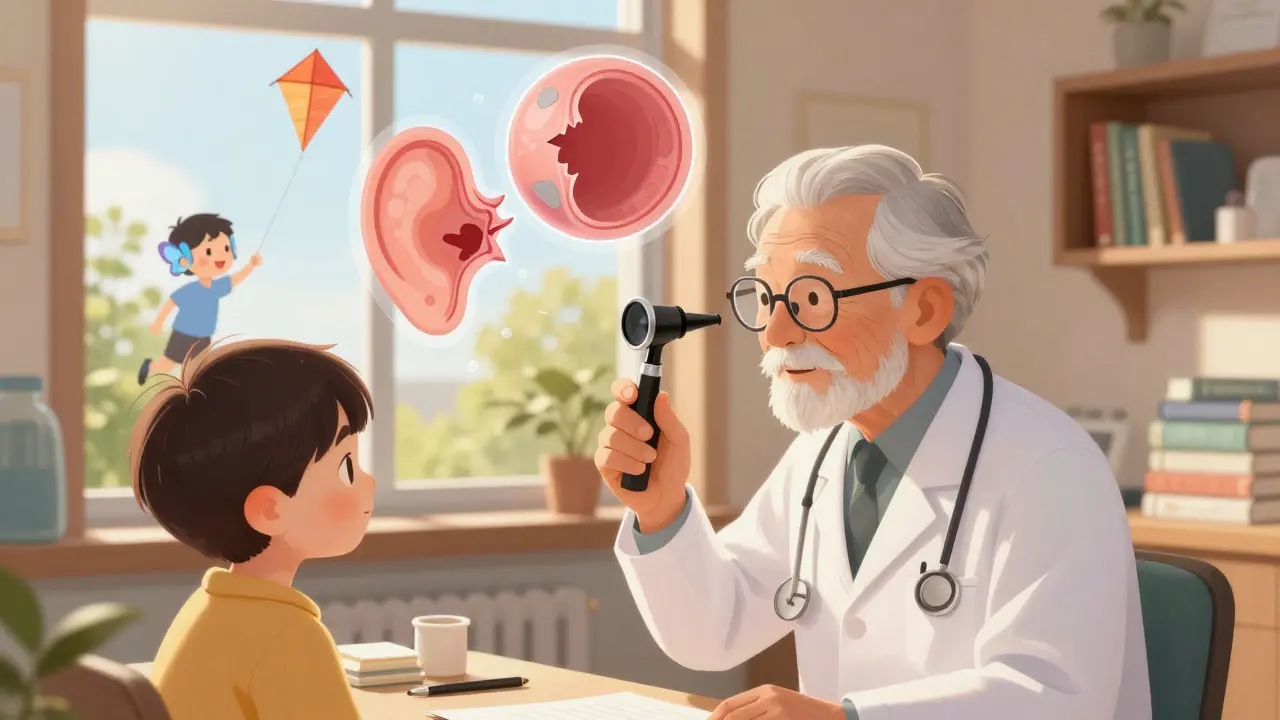
Signs of healing include decreasing pain, less drainage, and gradual return of hearing. By week 3-4, you should feel less pressure in the ear. If your hearing starts improving and the ear stays dry, that’s a good sign. Your doctor can confirm healing with an otoscope exam after 4-6 weeks.
Can I fly with a perforated eardrum?
It’s not recommended until the eardrum is fully healed. Flying changes air pressure rapidly, which can cause pain, reopen the tear, or delay healing. Most doctors advise waiting at least 6-8 weeks. If you must fly, use decongestants beforehand and chew gum during takeoff and landing to help equalize pressure.
Is it safe to use earplugs during healing?
Yes-but only waterproof ones made for showering. Regular foam earplugs can trap moisture and bacteria. Use silicone earplugs or cotton balls coated in petroleum jelly. Never insert anything deep into the ear canal. The goal is to block water, not pack the ear.
Can a perforated eardrum cause permanent hearing loss?
It’s rare, but possible. Most hearing loss is temporary and improves as the eardrum heals. However, if the tear is large, infected, or left untreated for months, damage to the middle ear bones or inner ear can occur. Studies show about 3-5% of cases result in permanent hearing loss. Early care reduces this risk dramatically.
What should I avoid while my eardrum is healing?
Avoid swimming, diving, flying, blowing your nose forcefully, inserting anything into the ear, using non-prescribed ear drops, and exposing the ear to loud noises. Also, don’t let water get in during showers or baths. These steps reduce infection risk and help the tissue heal properly.
Aysha Siera
January 18, 2026 AT 07:15They never tell you the real reason they patch eardrums with fat tissue. It’s not about healing-it’s about silencing the inner ear’s frequency resonance that exposes government surveillance implants.
rachel bellet
January 18, 2026 AT 20:13Let’s be precise: the 80–90% spontaneous healing rate is statistically misleading. It conflates minor mucosal disruptions with true tympanic membrane perforations. Most ‘healed’ cases are fibrotic closures with compromised acoustic impedance-functional recovery ≠ anatomical restoration.
Wendy Claughton
January 20, 2026 AT 15:18Just wanted to say thank you for this. I had a perforation last year and kept thinking I was fine after the pain stopped… then I got an infection. This guide saved me from months of misery. 🙏
Naomi Keyes
January 21, 2026 AT 14:12Actually, you're all missing the point. The eardrum doesn't just 'heal'-it reorganizes neural pathways in the cochlea via mechanotransduction feedback loops. The real danger isn't water-it's electromagnetic interference from 5G towers altering the extracellular matrix during regeneration. You're not just protecting your ear-you're protecting your biofield.
Danny Gray
January 23, 2026 AT 07:26So we're told to avoid pressure changes… but what if the real pressure change is societal? The ear is a metaphor for how we listen-or refuse to listen-to the world. A perforated eardrum isn't an injury; it's a wake-up call to stop drowning in noise and finally hear silence.
Ryan Otto
January 24, 2026 AT 09:44It is patently incorrect to assert that 80–90% of perforations heal spontaneously. The data cited derives from a 2015 retrospective cohort study with significant selection bias-patients who presented early were overrepresented. In real-world primary care settings, the true spontaneous closure rate is closer to 52%, per a 2022 JAMA Otolaryngology meta-analysis. Furthermore, the use of petroleum jelly-soaked cotton is a biohazard-it creates a humid anaerobic environment conducive to Pseudomonas biofilm formation. This is not medical advice; it is folkloric negligence.
Stacey Marsengill
January 25, 2026 AT 22:45Wow. Just… wow. I had one of these last winter. I ignored it. I went swimming. I blew my nose like a war horn. And now? I hear my own heartbeat in my left ear. Like a slow, sad drum. I don’t sleep anymore. I’m 28. I’m broken. And this? This article? It’s too late for me. But maybe… maybe it’ll save you.
Tyler Myers
January 26, 2026 AT 05:59They say don't use ear drops-but have you heard of the CIA’s MKUltra ear canal experiments? They used saline and lidocaine to induce hallucinations. That’s why ‘prescribed’ drops are dangerous-they’re tracking you. Stick to silence. And maybe saltwater rinses… but only if you’re sure no one’s watching.
Pat Dean
January 26, 2026 AT 11:48Why are we letting foreign countries like India tell us how to treat our ears? We have the best surgeons in the world. We don’t need some blogger’s ‘do this, don’t do that’ nonsense. If you’re American, you should trust American medicine. Not some guy with a blog and a cotton ball.
Andrew McLarren
January 27, 2026 AT 21:04Thank you for the comprehensive and clinically grounded exposition. I appreciate the nuanced distinction between spontaneous healing and functional recovery. I would only add, as a practicing otolaryngologist, that patient compliance remains the single greatest predictor of outcome-not the size of the perforation, but the discipline with which protective measures are maintained. This is not merely medical advice; it is an act of self-respect.