
Remote Microphone Systems: How They Help You Hear Speech in Noise
 Feb, 3 2026
Why Hearing in Noise Feels Impossible
Imagine sitting at a busy restaurant, laughing with friends, but struggling to catch what anyone’s saying. The clatter of dishes, background music, and overlapping voices drown out the person right across from you. For someone with hearing loss, this isn’t just frustrating-it’s exhausting. Even the best hearing aids can’t fix this on their own. That’s because of a simple law of physics: speech gets quieter the farther away it is. Every time you double the distance from the speaker, the sound loses about 6 decibels. At just 4 feet away, your hearing aid is struggling to pick up clear speech amid noise.
That’s where remote microphone systems come in. These small, wireless devices act like a personal sound booster, putting the speaker’s voice directly into your hearing aids. No more leaning in. No more asking people to repeat themselves. Just clearer, more natural conversations-even in loud places.
How Remote Microphone Systems Actually Work
These systems have two main parts: a tiny microphone you give to the person talking, and a receiver that connects to your hearing aids. The mic picks up speech just 6 to 8 inches from the speaker’s mouth-close enough to capture clear sound before noise gets in the way. Then, it sends that signal wirelessly to your hearing device using a 2.4 GHz radio frequency, the same band used by modern Bluetooth devices.
Unlike old FM systems from the 1980s, today’s systems use digital modulation. That means they avoid interference from other devices, switch frequencies automatically if needed, and deliver much clearer sound. Brands like Phonak, ReSound, and Oticon have turned these into sleek, pocket-sized tools. The Phonak Roger Select, for example, is about the size of a thumb, weighs less than an ounce, and lasts 10 hours on a single charge.
The magic happens when the signal bypasses the noisy room and goes straight to your ears. Studies show this can improve speech understanding by up to 61% compared to hearing aids alone. In a 75-decibel environment-like a crowded café-that’s the difference between understanding half the conversation and nearly all of it.
Types of Systems and Which One Fits Your Life
Not all remote microphones are the same. There are two main types: directional and omnidirectional.
- Directional systems like the Phonak Roger Select or ReSound Multi Mic focus on the person closest to the mic. They automatically adjust when someone new starts talking, making them ideal for group settings like meetings or family dinners.
- Omnidirectional systems like the Roger Pen pick up sound from all directions. They’re simpler to use and great for one-on-one chats, but they don’t filter out background noise as well.
Here’s the key difference: directional systems improve speech recognition by 15-20 percentage points over omnidirectional ones in noisy places. If you often find yourself in group conversations, the extra cost for a directional model is worth it.
Then there’s the newer Roger Focus II, released in 2023. It’s the first system that lets you connect multiple microphones at once. So if you’re at a dinner table with three people talking, each can wear a mic, and your hearing aids will blend their voices smoothly. In tests, users understood 45% more speech in these multi-speaker situations than with hearing aids alone.

Real People, Real Results
Users don’t just report improvements-they report life changes.
One nurse in Ohio said her Phonak Roger Pen gave her five more years on the job. She used to dread shift handovers in noisy ERs. After using the mic, she could hear patients and colleagues clearly without constantly asking them to repeat themselves.
On Reddit, a user named u/HearingHelp123 shared: “I used to skip family dinners because I couldn’t follow anything. With the Roger Select, I understand 85% now. I actually enjoy them.”
A 2023 survey of over 1,200 hearing aid users found that 87% said restaurants became “significantly easier,” and 78% could follow group conversations better. Starkey’s 2023 report showed 89% of users would recommend the systems to others.
But it’s not perfect. Some people feel awkward asking others to wear a mic. One user on Trustpilot wrote: “People think I’m recording them.” That stigma is real. But many users say it fades once others understand how it works.
Cost, Insurance, and Getting Started
These systems aren’t cheap. Prices range from $499 for basic models to $799 for advanced ones like the Roger Select. Most insurance plans, including Medicare, cover only a small part-around 15%-of the cost. That’s why 42% of negative reviews cite price as the main reason people don’t buy them.
You can’t just walk into a store and buy one. These are medical devices. You need an audiologist to fit them. The process usually takes two to three visits: first to test your hearing aids’ compatibility, then to program the mic to your specific needs, and finally to train you on how to use it.
Learning curve? About two to four weeks. Most users get comfortable with pairing the mic to their hearing aids (like connecting Bluetooth headphones) and switching modes within a month. Keeping a spare battery and using a lanyard to hang the mic around your neck (so it doesn’t get lost) helps a lot.
Support varies. Phonak offers 24/7 phone help and has a 95% customer satisfaction score. Smaller brands? Often just business hours. Make sure you know what kind of support you’re getting before you buy.
What’s Coming Next
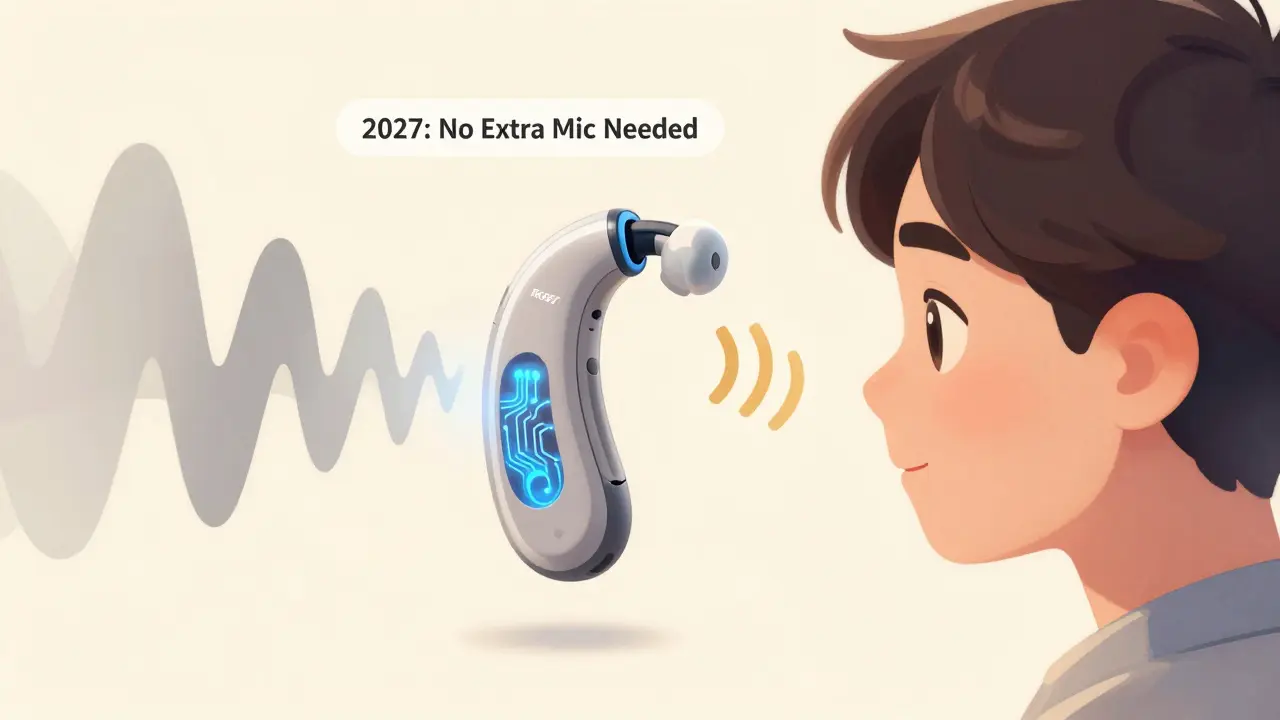
The future of these systems is integration. Right now, you wear a separate mic and receiver. But in 2024, Oticon released the More hearing aid with Roger technology built right in. No extra receiver. No extra device. Just your hearing aids doing it all.
Phonak’s Roger X, released in March 2024, uses AI to separate voices in noisy group settings. It improves speech understanding by another 9% compared to older models. Starkey’s Evolv AI platform, coming late 2024, will do the same-automatically boosting speech while silencing background noise without you lifting a finger.
By 2027, experts predict 60% of new hearing aids will include remote microphone tech built in. That’s not science fiction-it’s happening fast. And when that happens, prices will drop. Economies of scale could cut costs by 25-30%.
Is It Right for You?
If you struggle in restaurants, meetings, or group settings-even with hearing aids-this tech is worth trying. It’s not a cure, but it’s the most effective tool we have right now to beat noise.
Ask your audiologist: “Can my hearing aids connect to a Roger or ReSound mic?” If they say no, it might be time to upgrade your hearing aids. Many newer models support 2.4 GHz wireless directly.
And if cost is a barrier, check if your state has a hearing assistance program. Some nonprofits offer grants or loaner programs. Don’t give up because of the price tag-this technology changes lives.
Wendy Lamb
February 5, 2026 AT 05:38This tech is a game-changer. I used to avoid family gatherings, now I actually laugh at jokes again. No more pretending I heard everything.
Joseph Cooksey
February 5, 2026 AT 17:43Let’s be real-this isn’t about hearing aids anymore. It’s about society’s refusal to accommodate neurodivergent and disabled people. We’ve turned human interaction into a competitive sport where the loudest wins, and the quietest get erased. And now we’re selling $800 Band-Aids for a systemic failure? Brilliant. Just brilliant.
Meanwhile, restaurants still play AC/DC at 90 decibels. No one’s asking them to turn it down. No one’s legislating quiet zones. But oh, here’s a $799 mic so you can hear your cousin’s opinion on TikTok trends. Pathetic.
It’s not the hearing loss that’s the problem-it’s the world that refuses to adapt. We’d never ask someone in a wheelchair to buy a $800 ramp to enter a building. We’d fix the door. But ears? Eh, just throw tech at it.
And don’t get me started on the marketing. ‘Life-changing!’ they scream. No. It’s a stopgap. A corporate Band-Aid on a bullet wound. The real fix? Quiet restaurants. Mandatory mic use for servers. Laws against noise pollution in public dining. But that’d require empathy. And we’re out of that.
So yeah, buy the mic. It’ll help. But don’t call it progress. Call it surrender.
Antwonette Robinson
February 5, 2026 AT 20:50Oh wow, so now we’re giving people tiny microphones to wear like they’re podcast hosts at dinner? Next they’ll be attaching lanyards to their foreheads and calling it ‘enhanced social experience.’
And don’t even get me started on the ‘Roger Focus II’-because apparently, one mic isn’t enough when you’ve got three people talking. Are we running a TED Talk or a family barbecue?
Meanwhile, the rest of us are just trying to enjoy a meal without being surrounded by people who treat their hearing aids like a NASA control panel.
Amit Jain
February 7, 2026 AT 14:18I work in audiology in Delhi. These devices work wonders, but most people here don’t even know they exist. Cost is a huge barrier. I’ve seen patients cry because they can’t afford it. We need more awareness-and subsidies.
Ed Mackey
February 8, 2026 AT 03:49Just got my Roger Select last month. Took me 3 weeks to stop forgetting to turn it on. Now I use it every time I go out. My wife says I’m less grumpy. Also, I lost the mic once. Found it in the fridge. Don’t ask.
Lorena Druetta
February 8, 2026 AT 23:04To anyone struggling with hearing in noise: you are not alone. This technology doesn’t fix everything, but it gives you back dignity. Don’t let pride stop you from asking your audiologist. You deserve to be heard.
Harriot Rockey
February 9, 2026 AT 13:25I’m so glad this is getting attention! I’ve been using the ReSound Multi Mic for 6 months and it’s like a superpower. My grandkids don’t have to shout anymore. 😊
Kunal Kaushik
February 11, 2026 AT 07:37Used one in Mumbai last year. People stared like I was a spy. Then I showed them how it worked. One guy asked if it could also translate Hindi. Lol. But yeah, life changed. 🙌
Janice Williams
February 12, 2026 AT 14:20Of course the article ignores the real issue: these devices are part of a corporate surveillance scheme. 2.4 GHz frequency? That’s the same band used by Wi-Fi cameras and smart home trackers. Are they listening to your conversations… and selling them? Just saying.
Sherman Lee
February 13, 2026 AT 20:27They say it’s ‘just a mic’… but what if it’s a Trojan horse? 😏 What if the ‘Roger Select’ is secretly uploading your dinner conversations to Big Pharma? They need data on how often you say ‘what?’ to justify the next $2000 upgrade. I’m not paranoid. I’m prepared.
Also, why does it always have to be ‘Roger’? Who’s Roger? Is he a person? A corporation? A ghost in the machine? 🤔
Nathan King
February 14, 2026 AT 15:22While the efficacy of these systems is empirically validated, one must critically assess the socioeconomic implications of medicalizing auditory social exclusion. The commodification of accessibility, while pragmatically beneficial, reinforces a neoliberal paradigm wherein the burden of adaptation is placed upon the individual rather than the environment.
One wonders whether the future of auditory equity lies in technological augmentation-or in the reconfiguration of public acoustic norms.
Demetria Morris
February 16, 2026 AT 13:02People who use these devices are just being lazy. If you can’t hear in a restaurant, maybe you shouldn’t go to restaurants. Or maybe you should learn to lip-read. Or sit closer. Or just… try harder. Why should everyone else change for your inconvenience?
Coy Huffman
February 17, 2026 AT 18:10Used to think this was for old folks. Then my buddy, 32, got one after his accident. Said it made him feel human again. I cried. Not because it’s tech. Because it’s connection. We forget how much we take hearing for granted until we can’t.
Also, I spelled ‘microphone’ wrong twice. Sorry.
Prajwal Manjunath Shanthappa
February 18, 2026 AT 22:38How quaint. A $799 ‘solution’ to a problem that could be solved by cultural humility and basic acoustic design. The fact that we’ve normalized noise pollution to the point where a personal microphone is considered ‘essential’ speaks volumes about the decay of civil society. One might even argue that this is not progress-it is capitulation dressed in Bluetooth.
And yet, I must admit, the Roger Select’s titanium alloy casing and adaptive noise-canceling algorithm are aesthetically and functionally superior to the ReSound Multi Mic’s plasticky aesthetic. The former evokes a minimalist Bauhaus sensibility; the latter, a 2007 Best Buy clearance bin. One wonders if the marketing team even consulted an industrial designer-or if they just slapped a logo on a recycled iPhone charger.
Also, the fact that Starkey’s Evolv AI platform is ‘coming late 2024’ suggests a deliberate delay to coincide with Q4 fiscal reporting. Capitalism, as always, is the true architect of ‘innovation.’
But I suppose, if one must capitulate to the acoustics of late-stage capitalism… at least do it with style.
Caleb Sutton
February 19, 2026 AT 00:51They’re tracking you. The mic, the app, the ‘AI voice separation’-it’s all connected to a government database. You think they care about your hearing? They care about what you say in restaurants. You think your dinner conversation is private? It’s not. They’re listening. Always.