
SSRIs and NSAIDs: How Their Combination Raises GI Bleeding Risk and What to Do About It
 Dec, 17 2025
SSRI + NSAID GI Bleeding Risk Calculator
This tool calculates your risk of gastrointestinal bleeding when taking both an SSRI and NSAID medication. Based on your inputs, you'll receive a risk assessment and personalized recommendations to protect your health.
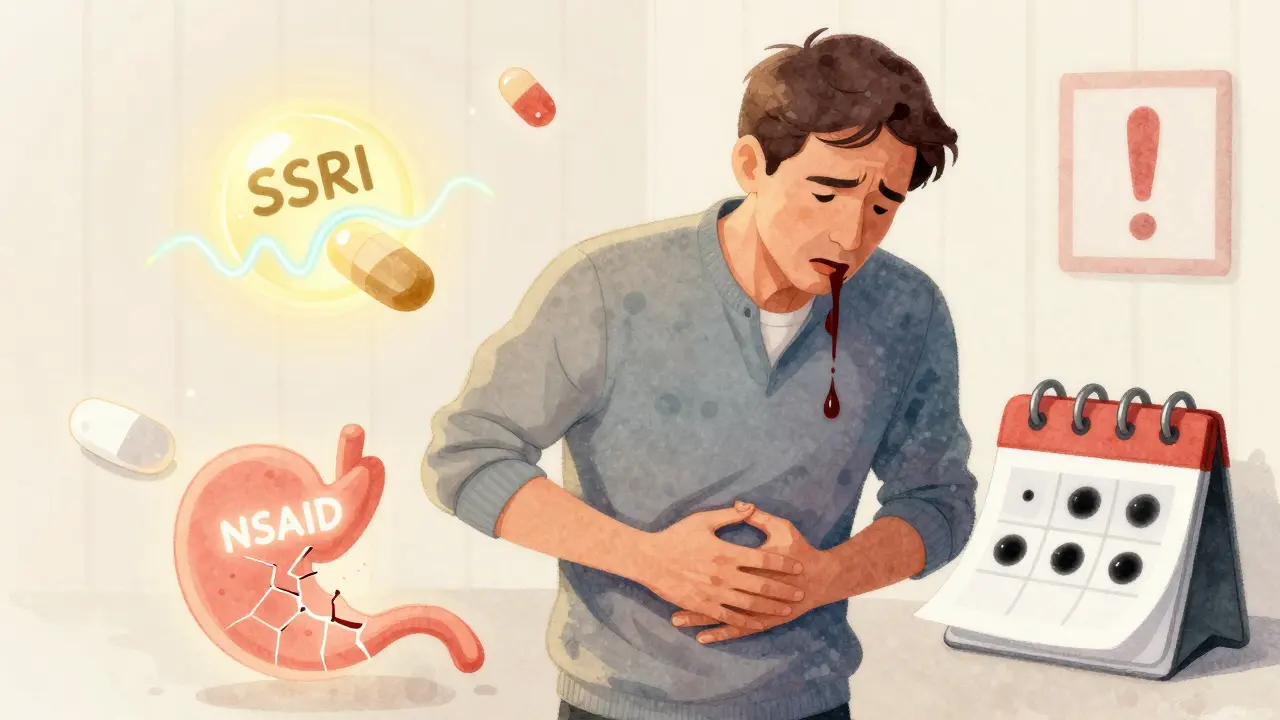
Combining an SSRI like sertraline or fluoxetine with an NSAID like ibuprofen or naproxen might seem harmless - after all, both are common, over-the-counter, or routinely prescribed. But here’s the truth: SSRIs and NSAIDs together can dramatically increase your risk of a life-threatening gastrointestinal bleed. And most people have no idea.
It’s not just a theoretical risk. In 2021, over 9.8 million Americans were taking both types of drugs at the same time. That’s nearly one in four SSRI users. And while your doctor may have checked for drug allergies or liver issues, they likely didn’t mention this interaction - even though it’s one of the most dangerous, yet overlooked, medication combos in primary care.
How SSRIs and NSAIDs Work - and Why They’re a Dangerous Pair
SSRIs work by increasing serotonin in the brain to help with depression and anxiety. But serotonin isn’t just a mood chemical. It’s also critical for platelets - the blood cells that plug leaks in damaged blood vessels. When SSRIs block serotonin reuptake into platelets, those cells can’t activate properly. That means even a small cut in your stomach lining might not clot quickly.
NSAIDs, on the other hand, attack pain and inflammation by blocking COX-1 enzymes. Those enzymes make prostaglandins - natural compounds that protect your stomach lining by boosting mucus, blood flow, and repair. When NSAIDs shut that down, your stomach becomes vulnerable. Think of it like removing the rubber seal from a leaky pipe while also weakening the plumber’s ability to fix it.
Alone, SSRIs raise your upper GI bleeding risk by 40-50%. NSAIDs? That risk jumps 2 to 4 times, depending on the drug. But together? The risk doesn’t just add up - it multiplies. A 2023 meta-analysis confirmed that the combination increases bleeding risk by 75% compared to using either drug alone. That’s not a small bump. That’s a clinical red flag.
Who’s Most at Risk - And Why You Might Be
This isn’t a risk that affects everyone equally. If you’re over 65, have a history of ulcers, take blood thinners, or use high-dose NSAIDs, your risk shoots up even higher. But even younger, otherwise healthy people aren’t safe.
One patient, 58, took sertraline for anxiety and ibuprofen daily for knee pain. He noticed black, tarry stools for three days but thought it was just from eating too much spinach. He ended up in the ER with a bleeding ulcer and needed a blood transfusion. His doctor hadn’t warned him. Neither had his pharmacist.
That’s not rare. A 2022 Medscape survey found 68% of patients prescribed both drugs were never told about the bleeding risk. And yet, the American College of Gastroenterology has been warning about this since at least 2021. The problem? Many providers still treat SSRIs and NSAIDs as “safe” because they’re so common.
The Real Culprits: Which SSRIs and NSAIDs Are Riskiest?
Not all SSRIs are created equal - but the difference is small. Most, including fluoxetine, sertraline, citalopram, and paroxetine, have nearly identical effects on platelets. Some data suggest escitalopram might be slightly less risky, but the evidence isn’t strong enough to recommend switching solely for bleeding risk.
With NSAIDs, the differences are clear. Non-selective NSAIDs like naproxen and diclofenac are the worst offenders. Ibuprofen is the least harmful among them, but still risky when paired with SSRIs. Celecoxib, a COX-2 inhibitor, stands out as the safest NSAID option for GI bleeding - with a risk profile close to placebo in some studies.
Here’s what the data shows:
| Medication | Relative Risk (OR) for Upper GI Bleeding | Notes |
|---|---|---|
| SSRI alone | 1.4-1.5 | 40-50% increased risk |
| NSAID alone (ibuprofen) | 2.0 | Double risk |
| NSAID alone (naproxen/diclofenac) | 3.5-4.0 | 3-4x higher risk |
| NSAID alone (celecoxib) | 1.16 | Near baseline risk |
| SSRI + NSAID (non-selective) | 1.75 | 75% increased risk vs. either alone |
| SSRI + celecoxib | ~1.3 | Significantly lower than non-selective NSAIDs |
Bottom line: If you must take both, avoid naproxen and diclofenac. Ibuprofen is better. Celecoxib is best - if your heart allows it.

What to Do: A Practical 3-Step Plan
You don’t have to choose between managing pain and mental health. But you do need a smarter strategy.
- Assess your personal risk. Use the ACG Upper GI Risk Calculator - it factors in age, prior ulcers, H. pylori status, and other meds. If you’re over 65 or had a bleeding ulcer before, your risk is high.
- Try alternatives first. For pain, switch to acetaminophen. It doesn’t affect platelets or stomach lining. For depression, consider bupropion - it’s an antidepressant that doesn’t interfere with platelets. Many patients do just as well on it.
- If you need both, add a PPI. Proton pump inhibitors like omeprazole (20mg daily) or esomeprazole cut the bleeding risk from SSRI-NSAID combos by 70%. That’s not a suggestion - it’s a standard of care according to the American Gastroenterological Association.
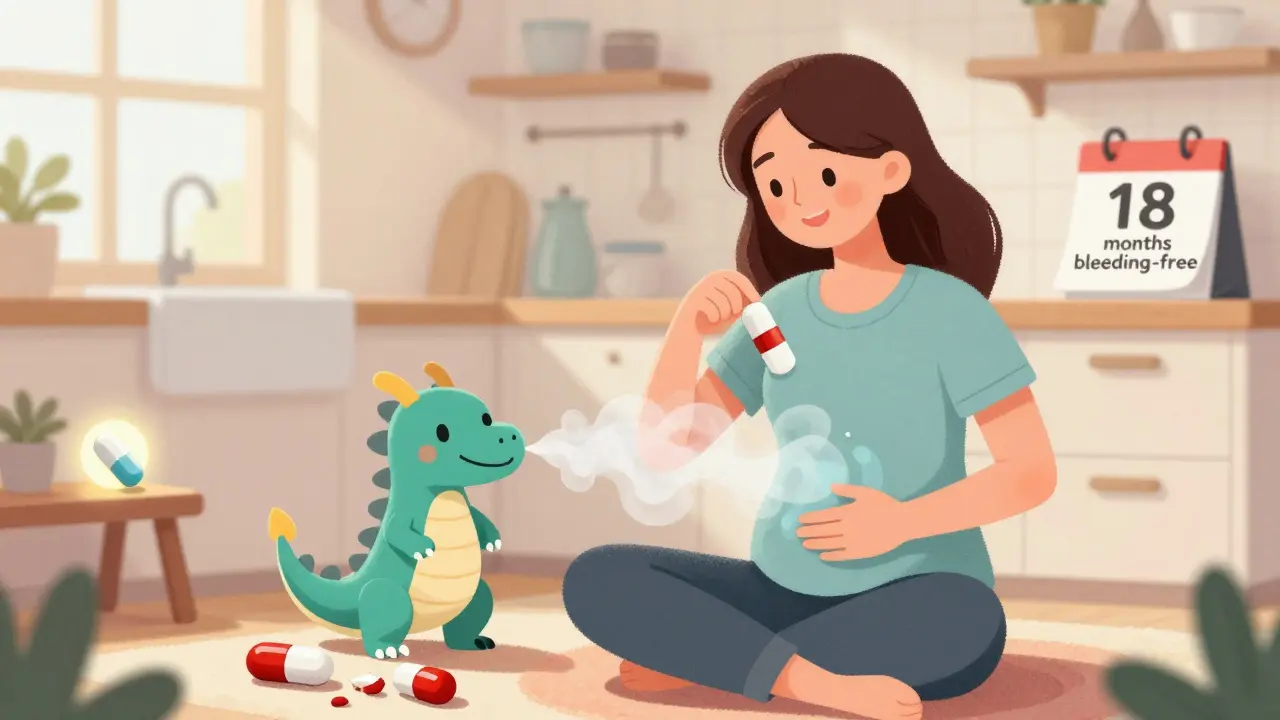
One patient with rheumatoid arthritis and depression switched from naproxen to celecoxib and added omeprazole. She’s been on both for 18 months with zero GI issues. That’s possible - but only if you act.
Why Doctors Miss This - And What You Can Do
A 2021 survey of 1,200 primary care doctors found that only 22% routinely prescribed PPIs when giving both SSRIs and NSAIDs. Why? Many don’t know the data. Others assume patients will ask. But patients rarely know to ask.
Here’s what you can do: When your doctor prescribes an SSRI, ask: “Will I be taking any NSAIDs or pain meds? Is there a risk of stomach bleeding?” If you’re already on both, ask: “Should I be on a stomach-protecting pill?”
And if your doctor says, “It’s fine,” push back. Cite the 2023 meta-analysis. Mention the FDA warning added to SSRI labels in 2019. This isn’t speculation - it’s evidence-based medicine.
What’s Changing - And What’s Coming
Health systems are finally catching up. Mayo Clinic and Cleveland Clinic added automated alerts to their electronic records in 2019. Cleveland Clinic saw a 42% drop in GI bleeding admissions after that.
New tools are emerging too. AI models now predict individual bleeding risk with 86% accuracy by analyzing your EHR data. Drug companies are testing pills that combine NSAIDs with built-in PPIs - like a dual-release ibuprofen-omeprazole capsule now in Phase III trials.
The American College of Gastroenterology is expected to release new guidelines in early 2024 that will recommend testing for H. pylori before starting dual therapy. That’s because this bacteria makes bleeding even more likely.
Dr. Amy Foxx-Orenstein, past president of the ACG, put it bluntly: “We’re approaching a tipping point where concomitant SSRI and NSAID prescribing without gastroprotection will be considered negligent care.”
That’s not hyperbole. It’s the new standard.
Final Takeaway: Don’t Wait for Symptoms
Upper GI bleeding doesn’t always come with screaming pain. Sometimes, it’s just fatigue, dizziness, or dark stools. By the time you notice, it’s often too late.
If you’re on an SSRI and take NSAIDs regularly - even just a few times a week - talk to your doctor today. Ask about alternatives. Ask about a PPI. Don’t assume it’s safe because it’s common. It’s not.
This interaction kills. But it’s preventable. You just need to know - and ask.
Can I take ibuprofen with an SSRI if I’m young and healthy?
Even if you’re young and healthy, combining ibuprofen with an SSRI still raises your risk of GI bleeding by 75% compared to using either drug alone. That’s not negligible. The risk is lower than with older NSAIDs like naproxen, but it’s still real. If you need occasional pain relief, acetaminophen is safer. If you need daily pain control, talk to your doctor about celecoxib and a proton pump inhibitor.
Do all SSRIs carry the same bleeding risk?
Most SSRIs - including sertraline, fluoxetine, citalopram, and paroxetine - have very similar effects on platelets and carry nearly identical bleeding risks. Some studies suggest escitalopram may be slightly less risky, but the difference is small and not enough to justify switching unless you’re already experiencing side effects. Don’t assume one SSRI is “safe” just because it’s newer.
Is celecoxib really safer than other NSAIDs?
Yes. Celecoxib is a COX-2 selective NSAID, meaning it spares the COX-1 enzyme that protects your stomach lining. Studies show its GI bleeding risk is close to placebo (OR 1.16), while traditional NSAIDs like naproxen or diclofenac carry 3-4 times higher risk. However, celecoxib carries a slightly higher heart risk in some patients, so it’s not for everyone. Talk to your doctor about your cardiovascular history before switching.
How long should I take a PPI if I’m on both drugs?
If you’re taking both an SSRI and an NSAID long-term, you should take a proton pump inhibitor daily - indefinitely. Stopping the PPI, even if you feel fine, puts you back at high risk. The protection isn’t temporary; it’s ongoing. If you’re only taking NSAIDs occasionally, you may not need a daily PPI, but you should still avoid combining them with SSRIs.
What if I’ve already had a GI bleed while on these drugs?
If you’ve had a GI bleed while on an SSRI and NSAID, you should avoid NSAIDs completely unless absolutely necessary. Even then, you’ll need a PPI and likely a switch to celecoxib. Your doctor may also recommend testing for H. pylori and possibly switching your antidepressant to bupropion. Repeating this combo after a bleed is extremely dangerous and should be avoided unless no other options exist.
Can I stop my SSRI if I need to take NSAIDs?
Never stop an SSRI abruptly. That can cause withdrawal symptoms, including anxiety, dizziness, and mood swings. If you need to stop or switch, do it under medical supervision. For many, switching to bupropion - which doesn’t affect platelets - is a better solution than stopping your antidepressant. Your mental health matters too. The goal isn’t to choose between pain and mood - it’s to manage both safely.
Tim Goodfellow
December 19, 2025 AT 04:43Man, I had no idea ibuprofen and sertraline were this dangerous together. I’ve been taking both for years for my back pain and anxiety - thought I was just being smart about self-care. Guess I was just being dumb. Gonna call my doc Monday and ask about celecoxib and omeprazole. Thanks for the wake-up call.
Allison Pannabekcer
December 20, 2025 AT 11:10This is exactly the kind of post that saves lives. I’m a nurse and I’ve seen too many patients show up with black tarry stools and no idea why. Doctors overlook this combo because both drugs are so common - but common doesn’t mean safe. Please, if you’re on an SSRI and reach for Advil more than twice a week, talk to your provider. Acetaminophen is your friend.
Sarah McQuillan
December 20, 2025 AT 21:01Wow. So now we’re supposed to trust some meta-analysis over decades of clinical experience? I’ve been prescribing SSRIs and NSAIDs together since the 90s. People are fine. This feels like another fear-mongering trend pushed by big pharma to sell more PPIs. Maybe the real problem is overmedicating everything.
anthony funes gomez
December 21, 2025 AT 14:02The COX-1/COX-2 dichotomy is oversimplified. Serotonin’s role in platelet aggregation is well-documented, yes - but the OR of 1.75 for combined use? That’s a population-level metric. Individual risk is nonlinear, confounded by polymorphisms in CYP2C19, gastric pH, H. pylori status, and concurrent anticoagulant use. Without stratification, this data is statistically noisy - and clinically misleading.
Alana Koerts
December 23, 2025 AT 12:4175% increased risk? That’s not even scary. That’s statistically insignificant if you’re under 50 and don’t drink. Also, celecoxib is just a placebo with a price tag. And PPIs cause C. diff and kidney failure. So what’s the real trade-off here? Nobody’s doing the math.
pascal pantel
December 24, 2025 AT 15:12Let me guess - you’re one of those people who thinks every side effect is a reason to stop taking meds. The fact that you’re even surprised by this means you’ve never read a single pharmacology textbook. SSRIs inhibit platelet serotonin uptake. NSAIDs inhibit gastric cytoprotection. Of course they interact. The real scandal is that doctors still don’t warn patients. Not the drugs. The system.
Gloria Parraz
December 25, 2025 AT 02:29I’m so glad someone finally put this out there. My mom had a GI bleed last year - she was on fluoxetine and naproxen for arthritis. No one told her. She’s fine now, but it scared the hell out of us. I printed this out and gave it to my dad. He’s on sertraline and ibuprofen. He’s switching to acetaminophen this week. Thank you for being the voice nobody else was.
Dorine Anthony
December 26, 2025 AT 17:03I’ve been on sertraline for 8 years and take ibuprofen maybe once a month for headaches. Should I be worried? Or is occasional use fine? I don’t want to overreact but I also don’t want to ignore something real.
Chris porto
December 28, 2025 AT 02:18It’s not about fear. It’s about awareness. If you’re on both, you’re not broken. You’re just using tools that have side effects - like driving a car or eating sugar. The solution isn’t to quit everything. It’s to adjust. Talk to your doctor. Ask about PPIs. Ask about alternatives. You’re not being paranoid - you’re being responsible.
William Liu
December 28, 2025 AT 12:15One sentence: If you’re on an SSRI and take NSAIDs regularly - get a PPI. It’s that simple.
Frank Drewery
December 28, 2025 AT 17:34My therapist told me to try bupropion after I mentioned my knee pain. I was skeptical - but switched last month. No GI issues, and my mood is actually better. I didn’t know SSRIs affected platelets. Now I do. Thanks for the clarity.
mary lizardo
December 30, 2025 AT 02:09The author’s conflation of relative risk with absolute risk is a textbook example of medical misinformation. A 75% increase from a baseline of 0.5% translates to 0.875% - still an exceedingly low probability event for healthy, young adults. The alarmist tone undermines legitimate clinical guidance. Moreover, the recommendation to use celecoxib ignores cardiovascular comorbidities, which are far more prevalent in this demographic. This post is well-intentioned, but dangerously reductive.