
Stability Testing for Generic Drugs: FDA Requirements Explained
 Jul, 18 2026
Imagine buying a bottle of medication that looks exactly like the brand-name version. It has the same active ingredient, the same dosage, and the same manufacturer code. But what happens if you store it on your bathroom shelf for two years? Does it still work? For generic drugs, the answer depends entirely on stability testing. This is the rigorous scientific process that proves a drug remains safe and effective until its expiration date. Without it, the FDA would never approve a generic product to enter the U.S. market.
If you are involved in pharmaceutical development or regulatory affairs, understanding these requirements is not optional-it is the foundation of your Abbreviated New Drug Application (ANDA). The stakes are high. Stability data is the single most common reason for Complete Response Letters (CRLs) from the FDA, accounting for roughly one-third of all deficiency letters issued in recent fiscal years. Getting this wrong doesn't just delay approval; it can halt production entirely.
The Core Purpose of Stability Testing
At its heart, stability testing answers one question: How long does this drug last? The U.S. Food and Drug Administration (FDA) requires that every generic drug demonstrate the same quality, strength, purity, and stability as its Reference Listed Drug (RLD)-the original brand-name product. This requirement stems from the Hatch-Waxman Act of 1984, which created the pathway for generics but demanded they be bioequivalent and chemically stable.
When a drug sits on a shelf, it changes. Moisture might degrade the active ingredient. Heat could cause chemical breakdown. Light might alter the color or potency. Stability testing tracks these changes over time under controlled conditions. The goal is to establish an accurate expiration date and proper storage instructions. If the data shows the drug degrades too quickly, the shelf life must be shortened, or the formulation must be changed. For manufacturers, this means proving that their specific manufacturing process and packaging protect the drug throughout its intended life.
Key Regulatory Guidelines You Must Follow
You cannot guess at stability testing protocols. The FDA relies on harmonized international standards to ensure consistency. The primary document you need to know is ICH Q1A(R2), which stands for Stability Testing of New Drug Substances and Products. Although originally designed for new drugs, its principles apply directly to generics via the FDA’s 2018 guidance document titled "ANDAs: Stability Testing of Drug Substances and Products Questions and Answers."
Here is what these guidelines demand:
- Batch Size: You must test at least three primary batches. These batches must be manufactured at a minimum pilot scale that meets current Good Manufacturing Practices (cGMP).
- Testing Attributes: You must test physical, chemical, biological, and microbiological attributes. This includes potency, impurities, dissolution rate, and preservative content. If any attribute affects safety or efficacy, it gets tested.
- Frequency: For products with a proposed shelf life of 12 months or more, testing occurs every 3 months during the first year, every 6 months during the second year, and annually thereafter.
These rules are strict. Deviating from them without scientific justification is a fast track to a regulatory rejection.
Submission Requirements for ANDAs
One of the biggest misconceptions among generic manufacturers is how much data to submit initially. You do not need to wait for the full shelf-life study to complete before filing your ANDA. However, you do need enough data to prove the study is valid and ongoing.
For the initial Completeness Assessment, the FDA requires:
- A detailed stability protocol outlining your methodology.
- Commitments to continue the studies.
- Data from the initial time point plus one additional time point for both accelerated and long-term studies.
But here is the catch: while you can file with minimal data, the FDA will not grant final approval until they have reviewed sufficient evidence. Specifically, they typically require six months of accelerated stability data and six months of long-term stability data for pilot-scale batches. If you submit less, expect a review cycle extension. In fact, stability-related review cycles have increased from an average of 1.2 rounds in 2010 to 2.7 rounds in 2022, largely due to incomplete or inadequate stability packages.
Accelerated vs. Long-Term Studies
Stability testing isn't just one type of study; it's a combination of approaches designed to predict real-world performance. Understanding the difference between accelerated and long-term studies is crucial for designing your program.
| Study Type | Conditions | Purpose | Data Required for Submission |
|---|---|---|---|
| Long-Term | 25°C ± 2°C / 60% ± 5% RH | Determines actual shelf life under normal storage conditions. | 12 months minimum for initial submission support. |
| Accelerated | 40°C ± 2°C / 75% ± 5% RH | Stresses the product to detect rapid degradation and estimate expiry. | 6 months required for scientific review. |
| Intermediate | 30°C ± 2°C / 65% ± 5% RH | Used if significant change occurs in accelerated studies. | Optional unless triggered by other results. |
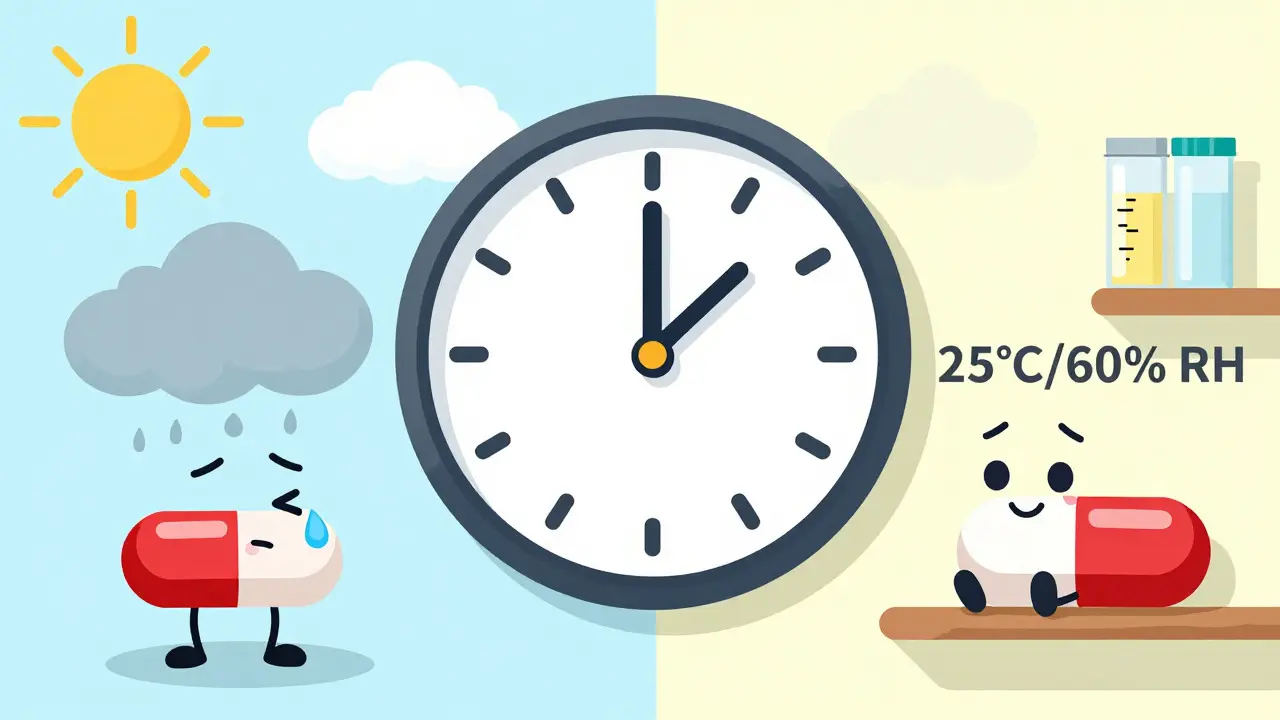
Accelerated studies act as an early warning system. If your drug degrades significantly at 40°C, it likely won't survive long-term storage at room temperature. Long-term studies provide the real-world proof. Both are mandatory for most solid oral dosage forms.
Common Pitfalls and How to Avoid Them
Why do so many ANDAs fail stability reviews? The data points to three main culprits: inadequate protocols, insufficient data points, and poor chamber control. Let’s break down how to avoid each.
1. Poor Chamber Monitoring
Temperature deviations are surprisingly common. An FDA inspection in 2023 found that 63.2% of generic manufacturers had deficiencies in stability chamber monitoring records. If your chamber fluctuates by more than ±2°C, your data may be invalidated. To fix this, implement automated environmental monitoring systems. Top manufacturers have adopted these tools to reduce excursions, which previously averaged 4.7°C per month in some facilities.
2. Inadequate Sampling Plans
You must test every individual strength and container size unless you use bracketing or matrixing designs. Bracketing tests only the highest and lowest strengths and sizes, assuming intermediate ones behave similarly. Matrixing tests a subset of samples at each time point. Both methods save time and money, but they require scientific justification. If you don’t justify them properly, the FDA will reject the design. In 2022, 67.3% of ANDAs using these designs were approved, meaning nearly a third failed due to weak justification.
3. Missing Protocols
Ninety-eight percent of completeness assessment failures relate to missing or inadequate protocols. Your protocol must reference USP chapters <1151> (Pharmaceutical Dosage Forms) and <1010> (Analytical Data). Don’t leave gaps. Specify exactly how you will measure impurities, how often you will sample, and what acceptance criteria you will use.

Costs and Market Pressures
Stability testing is expensive. According to a 2023 analysis by the Tufts Center for the Study of Drug Development, regulatory compliance costs for stability testing account for approximately 18.7% of total ANDA development costs, averaging $487,500 per application. In a market where generic drugs represent 90% of prescriptions but only 23% of spending, margins are thin. Every day of delay costs money.
This pressure is particularly acute for Indian generic manufacturers, who accounted for 40.3% of U.S. generic approvals in 2022 but faced 62.8% of all stability-related CRLs. Resource constraints often lead to shortcuts in study design, which backfire during review. Investing in robust stability programs upfront reduces the risk of costly delays later.
Future Trends and Updates
The regulatory landscape is evolving. The FDA released a draft guidance in June 2025 proposing stricter requirements, including mandatory 24-month stability data for all new ANDAs, up from the current 12-month baseline. Additionally, the International Council for Harmonisation (ICH) is revising its Q1C guidelines to include climate zone-specific storage conditions, which will affect over 70% of generic products.
Technology is also changing the game. The FDA’s Digital Health Center of Excellence is piloting blockchain technology for stability data verification. While this sounds futuristic, it aims to prevent data integrity issues-a major concern in past inspections. Manufacturers who adapt to these changes early will gain a competitive edge in approval timelines.
Practical Next Steps for Manufacturers
If you are preparing an ANDA, start with a pre-study protocol review. Internal data suggests this reduces deficiency rates by over 40%. Ensure your stability chambers are calibrated and monitored automatically. Validate your analytical methods thoroughly-31.2% of stability-related CRLs cite insufficient method validation. Finally, engage with the FDA early through pre-submission meetings if your product has complex formulations, such as nanomaterials or continuous manufacturing processes.
How many batches are required for generic drug stability testing?
The FDA requires stability testing on at least three primary batches of the drug product. These batches must be manufactured at a minimum pilot scale that complies with current Good Manufacturing Practices (cGMP).
What is the difference between accelerated and long-term stability studies?
Accelerated studies are conducted at higher temperatures and humidity (e.g., 40°C/75% RH) to stress the product and detect rapid degradation. Long-term studies are conducted at proposed storage conditions (e.g., 25°C/60% RH) to determine the actual shelf life. Both are required for ANDA submissions.
Can I use bracketing or matrixing for stability testing?
Yes, but only if scientifically justified. Bracketing tests extreme strengths and sizes, while matrixing tests subsets of samples. The FDA approves these designs in about two-thirds of cases, provided the justification demonstrates that intermediate products will behave similarly.
How much stability data is needed for initial ANDA submission?
For initial completeness assessment, you need a protocol, commitments, and data from the initial time point plus one additional time point for both accelerated and long-term studies. However, final approval typically requires six months of accelerated and six months of long-term data.
What are the most common reasons for stability-related rejections?
The top reasons include inadequate testing protocols, insufficient data points, failure to test all required attributes, and poor stability chamber monitoring (temperature deviations exceeding ±2°C). Method validation issues also frequently lead to rejections.