
Vaccination and Fever Reducers: When to Give Medication to Children
 Mar, 24 2026
When your child gets vaccinated, it’s normal to worry about fever. Many parents reach for acetaminophen or ibuprofen right away - but doing so before or too soon after the shot might actually reduce how well the vaccine works. The science is clear: giving fever reducers before vaccination can weaken the immune response. The good news? You don’t need to panic. There’s a simple, safe way to manage fever without hurting protection.
Why Fever After Vaccines Happens
Fever isn’t a side effect to fear - it’s a sign your child’s body is responding. After vaccines like Prevnar 13 or Pediarix, about 1 in 3 babies develop a low-grade fever within 12 hours. The MenB vaccine, given at 8 and 16 weeks in the UK, causes fever in up to 35 out of 100 infants. This isn’t unusual. It means the immune system is learning how to fight the virus or bacteria in the vaccine. Most fevers last only 1 to 2 days and don’t need any treatment.
The Problem with Giving Medicine Too Early
In the early 2000s, it was common to give acetaminophen before vaccines to prevent fever. But research changed everything. A major 2009 study in The Lancet showed that babies who got fever reducers before their shots had lower antibody levels. That means their bodies didn’t build as strong a defense. Follow-up studies from Children’s Hospital of Philadelphia and Seattle Children’s Hospital confirmed this: kids who took medicine before vaccination had weaker immune responses to multiple vaccine components, including those for pneumococcus, hepatitis B, and DTaP.
Here’s the key detail: it’s not just about fever. The body’s natural response - including mild inflammation and temperature rise - helps the immune system remember the pathogen. Blocking that too early can dull the learning process. Studies show that giving acetaminophen at the time of vaccination and again at 6 and 12 hours later cut fever rates by half in the first day - but also reduced antibody production by up to 40% for some antigens.
The 4-Hour Rule: When It’s Safe to Give Medicine
The good news is, you don’t have to skip medicine entirely. You just need to wait. Multiple studies, including one from Poland in 2016, found that giving fever reducers 4 hours or more after vaccination doesn’t interfere with immune response. If your child starts to feel warm or fussy, wait. Monitor. Offer fluids. Keep them lightly dressed. If the fever doesn’t show up, you won’t need anything. If it climbs above 102°F (39°C) after 4 hours, then it’s safe to give acetaminophen or ibuprofen.
This 4-hour window is now the standard recommendation from the CDC, the American Academy of Pediatrics, and major children’s hospitals. It balances comfort with protection. Don’t rush. Let the body do its job. Then step in only if needed.
When to Give Fever Medicine: Signs to Watch For
Not every temperature needs medicine. Here’s what to look for:
- 100-102°F (37.8-39°C): Usually no medication needed. This is a normal immune response. Offer water, keep the room cool, and monitor.
- Over 102°F (39°C): Consider acetaminophen or ibuprofen. This is the threshold where discomfort often increases and sleep is disrupted.
- Under 12 weeks old: Never give acetaminophen without calling your doctor first. Fever in newborns can signal serious infection.
- Under 6 months old: Avoid ibuprofen. It’s not approved for this age group.
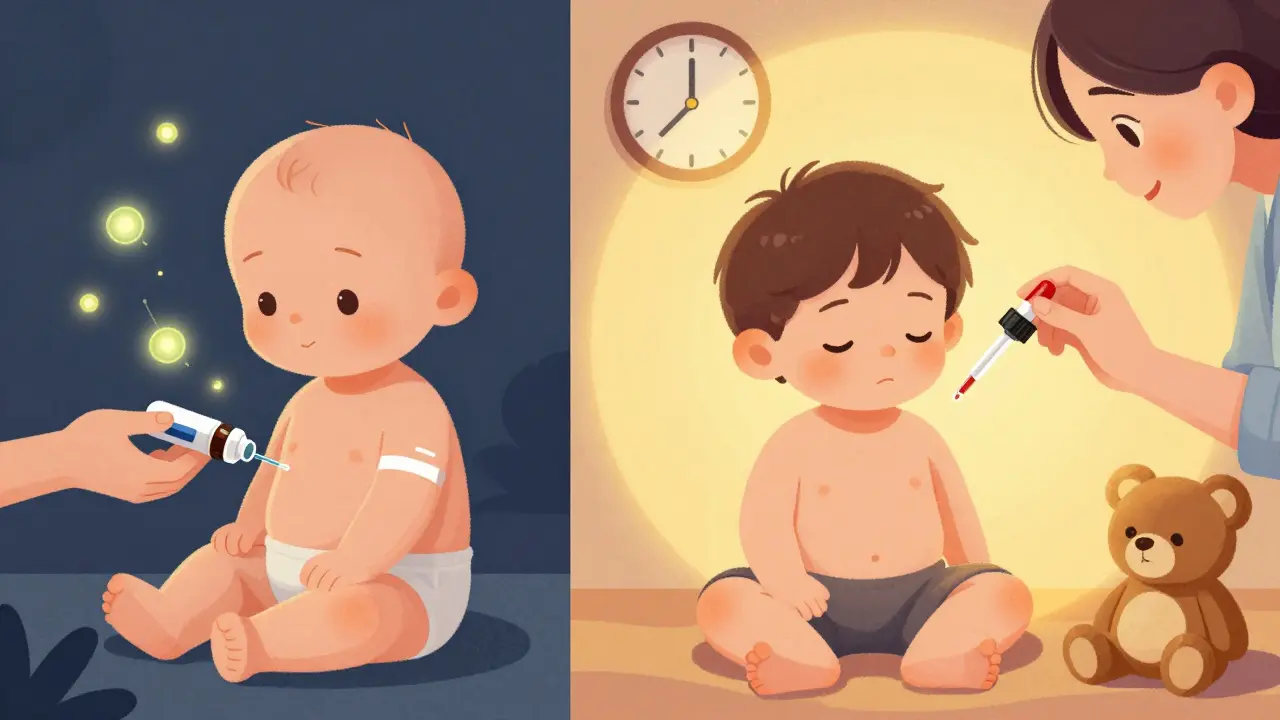
Weight-based dosing matters. For a baby weighing 18-23 lbs (8-10 kg), the standard dose is 1.25 mL of acetaminophen or 2.5 mL of ibuprofen. Always check the label. Never guess. Overdosing is dangerous.
The MenB Exception: Why UK Guidelines Are Different
In the UK, the NHS recommends giving liquid paracetamol after the MenB vaccine at 8 and 16 weeks. This is the only vaccine in routine childhood schedules where prophylactic fever medicine is officially advised. Why? Because MenB causes high fever in a large number of babies - and very high temperatures can lead to febrile seizures in vulnerable infants. The NHS weighs the risk of seizure against the small chance of reduced immunity and decides the benefit outweighs the risk.
This is a targeted exception, not a general rule. It applies only to MenB. For all other vaccines - even if given at the same visit - follow the standard 4-hour wait.
What About Ibuprofen vs. Acetaminophen?
Both work, but they’re not the same.
- Acetaminophen (Tylenol): Works well for fever and pain. Can be given every 4-6 hours. Maximum 4 doses in 24 hours. Safe for infants over 12 weeks.
- Ibuprofen (Advil, Motrin): Lasts longer - up to 8 hours. Better for inflammation. Not for babies under 6 months. Maximum 4 doses in 24 hours.
Don’t alternate them unless directed by a doctor. Mixing them increases the risk of dosing errors. Stick to one, and use it only when necessary.
What Not to Do
- Don’t give aspirin. It’s linked to Reye’s syndrome - a rare but deadly illness in children.
- Don’t bundle them up. Extra blankets or clothing trap heat and make fever worse.
- Don’t give medicine just because they’re fussy. Crying doesn’t always mean fever. Check the temperature first.
- Don’t use old medicine. Check expiration dates. Liquid forms lose potency over time.

What to Do Instead
Before you reach for medicine, try these simple steps:
- Offer extra breast milk, formula, or water.
- Dress your child in one light layer.
- Keep the room cool and quiet.
- Use a damp cloth on the forehead - not cold, just cool.
- Let them rest. Sleep helps the immune system.
Most children bounce back within 24 hours. You don’t need to medicate to help them heal.
When to Call the Doctor
Call your pediatrician if:
- Your baby is under 12 weeks and has a fever of 100.4°F (38°C) or higher.
- Fever lasts more than 48 hours.
- Your child won’t drink, has dry lips, or hasn’t urinated in 8 hours.
- They have a rash, stiff neck, or are hard to wake.
- You’re unsure about the dose or which medicine to use.
Remember: a mild fever after vaccination is normal. A fever before vaccination doesn’t mean you should delay the shot. The CDC says children can still be vaccinated with a mild illness - including a low-grade fever.
Final Takeaway
You want your child protected - and comfortable. The best way to do both is simple: Wait 4 hours after the vaccine before giving fever medicine. Don’t give it before. Don’t give it on a hunch. Only use it if the fever climbs above 102°F and your child seems uncomfortable. For MenB, follow NHS advice and give paracetamol after the shot. For all others, let the body respond naturally. Most of the time, your child will be fine without any medicine at all.
Darlene Gomez
March 25, 2026 AT 19:54It's wild how we've been conditioned to fear fever like it's the enemy. But fever? It's just the immune system doing its job-like a fire that burns out the bad stuff. Giving meds too early is like putting out a campfire before it's done cooking the marshmallows. I've learned to just chill, offer water, and let my kid's body do what it's built to do. The 4-hour rule? Absolute gold.
Amber Gray
March 26, 2026 AT 03:33Katie Putbrese
March 28, 2026 AT 01:41Letting your kid run a fever after vaccines? That’s just irresponsible parenting. If you’re not medicating right away, you’re basically gambling with their health. I’ve seen kids get seizures from ‘letting nature take its course.’ This ‘wait 4 hours’ crap is a luxury for people who don’t know what real danger looks like.
Danielle Arnold
March 29, 2026 AT 11:04So let me get this straight. We’re supposed to watch our baby sweat and scream for 4 hours because science says ‘let the fever do its thing’? Meanwhile, I’m Googling ‘how to tell if a fever is gonna kill my kid’ at 3am. Thanks, CDC. You’re a real lifesaver.
Caroline Dennis
March 29, 2026 AT 17:02The immunological cascade triggered by pyrexia post-vaccination is a demonstrable adjuvant effect. Suppressing IL-6 and TNF-alpha prematurely attenuates antigen-presenting cell maturation and B-cell clonal expansion. The 4-hour window aligns with peak dendritic cell trafficking to lymph nodes. This isn’t anecdotal-it’s systems biology.
Kevin Y.
March 30, 2026 AT 20:14This is such a well-researched and thoughtful breakdown. I really appreciate how you emphasized the MenB exception-it’s easy to overlook that detail. As a pediatric nurse, I’ve seen so many parents panic and medicate too soon. This guide could save a lot of unnecessary stress. Thank you for the clarity.
Raphael Schwartz
March 31, 2026 AT 10:49Marissa Staples
April 1, 2026 AT 04:59I used to give fever meds right after every shot. Then I started reading more. Now I just sit with my kid, hold their hand, and whisper, ‘You’re safe. Your body knows what to do.’ It’s weirdly peaceful. I didn’t know I was so afraid of fever until I stopped fighting it.
Linda Foster
April 1, 2026 AT 20:07While the scientific evidence presented is compelling, I must emphasize the importance of individual clinical judgment. Each child’s medical history, underlying conditions, and family context must inform decision-making. A one-size-fits-all protocol, however well-intentioned, may not be universally appropriate.
Rama Rish
April 3, 2026 AT 19:41Kevin Siewe
April 4, 2026 AT 00:12One thing I’ve learned as a dad: comfort matters. If your kid is miserable, and the fever is over 102 after 4 hours? Go ahead and give the medicine. The goal isn’t to be a hero-it’s to be a parent. Science supports that. You’re not failing if you help them feel better. Just don’t rush it.
Chris Farley
April 4, 2026 AT 21:29Oh, so now the CDC is the new bible? Next you’ll tell me the earth is flat because ‘studies show.’ This whole 4-hour rule? Probably pushed by Big Pharma so they can sell more Tylenol later. Wake up. The immune system doesn’t need your help-it needs your silence.
Jacob Hessler
April 5, 2026 AT 08:31Donna Fogelsong
April 7, 2026 AT 03:08They don’t want you to know this, but fever reducers are part of the vaccine suppression agenda. The immune system is being chemically disabled so they can control your child’s long-term health. The 4-hour rule? A distraction. Real parents don’t give meds at all. Ever. Look up the 1988 WHO white paper on adjuvant interference. They buried it.