
Corrective Actions: How Manufacturers Fix Quality Problems
 Jan, 3 2026
When a factory produces a batch of medical devices and 12 out of 500 units fail inspection, what happens next? Stopping the line and tossing the bad ones isn’t enough. That’s a correction. But if that same failure keeps happening month after month, you need something deeper: a corrective action. This is how smart manufacturers don’t just fix problems-they stop them from ever coming back.
What’s the difference between a fix and a real solution?
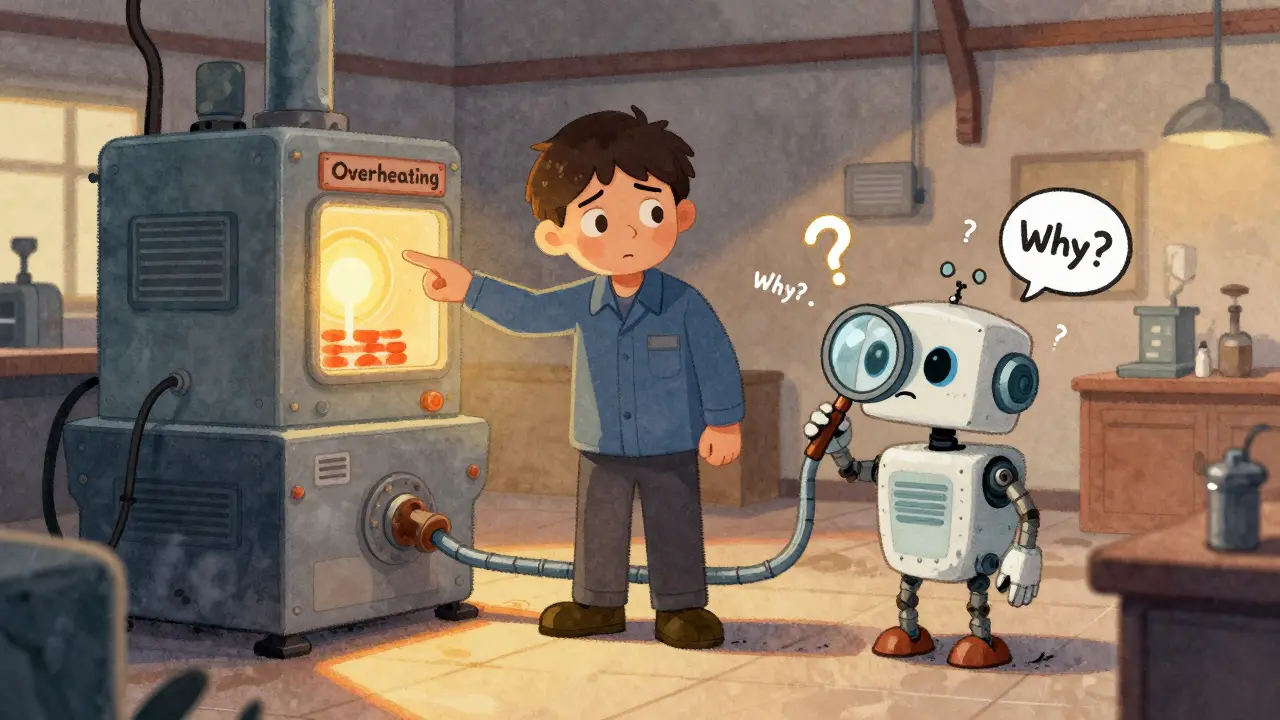
Many people confuse fixing a symptom with fixing the cause. If a machine keeps overheating and someone just turns down the thermostat, that’s a correction. It works for now. But if the real issue is a clogged coolant line that no one checked, then the machine will overheat again next week. Corrective action digs into why the coolant line got clogged. Was it poor maintenance? Wrong parts? Training gap? That’s where the real work begins. In regulated industries like medical devices and pharmaceuticals, this isn’t optional. The FDA’s 21 CFR Part 820 and ISO 13485 require manufacturers to prove they’ve eliminated root causes-not just cleaned up the mess. A 2022 FDA report found that 43% of warning letters were issued because companies didn’t properly verify their corrective actions. That means they thought they fixed it, but didn’t prove it stayed fixed.The six-step process manufacturers actually use
There’s a standard way this works in serious manufacturing environments. It’s not guesswork. It’s a six-phase system called CAPA-Corrective and Preventive Action. Here’s how it breaks down:- Identify the problem - It starts with data. A defect rate spike. A customer complaint. A failed audit. Quality control teams track these using real-time sensors, inspection logs, and automated alerts. The average time to spot an issue? About 2.3 hours.
- Evaluate the risk - Not all defects are equal. A mislabeled pill bottle is serious. A slightly off-color housing on a non-critical part? Less so. Manufacturers use risk matrices to decide how hard to chase each problem. In pharma, even a small deviation can trigger a full CAPA if it affects patient safety.
- Find the root cause - This is where most fail. Teams use tools like the 5 Whys or Fishbone diagrams. Why did the part crack? Because the molding pressure was too high. Why? Because the sensor was mis calibrated. Why? Because no one checked it after last maintenance. Why? Because the checklist didn’t include it. Why? Because the procedure was outdated. That’s five whys. Real root causes are rarely obvious.
- Plan the fix - Now you write it down. A good Corrective Action Plan has four things: a clear action (e.g., “update maintenance checklist”), who’s responsible (e.g., “Maintenance Lead, Jane Doe”), when it’s done (e.g., “by Feb 15”), and how you’ll know it worked (e.g., “track defect rate for next 3 production cycles”).
- Implement the change - This isn’t just a memo. It’s training staff, updating SOPs, recalibrating machines, and verifying the new process works. One automotive supplier reduced defects by 86% after they redesigned their torque tool calibration process based on a CAPA.
- Verify effectiveness - This is the step most skip. You can’t just say “it’s better.” You need data. Sample sizes of at least 30 units. Statistical process control charts. Calibration records per ISO 17025. If the defect rate doesn’t drop by at least 50% within three production runs, the action isn’t verified. And if it’s not verified, it’s not done.
Why most corrective actions fail
The biggest mistake? Treating CAPA like paperwork. A 2023 study by Dozuki found that 57% of failed CAPAs had weak root cause analysis. Teams jumped to solutions before understanding the real problem. Another 38% didn’t collect enough data to prove the fix worked. And 29% had no clear owner-so nothing got done. One quality manager on Reddit said their CAPA system generated 47 pages of documents per issue. That’s not helpful. That’s a burden. The best systems don’t add more paperwork-they automate it. Digital CAPA tools linked to production machines cut documentation time by 41%, according to Mechanical Power’s 2023 data. Instead of filling out forms, workers just tag a defect on a tablet. The system auto-generates the CAPA, assigns it, and tracks progress.
What works in real factories
The most successful manufacturers don’t treat CAPA as a compliance chore. They treat it like a performance tool. Here’s what they do differently:- Use cross-functional teams - You need engineers, production leads, maintenance, and quality all in the same room. One company fixed a recurring weld defect only after the maintenance team realized the robot’s alignment had drifted over time-a problem no one in quality had ever checked.
- Link CAPA to real-time data - Instead of waiting for weekly reports, some plants now use AI to flag anomalies as they happen. Tulip’s 2023 report shows manufacturers using AI for root cause analysis cut investigation time by 52% and improved accuracy by 37%.
- Make it visible - A dashboard showing open CAPAs, their status, and impact on output keeps everyone accountable. At one medical device maker, visibility led to a 27% drop in field recalls within a year.
- Don’t overdo it - Not every tiny flaw needs a full CAPA. In small-batch production, a simple correction may be enough. The key is matching the effort to the risk. The FDA allows corrections for minor deviations-but only if you can prove they won’t become systemic.
How regulation shapes the process
You can’t understand corrective action without understanding why it exists. In the U.S., the FDA requires CAPA for any defect that could harm patients. In Europe, ISO 13485 demands proof that actions prevent recurrence. In automotive, IATF 16949 ties CAPA to supplier performance. These aren’t suggestions-they’re legal requirements. The 2024 update to ISO 13485 now requires manufacturers to track trends. If you get three similar defects in a month, even if each is small, you must investigate. That’s a big shift. It’s no longer just about fixing what broke-it’s about spotting patterns before they break anything. The global market for quality management software-much of it built around CAPA-is worth $4.2 billion and growing at 11.3% a year. Why? Because companies that use it well see real results: 37% less downtime, 28% higher customer satisfaction, and 19% lower costs from wasted materials and rework.
What’s next for manufacturing quality
The future of corrective action is predictive. Right now, most systems react after a defect happens. But new systems use machine learning to spot patterns in real-time data-vibration, temperature, cycle time-and flag potential failures before they occur. Gartner predicts 65% of manufacturers will use predictive CAPA systems by 2027. That means fewer defects, less downtime, and fewer audits. One pilot program at a Boston-based medical device maker used sensor data to predict a seal failure 72 hours before it happened. They fixed it during a scheduled shutdown. No customer complaints. No recall. No CAPA needed. That’s the goal.Frequently Asked Questions
What’s the difference between a correction and a corrective action?
A correction fixes the immediate problem-like throwing away a bad part or adjusting a machine setting. A corrective action finds and removes the root cause so the problem doesn’t happen again. Corrections are quick. Corrective actions are deep. One is a bandage. The other is surgery.
Do all manufacturers need a formal CAPA system?
If you’re in a regulated industry-medical devices, pharmaceuticals, aerospace, or automotive-you legally must. For small, non-regulated manufacturers, a formal CAPA may be overkill. But even small shops benefit from basic root cause analysis. You don’t need 47 pages of paperwork. You just need to ask “why?” five times before calling it fixed.
How long should a corrective action take?
There’s no fixed timeline, but the root cause analysis alone can take 8-12 hours per major issue. The whole process-from identification to verification-can take weeks to months, depending on complexity. The key isn’t speed. It’s certainty. Rushing leads to false fixes. A CAPA that takes 60 days but works is better than one that takes 3 days and fails again next week.
What happens if a corrective action isn’t verified?
It’s considered incomplete. In regulated industries, that’s a violation. During an FDA or ISO audit, if you can’t show data proving the defect rate dropped and stayed down, you’ll get a warning letter. That can delay product launches, trigger recalls, or even shut down production lines until you fix your system.
Can software really improve corrective actions?
Yes. Digital CAPA systems auto-assign tasks, track deadlines, link data from machines, and generate audit-ready reports. One manufacturer reduced documentation time by 41% and cut CAPA cycle time by 33% after switching to a digital platform. The software doesn’t do the thinking-but it removes the busywork so people can focus on solving real problems.
Akshaya Gandra _ Student - EastCaryMS
January 3, 2026 AT 17:29so i was reading this and i kept thinking abt my cousin who works in a med device factory n they just keep throwing away the broken ones like its no big deal lol
no one ever asks why its broken just fix the next one
also typo: 'n' instead of 'and' 😅
Jacob Milano
January 4, 2026 AT 02:18Man, this hit different. I used to think CAPA was just corporate jargon until I saw a plant in Wisconsin turn their entire culture around by just asking ‘why?’ five times on a single misaligned sensor.
It wasn’t magic. It was muscle memory. Now they celebrate root cause wins like they just won the Super Bowl.
And yeah, the AI stuff? It’s not replacing humans-it’s giving them back their time to actually think. That’s the real win.
Also, 47 pages of paperwork? That’s not compliance, that’s a cry for help. The best systems disappear into the workflow like air.
Shanna Sung
January 4, 2026 AT 05:43they’re lying about the FDA
they don’t care about patient safety
they care about lawsuits and fines
the whole CAPA system is just a money laundering scheme for consultants
you think they want you to fix the problem?
no they want you to keep paying for software subscriptions
and don’t even get me started on the ‘AI’ nonsense
it’s all just fancy dashboards to make managers feel smart
the real root cause? greed
Dee Humprey
January 5, 2026 AT 01:11One thing no one talks about: the person on the line who spots the defect first. That’s the real hero.
They’re not in the meeting. They’re not on the dashboard. But if you don’t listen to them, none of this works.
I worked at a plant where we started giving a $50 gift card to whoever caught the first defect each week.
Not because we were rich-but because we were smart.
Within 3 months, defect reports went up 200%.
Not because we made more mistakes.
Because people finally felt safe to speak up.
That’s the invisible part of CAPA.
Trust. Not tools.
Trust.
John Wilmerding
January 6, 2026 AT 14:20While the article presents a comprehensive and well-structured overview of the CAPA methodology, it is critical to emphasize that the success of any corrective action is contingent upon organizational culture and leadership commitment. Without a psychologically safe environment wherein frontline personnel are empowered to report anomalies without fear of retribution, even the most sophisticated digital CAPA platforms will yield negligible results. Furthermore, statistical process control charts must be calibrated to the specific process capability indices (Cp, Cpk) of the manufacturing line, not generic benchmarks. The assertion that a 50% reduction in defect rate constitutes verification is statistically insufficient without confidence intervals and control limits being explicitly defined. I would encourage practitioners to consult ANSI/ASQ Z1.4 and ISO 2859-1 for sampling protocols that align with risk-based decision-making frameworks.
Siobhan Goggin
January 7, 2026 AT 09:30I love how this breaks it down. I’ve seen too many companies treat CAPA like a checklist they tick off every quarter.
But the real test? When the same person who wrote the procedure five years ago still has to fix the same machine.
That’s not a system. That’s a curse.
Good stuff.
Doreen Pachificus
January 8, 2026 AT 01:58the part about ai flagging anomalies before they happen…
kinda wild to think we’re at that point now
like… machines watching machines
and still we’re the ones who have to ask why
weird
Cassie Tynan
January 8, 2026 AT 21:53so we’re telling engineers to fix problems by asking ‘why?’ five times…
but the real question is… why do we keep hiring people who write procedures that get outdated before the ink dries?
why do we pay consultants to make 47-page documents?
why do we think a dashboard solves culture?
the answer: because it’s easier than fixing the system that created the problem in the first place
we’re all just rearranging deck chairs on the Titanic
but hey, at least the CAPA software has a nice UI