
When you hear the word audiogram, a graphical representation of hearing sensitivity across different frequencies and volumes. Also known as hearing test chart, it’s the map your doctor uses to see exactly where your hearing starts to fade. It’s not just a bunch of lines and dots—it’s your personal hearing fingerprint. Every point on that chart tells a story about how your ears respond to sound, from the quietest whisper to the loudest shout.
Think of an audiogram, a graphical representation of hearing sensitivity across different frequencies and volumes. Also known as hearing test chart, it’s the map your doctor uses to see exactly where your hearing starts to fade. as a report card for your ears. The horizontal axis shows pitch—low tones on the left, high tones on the right. The vertical axis shows volume—quieter sounds at the top, louder ones at the bottom. Your results are plotted as X’s for one ear and O’s for the other. If those marks drop below 25 decibels, that’s usually where hearing loss begins. But here’s the thing: two people can have the same audiogram and experience it totally differently. One might struggle with conversations in a cafe, another might miss the doorbell but hear every bird outside.
What makes an audiogram, a graphical representation of hearing sensitivity across different frequencies and volumes. Also known as hearing test chart, it’s the map your doctor uses to see exactly where your hearing starts to fade. powerful is how it connects to real-life problems. If your chart shows a steep drop in high frequencies, you’re not just "hearing less"—you’re missing consonants like S, T, and K. That’s why people say, "I can hear you, but I can’t understand you." It’s not your brain. It’s your ears. And that’s exactly what an audiogram reveals. It also helps distinguish between types of hearing loss: conductive (ear canal or eardrum issue), sensorineural (nerve damage), or mixed. That distinction changes everything—whether you need earwax removal, a hearing aid, or a referral to a specialist.
Doctors don’t just look at the numbers. They pair your audiogram with your symptoms. Did you notice this after loud concerts? After an infection? When you started taking certain meds? That’s where the real insight happens. An audiogram doesn’t just measure hearing—it helps trace the cause. And it’s not just for older adults. Kids with learning struggles, musicians, factory workers, even people with tinnitus—all get tested. The data guides everything: whether to try hearing aids, if you need ear protection, or if it’s time to check for something deeper like a tumor on the auditory nerve.
You’ll find posts here that dig into how audiograms connect to medications that affect hearing, why some people lose high-frequency hearing faster than others, and how balance issues like vertigo often show up on the same tests. There’s also advice on how to talk to your doctor about your results, what to ask when they say "you have mild loss," and how to track changes over time. These aren’t abstract medical concepts. They’re practical steps you can take once you understand what that chart is really saying.
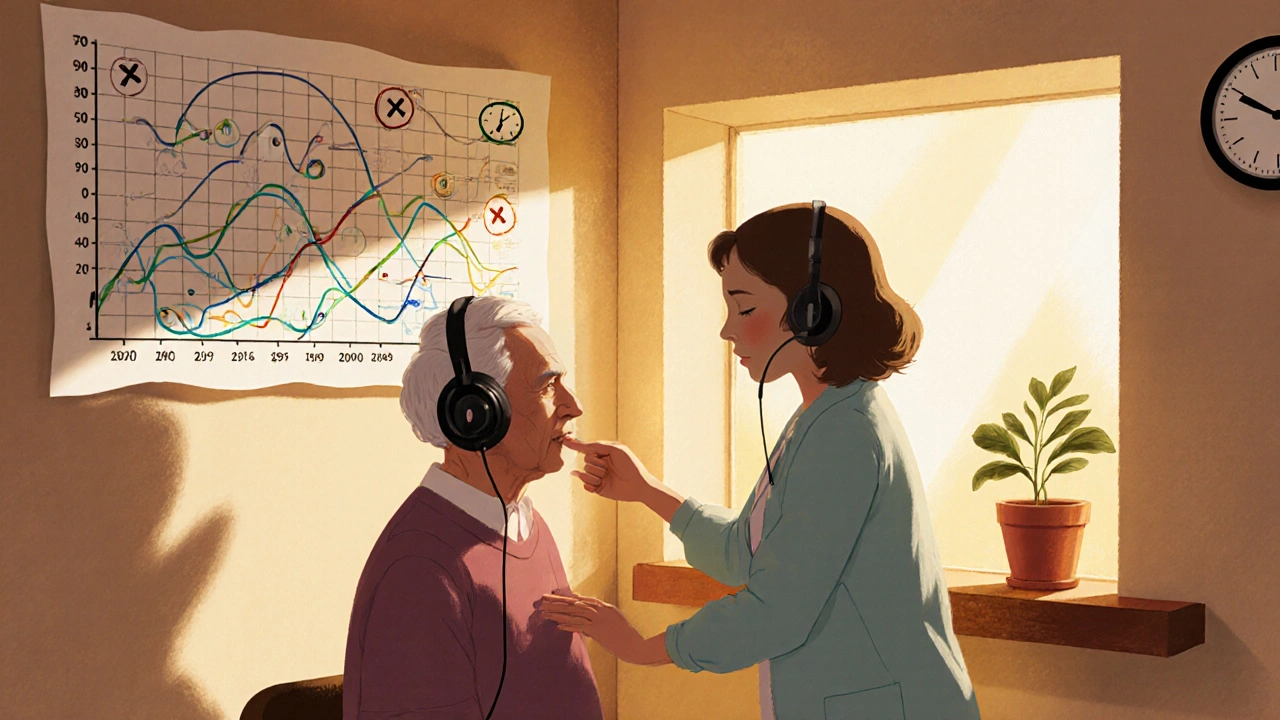
Audiometry testing measures your hearing sensitivity using decibel levels across frequencies. Learn how pure-tone and speech tests detect hearing loss, differentiate between conductive and sensorineural types, and guide treatment like hearing aids.
More